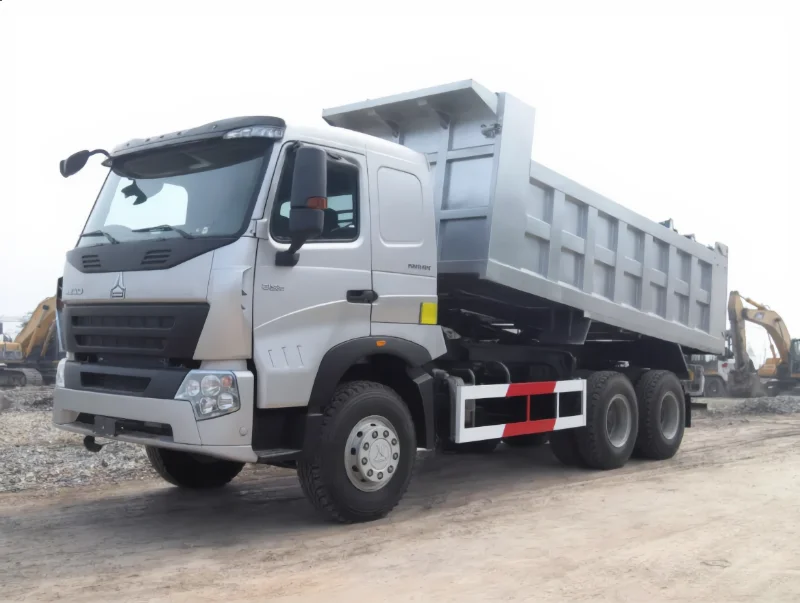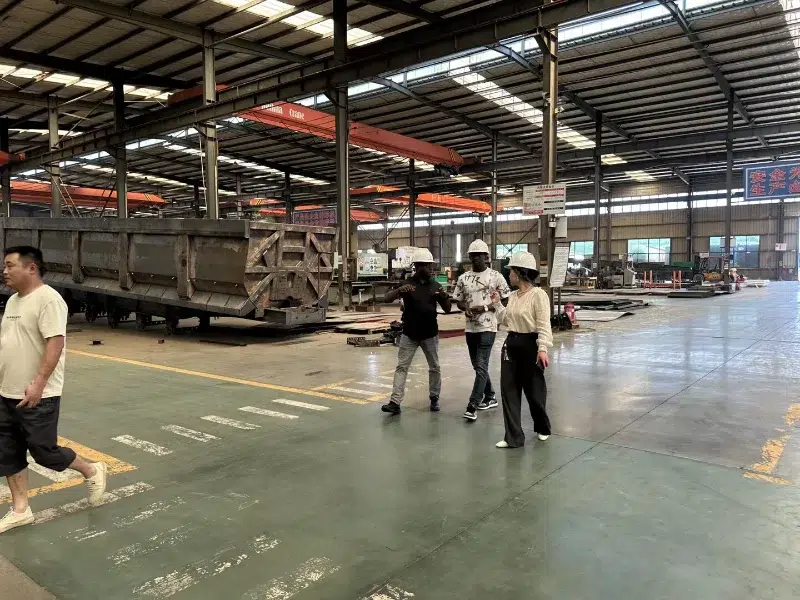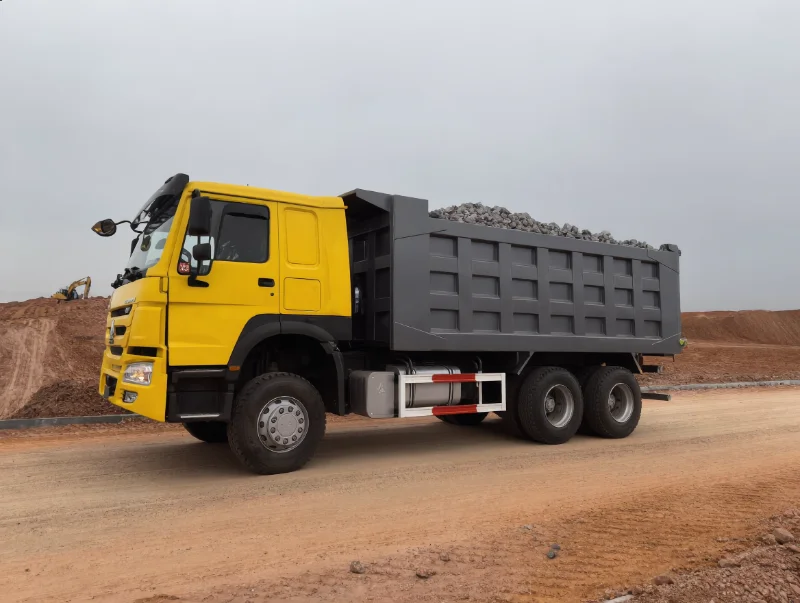
A HOWO 371 dump truck is a Sinotruk 6×4 heavy tipper rated at 371 horsepower, where the badge names engine output and not model year, cab generation, or emission class. Whether it fits depends on sustained ramp grade, loaded haul distance, and destination emission rules. Units under this badge span several cab families. They reach buyers as new export builds, used stock, or refurbished chassis, so two trucks wearing the same number can differ in gearbox, axle stamping, and body plate thickness. Read the nameplate before you compare prices. We cross-check the engine designation against the proforma invoice before a unit is allocated to an order.
What Does the “371” Badge Actually Designate?
The 371 badge on a Sinotruk tipper designates rated engine output and nothing beyond it; cab generation, axle rating, gearbox, and emission calibration all shift with build year and export line.
HOWO 7, A7, TX and NX are cab-platform names. They describe generation and cab family, never power. A listing that pits “371 versus A7” compares two things that were never alternatives, and a buyer who takes that comparison at face value negotiates on the wrong axis.
Buyers most often treat 371 as a model code and read two offers as though they described the same vehicle. Where the badge becomes the comparison key and nobody reads the nameplate, the difference surfaces later, usually in axle stamping or floor plate thickness, by which point the letter of credit is already open.
Supplier datasheets also disagree on which engine sits behind the badge. WD615.47 appears most often on 371 hp builds, while other engine designations used across HOWO trucks turn up on different listings and build years. Published torque figures for the same rated output do not match across sources either. Treat the engine number and the data plate as the source of record, request photographs of both, and write those numbers into the contract.
The badge fixes the output class. Everything downstream of it stays open.
Which HOWO 371 Dump Truck Specifications Should You Verify Against the Nameplate?
Chassis and driveline specifications on a 6×4 HOWO 371 dump truck vary between export batches, so the figures that decide a purchase are the ones stamped on the vehicle. A brochure figure is a starting point for the question, never an answer to it.
| Item | Commonly listed reference | What to verify, and where |
|---|---|---|
| Rated output | 371, quoted as metric horsepower (PS) on most Chinese datasheets | Which notation is used, before converting to kilowatts |
| Engine | WD615.47 most often; other Weichai designations appear on some build years | Engine number and data plate, photographed |
| Displacement | About 9.7 L across WD615-family datasheets | The plate, never the catalogue |
| Torque | Published figures conflict across supplier datasheets | Read from the plate; do not accept a brochure figure |
| Emission calibration | Commonly Euro II on export listings; Euro III appears on some stock | Destination acceptance, not the plate alone |
| Transmission | Commonly HW19710, ten forward and two reverse; other units appear on some batches | Gearbox casting, and whether local parts channels stock it |
| Drive configuration | 6×4 most common; 4×2, 6×6 and 8×4 builds also carry 371 hp engines | Axle count against your destination’s axle-load limit |
| Axles | Front and rear designations vary by batch; ratings are stamped on the housing | The stamping, not the datasheet |
| Body plate | Commonly specified as 8 mm floor and 6 mm sides | Measure the actual unit before acceptance |
| Tyres and rims | 12.00R20 common on export builds | Destination rules on tyre and rim specification |
The reference column records what export datasheets commonly state. None of it is a warranty, and every row has been observed to vary between batches.
The output figure carries a notation trap. Chinese datasheets normally quote metric horsepower, so 371 PS converts to roughly 273 kW; read as imperial horsepower, the same number converts to about 277 kW. The gap is small. It explains why kilowatt figures on competing listings disagree while both claim 371. Ask which notation the datasheet uses, then compare kilowatts.
Floor plate thickness is the specification most often trimmed to meet a price. A thinner floor lowers kerb weight and lowers the quotation. It then deforms early under rock or demolition rubble, and the repair becomes a workshop job at the destination, not a warranty conversation. Measure it. Record the measurement you accepted.
When Is 371 hp Enough, and When Does a Higher-Output Engine Earn Its Cost?
Rated horsepower earns its purchase premium only above a duty-cycle threshold, and on a 6×4 tipper that threshold is set by sustained ramp grade, loaded haul distance, and site altitude before payload enters the calculation.
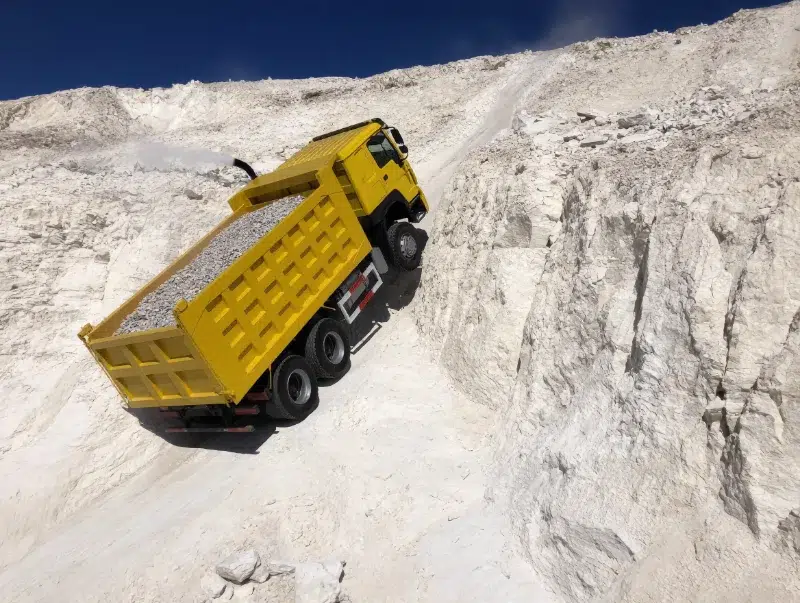
Two variables should be settled before any other. The first is the steepest sustained grade the truck must climb loaded, together with the length of that climb; grade drives the engine and axle-ratio decision, which then cascades into gearbox, cooling and tyre selection. The second is the emission and age rule at the port of entry, because a rule discovered late invalidates an otherwise correct specification. Payload target, body volume and cab trim stay revisable after those two are fixed. The first two do not, once the unit ships.
There is a case for spending less. If your haul is short, largely flat, and your payload sits at the low end of the load capacity range for a HOWO dump truck, a lower-output HOWO tipper does the same work for a lower purchase price and a lower fuel burn. The 371 hp build earns its premium only when sustained grade, loaded distance or altitude keeps the engine working near its rated ceiling for long stretches.
| Rated output | Engine family usually fitted | Where the extra output pays | Trade-off to check | Choose it when |
|---|---|---|---|---|
| 336 hp | WD615 family | Flat to gentle grades, short cycles | Thermal margin narrows on long climbs | Graded roads, payload at the low end of the class |
| 371 hp | WD615 family, designation varies by build year | Mixed civil work with intermittent grades | Nameplate and emission class differ between export batches | Road works, general aggregate haul |
| 375 hp | WD615 family, higher-output calibration | Sustained ramp exits, high ambient heat | Gain over 371 hp is small; confirm it on the plate | Quarry ramps, hot climates, two-shift cycles |
| 380 hp and above | Larger-displacement families on later builds | Long steep ramps, altitude, top-of-class payload | Higher kerb weight, separate parts channel | Mining ramps, high-altitude sites |
Engine family names differ across supplier datasheets and build years, and published torque figures for the same rated output do not agree. Use the table to frame the decision, then confirm the designation stamped on the engine before it enters a contract.
371 hp is usually enough when:
- grades are intermittent rather than continuous, and the loaded haul is moderate;
- the material is general aggregate or civil fill, not dense rock;
- WD615-family parts are stocked within a day’s drive of the site.
Step up in output when:
- the truck climbs a long ramp loaded on every cycle, or runs two shifts;
- ambient temperature or site altitude cuts the engine’s working margin;
- the payload target sits at the top of the class, not the middle.
Before we quote an engine, we weigh sustained grade and loaded haul distance against the payload target, in that order.
Should You Buy a New, Used, or Refurbished HOWO 371 Dump Truck?
The choice between a new export build, a used unit and a refurbished chassis turns on which risk your operation can absorb. Each condition carries a different exposure: specification lock-in, unobserved service history, or an undefined scope of rebuild.
| Condition | What you are buying | Risk you absorb | Documents to demand |
|---|---|---|---|
| New export build | A configuration fixed at order stage | Specification errors lock in at the proforma invoice | PI stating engine designation, emission class, axle and body spec |
| Used unit | A service history you did not observe | Wear concentrated in hoist, frame, rear bogie | Nameplate and engine-number photos, mileage evidence, inspection report |
| Refurbished chassis | A rebuild whose scope the seller defines | Grade labels are supplier-defined, not standardised | Written scope of work: replaced, repaired, repainted, untouched |
Refurbishment grade names used in listings are supplier-internal. An “A grade” on one seller’s site carries no meaning on another’s.
Quotations diverge on four cost drivers, not on the truck itself:
- Emission calibration, which decides both the build line and the destination paperwork;
- Body plate thickness and volume, the easiest place to shave a quotation;
- Tyre and rim specification, sometimes regulated separately at the destination;
- Incoterm, and whether pre-shipment inspection sits inside the figure or outside it.
An offer that omits any of the four cannot be compared with one that states them, and that is the first filter to apply when comparing Chinese dump truck suppliers.
In practice, though, low FOB rarely survives contact with the landed-cost sheet. Add inland haulage, inspection fees and destination charges, and two offers that looked far apart at the yard tend to converge. The cheaper unit is sometimes the one with the thinner floor. Landed cost moves by market, and what these trucks cost landed in the Kenyan market is one worked example.
Will Your Destination Accept a Euro II HOWO 371 at Customs?
Import eligibility for a Euro II heavy tipper is decided by the destination’s rules on emission class, vehicle age and conformity assessment, not by the engine plate. The rule that binds you is the one written at the port of entry.
In China, GB 17691-2018 (Limits and measurement methods for emissions from diesel fuelled heavy-duty vehicles, China VI), issued by the Ministry of Ecology and Environment, sets emission limits and test methods for diesel heavy-duty vehicles above 3,500 kg. It applies in two stages: China VI-a to all new heavy-duty vehicles from July 2021, and China VI-b from July 2023. A Euro II calibration is therefore a legacy, export-line, used or refurbished configuration, no longer a current Chinese domestic-market one. Whether a new 371 hp unit can be built for you depends on the supplier’s export production. Euro II engines also run without selective catalytic reduction and tolerate higher-sulphur diesel, which is why they persist where low-sulphur fuel and urea supply remain uneven; the emission standards applied to HOWO engines span several stages, and the stage on your unit is a build-line fact, not a brand fact.
The rule most often quoted at buyers is the wrong one. The “Euro 4/IV plus a five-year age limit” figure circulating in truck listings comes from the ECOWAS regional vehicle directive adopted in 2020 with UNEP support, and that age limit was framed for light-duty vehicles. UNEP’s 2020 report Used Vehicles and the Environment likewise covers light-duty vehicles, and it notes that heavy-duty used vehicles require further study. Neither document tells you what your customs authority will do with a tipper.
What does bind, in many markets, is a conformity assessment programme. Kenya’s Pre-Export Verification of Conformity scheme, run by the Kenya Bureau of Standards, requires a Certificate of Conformity issued in the country of supply for regulated goods. Used goods go through the route demanding both physical inspection and testing, and used vehicles that arrive without a certificate are sent to destination inspection. The inspection practice behind it is published as KS 1515, Kenya Standard Code of Practice for Inspection of Road Vehicles. Nigeria’s equivalent gate is operated by the Standards Organisation of Nigeria, whose product certification programme covers regulated imports generally, with vehicle imports handled under a separate vehicle conformity scheme.
Which programme catches a heavy tipper is a matter of jurisdiction and of the scope published this year. Confirm it in writing with the destination standards body or a licensed clearing agent before the proforma invoice is signed. Emission and age rules are amended far more often than truck specifications are.
What Should You Inspect Before Releasing Final Payment?
Pre-shipment inspection on a used or refurbished tipper should concentrate where failure is expensive and slow to correct after arrival: the frame, the hoist assembly, the rear bogie, and the paperwork that follows the chassis number.
- Chassis number on the frame rail matches the nameplate, the engine number, and every shipping document.
- Frame rails and cross-members show no weld repairs, cracks at the bogie mounts, or re-drilled holes.
- Hoist cycles fully up and down under observation; a ram that holds under load but drifts when parked points to seal or valve work.
- Rear bogie shows correct leaf pack alignment and sound u-bolts, with hub temperatures checked after a road test.
- Body floor and side plate thickness are measured on the unit, and tailgate hinges and locking gear are original.
- Documentation covers engine designation, emission calibration, and the conformity certificate your destination requires.
Three photographs settle most later disputes: the engine data plate, the chassis number on the frame rail, and the rear axle stamping. Take them at the yard. Take them again at arrival, and match both sets against the proforma invoice.
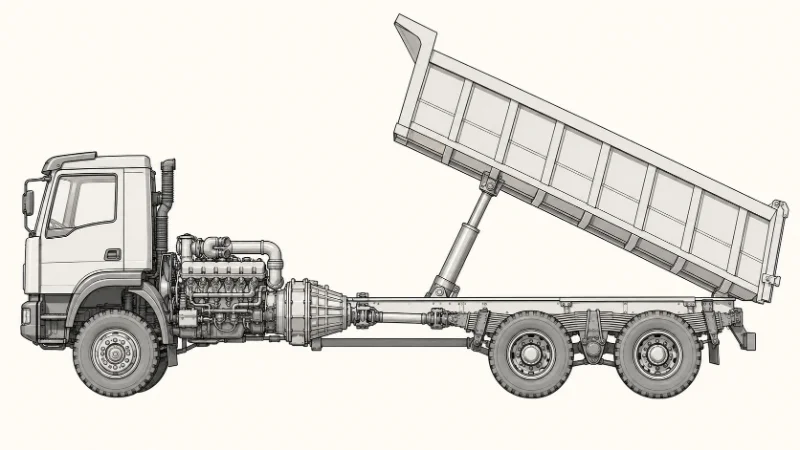
On short-cycle quarry work the body is raised many times per shift. Hoist seals and the tipping cylinder mount tend to demand attention well before anything in the driveline does. That pattern should shape where the inspection hour is spent: a long look at the hoist and its mounting, a shorter one at the engine bay.
Which Two Risks Should You Close Before a HOWO 371 Dump Truck Order?
Two risks account for most of what goes wrong on a HOWO 371 dump truck order, and each has a verification action attached.
The first is specification drift between the badge and the nameplate. Close it by requiring the engine designation, engine number, axle stampings and measured body plate thickness on the proforma invoice, supported by photographs taken at the yard. The second is import ineligibility. Close it by confirming the emission class, age rule and conformity certificate your destination requires, in writing, with the standards body or a licensed clearing agent before the invoice is signed. The floor thickness accepted verbally is the one that arrives thinner.
We verify nameplate, emission documentation and hoist function against the order sheet before a unit leaves the yard. Body volume selection by material bulk density and destination axle-load limits sits outside this article; that calculation belongs to the loading study you run once the chassis is fixed.
Seven inputs decide the specification. Bring them before asking for a price:
- Steepest sustained grade the truck climbs loaded, and the length of that climb.
- One-way loaded haul distance and the number of cycles per shift.
- Material carried, its bulk density, and the target payload.
- Site altitude and peak ambient temperature.
- Destination port and country, plus the conformity certificate your customs authority requires.
- Drive side, and any national requirement covering lighting, mirrors, or speed limiters.
- Whether the price is needed at FOB, CFR, or CIF, and whether pre-shipment inspection is included.
Ask our team for the pre-shipment inspection checklist used across the HOWO dump truck range, and work through it with those seven inputs already answered. The checklist is only as good as the duty cycle you bring to it.
FAQ
Body plate specification follows the material and the loading method; horsepower has no bearing on it. A standard floor copes with sand and graded fill. Blasted stone and crushed concrete are what wear it out, and a rock body earns its extra kerb weight there. Drop height counts as much as the material itself: an excavator releasing stone from height concentrates impact on the floor, where a low wheel-loader bucket spreads it. Tell the supplier what loads the truck, and from what height.
Payload on a 6×4 tipper is capped by axle-load limits at the destination, not by the engine. Beneath that ceiling, the stamped axle ratings and your chosen body volume set the real figure. Two identical 371 badges can therefore be legal at different payloads in different countries, and how 6×4 and 8×4 axle layouts differ moves the ceiling before the engine does. Confirm the stampings first, then work backwards from your destination’s axle-load table.
No used HOWO 371 price is comparable to another until three attachments travel with the figure. Those attachments are the engine designation and emission calibration read from the plate, the written scope of any refurbishment, and the Incoterm, including whether pre-shipment inspection sits inside the price. Two sellers quoting the same number are frequently describing different trucks. Most buyers skip the step that fixes this: send one specification sheet to every seller and ask each to quote against it. The lowest quote is usually the one priced against the loosest assumption.
Fuel consumption on a 371 hp tipper tracks the duty cycle, so no single figure holds across sites. Tyre pressure discipline, driver behaviour, the share of each cycle run loaded, and the grade of the haul road all move the number. A figure quoted without a stated duty cycle is a marketing number. Ask which cycle produced it.
A missing or painted-over data plate does not erase an engine’s identity, because the engine number is stamped into the block itself. The chassis number is stamped into the frame rail. Builds rated 371 hp and 375 hp share an engine family and look near-identical externally, so factory markings are the only reliable separation. Ask for photographs of both stampings, and have the numbers transcribed onto the proforma invoice. A repainted plate area deserves more scrutiny than a missing one.
Spare parts availability turns on the depth of the local network for that specific engine family, not on how well the brand sells. Check at part-number level the components that ground a vehicle: injection parts, turbocharger cartridges, hoist seals, and brakes. Trim and cab parts can wait. Ask a distributor at your destination, one not appointed by the seller, which of those part numbers are held in stock today. Where every order routes through an importer, the wait stretches into shipping cycles.