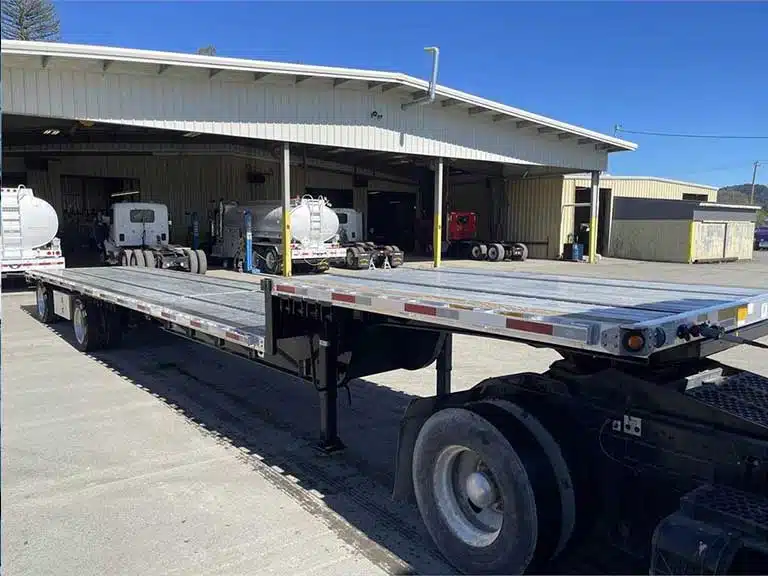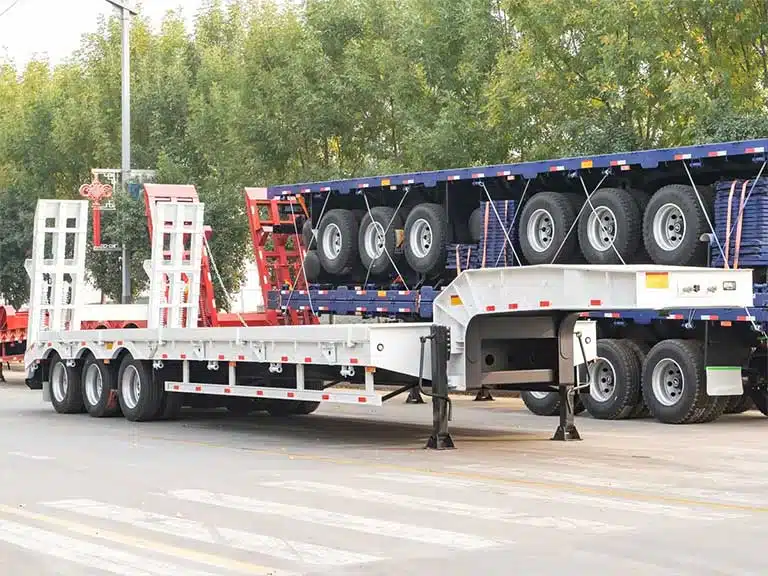
A low bed semi trailer is a heavy-haul semi-trailer whose load deck sits in a well between the gooseneck and the rear axles, low enough that tall machines can travel inside the height limit of the route. Whether a low bed fits a given job comes down to the tallest machine to be carried, how that machine gets on the deck, and the axle-load rules on the route. A low deck buys height and a lower centre of gravity. Width and weight still have to be checked separately, which is why choosing a low bed starts with the load and the road rather than with a tonnage figure.
What Is a Low Bed Semi Trailer?
A low bed semi trailer trades deck length and some tare weight for loading height, dropping the main deck below flatbed level so that the load uses most of the height the road allows. Buyers who understand that trade can tell quickly whether a low bed solves their problem or only adds cost.
The layout has three parts. The gooseneck at the front couples to the tractor’s fifth wheel through the kingpin and passes part of the load to the tractor. The well, the lowered section in the middle, carries the machine. The rear bogie holds the axles and suspension, and the deck rises again above it because wheels and suspension need space.
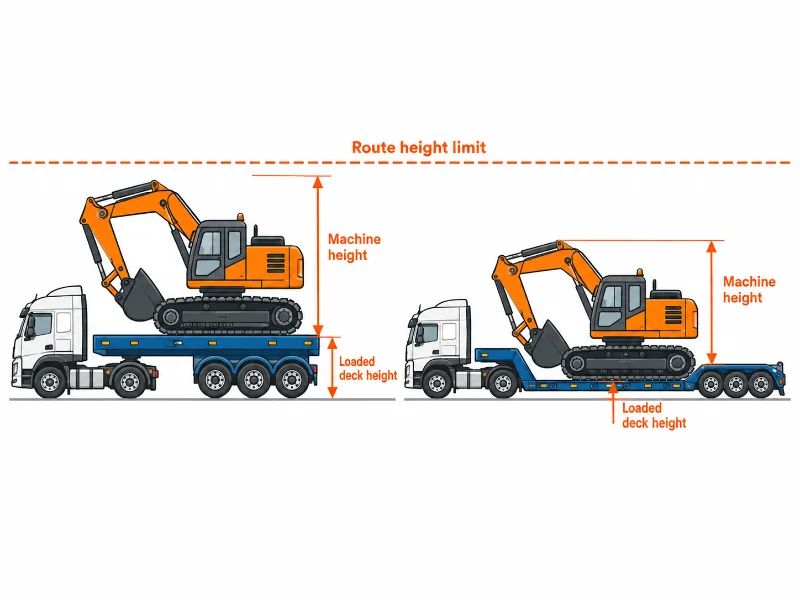
The height gain can be worked out directly. Overall loaded height can be approximated as loaded deck height plus machine height, so the tallest machine you can carry is about the height limit minus the loaded deck height. Council Directive 96/53/EC, the EU framework for maximum vehicle dimensions and weights, sets a 4.00 m maximum height in Annex I. Within that limit, a deck sitting at 0.9 m loaded leaves about 3.1 m for the machine, and a deck at 1.4 m leaves about 2.6 m. Every centimetre of deck is a centimetre lost from the machine. Ask for the deck figure on a quotation as loaded height. Actual clearance under bridges, tunnels and overhead lines on the route still has to be checked on its own.
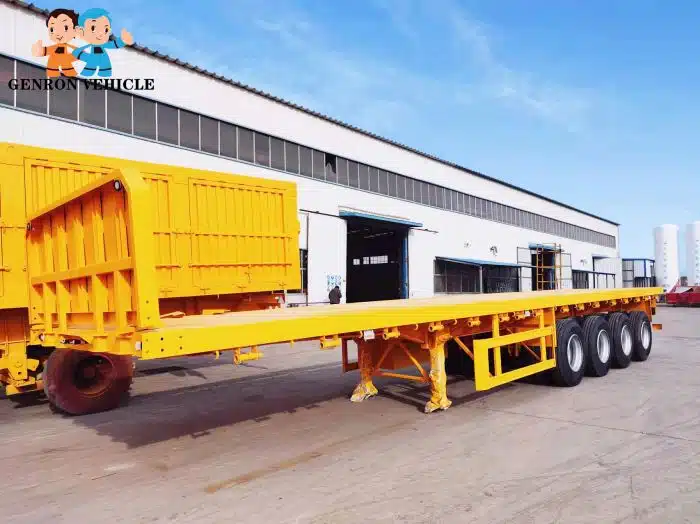
The same arithmetic shows when a low bed is unnecessary. Sometimes it is. If the tallest machine in the fleet already fits under the route limit on a standard flatbed or step deck, a low bed adds weight, cost and a shorter usable deck without solving anything. In that case the simpler trailer is the better purchase.

Why Doesn’t a Lower Deck Solve Width or Weight?
A lower deck changes only the vertical dimension of the load, so a machine that is too wide or too heavy for the route stays too wide or too heavy on a low bed. Buyers who assume the trailer type removes the need for special permits usually find the limitation after the trailer is built.
Width rules apply to the vehicle and its load at any deck height. On the U.S. National Network, 23 CFR 658.15 sets the federal width standard for commercial motor vehicles at 102 inches (about 2.6 m), and other roads can carry state or local limits. Directive 96/53/EC sets 2.55 m for most vehicles, while Article 4 lets member states issue special permits for indivisible loads that exceed the standard dimensions. A dozer blade or crawler track frame wider than the limit needs that kind of permit whether it rides at 0.9 m or at 1.5 m.
So a low bed answers the height question and leaves at least two others open: width, and axle or gross mass. Route restrictions such as bridge ratings and seasonal load limits also apply. Applying for oversize or overweight permits follows each authority’s own procedure and sits outside the scope of choosing the trailer. What matters at purchase is that the trailer’s width, axle spacing and axle count suit the permit categories the loads will actually need.
Are Lowboy, Low Loader and Low Bed the Same Trailer?
Lowboy, low loader, low bed and float are regional names for the same drop-deck heavy-haul trailer, while RGN and its variants describe how the gooseneck is built. Quotations from different markets use these words loosely, and two offers can look comparable while describing different trailers.
According to the Wikipedia entry on lowboy trailers, “low-loader” is the usual British term, “low-bed” is used in western Canada and South Africa, and “float” in Australia and eastern Canada. Suppliers in China and many export markets say “low bed” or “lowbed” for the same layout. In some North American usage “lowboy” also means a fixed-gooseneck trailer specifically, which is why the gooseneck type matters more than the name.
| Word or phrase | What it usually refers to | What to specify or check |
|---|---|---|
| Lowboy / low loader / low bed / float | The same drop-deck trailer, named by market; some sellers reserve “lowboy” for fixed-neck designs | Ask for a drawing with usable deck length and loaded deck height |
| RGN / DGN / detachable gooseneck | Gooseneck that separates so the front of the deck lowers to the ground | Ask whether detaching is hydraulic or mechanical, and what powers the hydraulics |
| Fixed gooseneck (FGN) | Gooseneck permanently attached; loading is from the rear over ramps | Ask for ramp length and the ramp angle at loaded deck height |
| Deck height | Often quoted unladen, sometimes at the deck’s lowest point | Ask for loaded deck height at rated payload, measured at the well |
| “60 ton”, “100 ton” | A design payload, in metric tonnes or US short tons (about 907 kg each) depending on the seller | Ask which unit, and under what load distribution the rating applies |
Which Low Bed Configurations Exist, and How Does Each One Load?
Low bed trailers are usually chosen first by gooseneck and loading arrangement, because whether the machine drives on from the front, climbs ramps at the rear or is lifted on fixes the gooseneck and deck design. That design is welded into the frame and cannot be changed economically after fabrication.
| Gooseneck and loading arrangement | How the machine gets on | Usually suits | Where it stops being the right choice |
|---|---|---|---|
| Fixed gooseneck with rear ramps | Drives up ramps over the rear bogie | Wheeled or tracked machines with enough clearance for the ramp angle | Machines with low clearance or long overhangs that ground on the ramp crest |
| Removable gooseneck, hydraulic | Gooseneck detaches under hydraulic power; machine drives on from the front | Frequent drive-on loading of crawler excavators, dozers and similar | Operations that cannot carry the extra gooseneck weight or maintain the hydraulic system |
| Removable gooseneck, mechanical | Gooseneck detaches by tractor movement and pins | Occasional front loading at lower cost and weight | Sites where loading time matters, since detaching takes longer |
| Folding gooseneck | Gooseneck folds down to form a front ramp | Front loading without a separate detached unit | Loads that need the lowest possible deck, where detachable designs usually go lower |
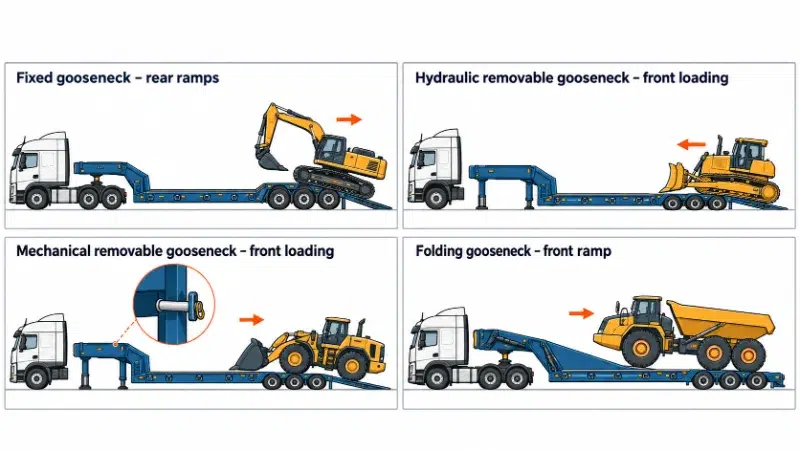
Hydraulic removable goosenecks can run from the tractor’s wet kit or from a self-contained power unit mounted on the gooseneck. Confirm the power source, pressure and flow requirements, and the couplings for the intended tractor. Machines lifted on by crane can use any of the four arrangements; for them, deck height and tie-down positions matter more than ramps.
Deck and running gear are separate choices that combine with any of these goosenecks. An extendable deck suits long items such as beams, pipes or long-boom machines and is only extra tare on short, dense loads. Steerable or hydraulic axle-line bogies carry concentrated very heavy loads such as transformers, and above conventional low bed ratings the job moves to modular hydraulic trailers, which are a different class of equipment.
Ramp angle is the reason rear-loading designs suit some machines and not others. On level ground, the angle is arctan(crest height ÷ horizontal run of the ramp), or arcsin(crest height ÷ ramp length) when you measure along the ramp itself. A 1.0 m crest over a 4 m horizontal run gives about 14°, and over a 3 m run about 18°. To check your own machine, put your trailer’s crest height and ramp run into the same formula. Then compare the result with the approach, departure and breakover clearances in the machine maker’s data, allowing for the shape of the transition at the crest. Front loading on a removable gooseneck avoids the crest entirely, which is why it suits machines with low ground clearance. A fuller comparison of the two main layouts is in Lowboy vs. RGN Trailers.
How Do Axle Count, Suspension and Deck Choices Change What a Low Bed Can Carry?
The usable payload of a low bed trailer depends on four ceilings at once: the trailer’s structural capacity, the permitted gross mass of the combination, the actual axle-group and kingpin loads, and the restrictions on each route. A nominal rating such as “60 tons” does not establish what can be carried legally or structurally on every route.
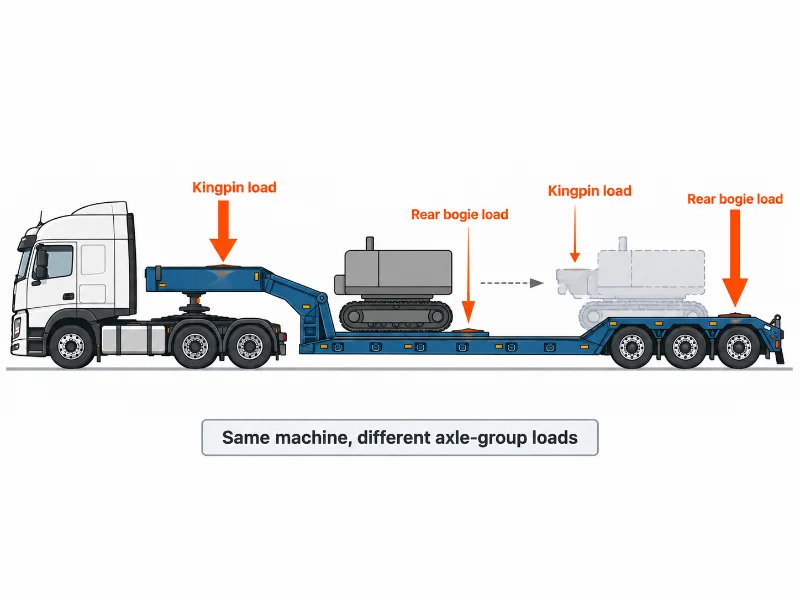
Axle count therefore comes from the route and the load position. Where the machine sits on the deck decides how its weight splits between the kingpin and the rear bogie. The same machine can overload one axle group while the gross mass is still legal. Axle spacing matters as well: in the United States the federal Bridge Formula limits the weight on any group of consecutive axles according to how far apart they are. The machine’s footprint also has to suit the deck’s concentrated-load rating, since a short track base puts the whole weight on a small part of the well. Worked examples for specific machines are in How Much Can a Lowboy Trailer Load?, and typical deck lengths by axle count are in Low Bed Trailer Dimensions.
Suspension choice follows the roads and the parts supply. Mechanical leaf-spring suspension is the simpler, lower-cost option and tolerates poor roads with limited workshop support. Air suspension rides more smoothly and on some designs can raise or lower the deck for loading, though the travel height still has to stay within the design range. Hydraulic suspension, common on multi-axle designs, equalises load between axles at the cost of more components to maintain. Where air or hydraulic parts have to be imported, a single failed valve or air spring can keep the trailer parked until parts arrive. Parts availability in the operating country deserves as much weight as ride quality.
Deck surface and fittings are smaller decisions but still physical ones. Timber decking gives grip for tracks and can be replaced in sections; steel plate resists cutting from grousers but is slippery when wet. Tie-down points need the number, position and rating that the heaviest machine requires. In the United States, 49 CFR 393.130 calls for at least four tiedowns on wheeled or tracked equipment of 10,000 lb (4,536 kg) or more. In Europe, lashing points on vehicles fall under EN 12640.
What Should a Buyer Settle Before Asking for a Low Bed Quote?
The tallest machine and its loading method should be settled first in a low bed semi trailer specification, because together they fix the deck height and the gooseneck design, and both are welded into the frame. Axle count, suspension and tractor interfaces follow from the route and the machine list, but all of them have to be fixed before the general arrangement drawing is approved.
A practical order is to list the machines first: transport height, width, length, operating weight, footprint and how each one gets on the trailer. Next, check the height, width and axle-load rules on the main routes, including any border crossing. Then choose the gooseneck arrangement and axle layout, and finally the suspension, deck surface and accessories. Buyers who start from tonnage often end up with an over-axled trailer that is heavy empty. Or with a fixed gooseneck their lowest machine cannot climb.
Industry uses for each type of load are described in What Is a Lowbed Trailer Used For?, and the general benefits compared with other trailers in What Are the Advantages of a Lowboy Trailer?. Both feed the machine list and leave the order above unchanged. A factor-by-factor checklist for comparing offers is in How to Choose the Right Low Bed Semi Trailer.
Once a supplier is shortlisted, the general arrangement drawing is the cheapest place to catch a wrong specification. Before paying a deposit, check its loaded deck height, overall width, kingpin position and axle spacing against your machine list and route limits. Where to source a low bed and how to vet the supplier itself are covered in Where To Buy Low Bed Semi Trailers.
Which Details Turn a Low Bed Inquiry Into a Drawing?
The machines, the routes and the loading method decide almost every dimension of a low bed semi trailer, so an inquiry that states them can go straight to a drawing instead of a round of questions. When we prepare a general arrangement, we check loaded deck height, overall width and the axle-group loads for the stated machines against the route limits before discussing price. Model ranges and current configurations are on our Low Bed Semi Trailer page; the inputs below are what turn one of them into a specification.
- Transport height, width, length, operating weight and track or wheel footprint of the tallest, widest and heaviest machines
- How each machine is loaded: drives on under its own power, is winched, or is lifted by crane
- Ground clearance of the lowest machine, if rear ramps are being considered
- Main routes and destination country, including border crossings, with any known height, width or axle-load limits
- Tractor model, fifth-wheel height, kingpin size and position, coupling ratings, and the turning clearance between tractor and gooseneck
- Brake, electrical and hydraulic connections on the tractor, including whether a wet kit is fitted
- Preferred suspension type, and how readily air or hydraulic parts can be sourced where the trailer will operate
- Capacity unit to be quoted (metric tonnes or US short tons) and any required tie-down points, track guides or wheel recesses
- Registration or inspection requirements in the destination country, if already known
Related Posts
- Folding Neck Lowboy — the folding-gooseneck arrangement from the configuration table as a built model.
- Heavy Haul Trailer Types: Flatbed to Multi-Axle Guide — where a flatbed or step deck is enough and a low bed is not needed.
- Maintenance Tips For Low Bed Trailers — routine upkeep once suspension and parts supply have been chosen.