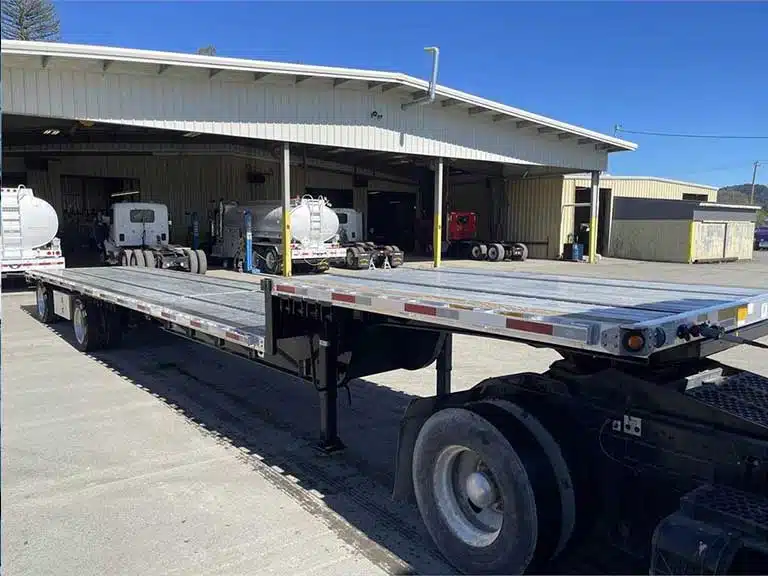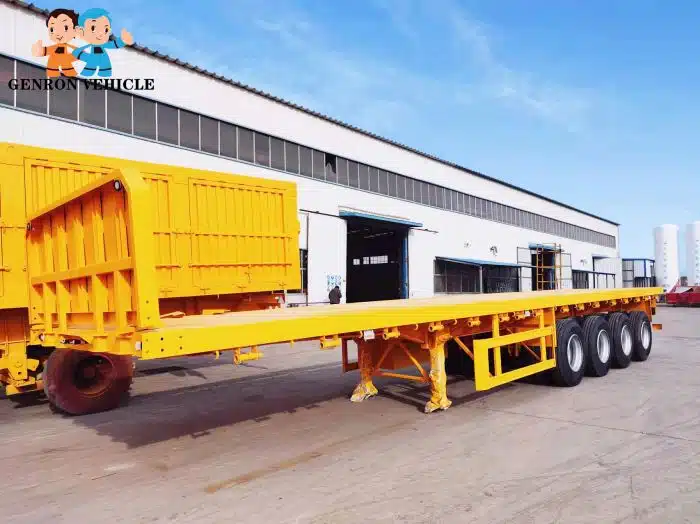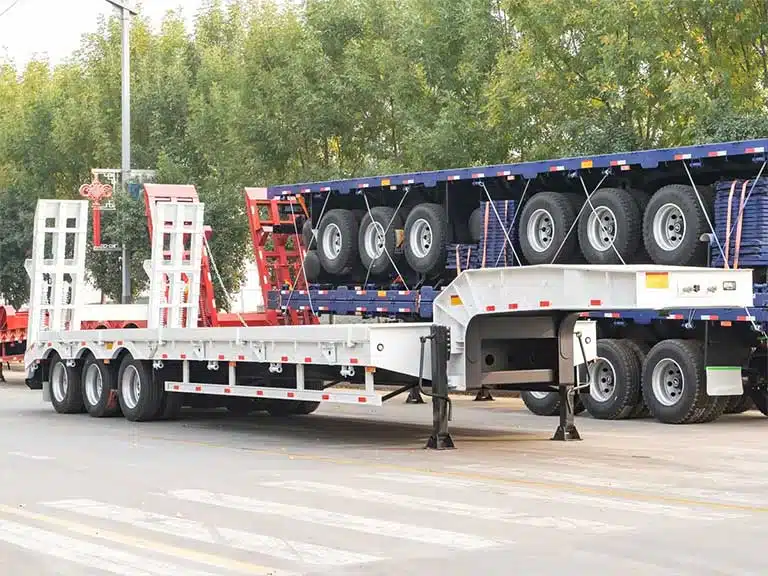
RGN stands for removable gooseneck, a lowboy semi-trailer design in which the neck detaches, the front of the deck lowers to the ground, and tracked or wheeled machines drive on from the front. An RGN trailer is used when a machine is too tall or sits too low for a flatbed or step deck. US freight references commonly plan a standard RGN around a 29-ft well, an 8.5-ft deck and about 42,000 lb of payload. Those are planning figures; a given trailer’s build sheet can differ. The machine’s transport height, operating weight and ground clearance decide whether a particular RGN move stays within legal limits or needs permits.
The RGN Trailer Defined: A Lowboy With a Detachable Neck
An RGN belongs to the lowboy family, in which the deck drops into a well between the gooseneck and the rear axles, and its front connection is what sets it apart from other lowboys. On a fixed-neck lowboy the gooseneck stays attached, so machines load over the rear on ramps. On an RGN the neck lifts off and the front edge of the deck becomes the loading point. Regional names such as lowbed and low loader cover the same family; the naming overlap is covered in What Is a Low Bed Semi Trailer.
The letters carry two meanings depending on who uses them. A freight broker posting an “RGN load” is naming an equipment class with an expected footprint and payload. A manufacturer quoting an RGN is describing one build, with its own rated capacity, axle count, neck type and deck lengths.
Why the Detachable Neck Matters for Low-Clearance Machines
The removable gooseneck changes how a machine reaches the deck; how much the deck can carry is set by its structure and the road limits. Loading from the front avoids the ramp crest over the rear axles. That crest is where machines with low ground clearance, long overhangs or low-slung booms tend to ground.
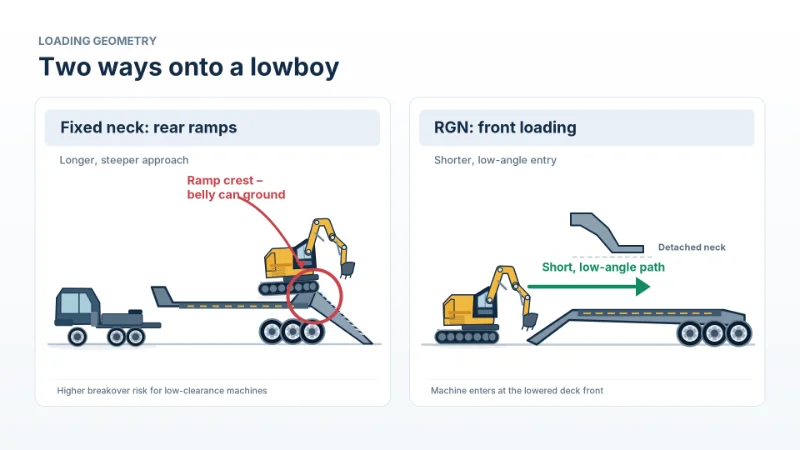
A common misreading is that fixed-neck lowboys need a crane to load. Most load over rear ramps. The RGN’s advantage appears only when that rear path is too steep or too high for the machine.
Detaching works in two ways, and the choice is fixed when the trailer is built. A hydraulic removable gooseneck raises and lowers the deck with cylinders, powered by the tractor’s wet kit or a pony motor on the neck. It detaches quickly but carries the weight of those cylinders, hoses and any power unit. A mechanical gooseneck leaves that hardware out and detaches through tractor movement and locking pins, which takes longer at each loading. The more often the neck comes off, the more the hydraulic time saving is worth its weight.
A hydraulic neck specified without checking the tractor’s wet kit pressure and flow tends to show the mismatch at the first loading on site, and a pony motor or a different tractor then has to be arranged. The step-by-step detach and reconnect sequence is covered in Removable Gooseneck Truck Characteristics. Once a machine of 10,000 lb or more is on the deck, 49 CFR 393.130 requires at least four tiedowns, with accessories such as buckets lowered and articulated parts restrained.
RGN Trailer Dimensions on a Load Board Versus a Build Sheet
Broker-quoted RGN dimensions are planning figures for a standard unit moving without permits, so they describe what the freight may measure, while a particular trailer’s well length, deck height and rating can differ. The table draws on the RGN reference published by DSV, a logistics provider. The legal limits come from the FHWA overview of truck size and weight rules, which summarises 23 CFR Part 658 for the Interstate System and the National Network, not for permitted moves.
| Figure | Typical value or limit | What changes it |
|---|---|---|
| Well (main deck) length | About 29 ft in DSV’s reference | Model and any extendable deck |
| Deck width | 8.5 ft (102 in), the federal width standard | Wider freight needs a permit |
| Loaded deck height | Commonly cited as 18–24 in | Model, suspension, tyre size and load weight |
| Legal freight height | 11 ft 6 in to 12 ft in freight references | Lowest state height limit on the route and the actual loaded deck height |
| Payload (planning figure) | About 42,000 lb in DSV’s reference | Actual tare, axle loads and bridge-formula spacing |
| Gross vehicle weight | 80,000 lb federal Interstate limit | State permit for a nondivisible load |
The freight-height range follows from the deck. FHWA notes there is no federal height limit and that state limits start at 13 ft 6 in; its overview writes the range as 13.6–14.6 ft. Subtract a 24-in loaded deck from 13 ft 6 in (162 in) and about 138 in, or 11 ft 6 in, remains. An 18-in deck leaves about 144 in, or 12 ft. That matches the 11 ft 6 in to 12 ft range in Traffix’s flatbed equipment guide, so DSV’s “11.6 ft” is best read as 11 ft 6 in. Put your own loaded deck height and the lowest state limit on your route into the same subtraction to find the tallest machine a move can carry without a height permit.
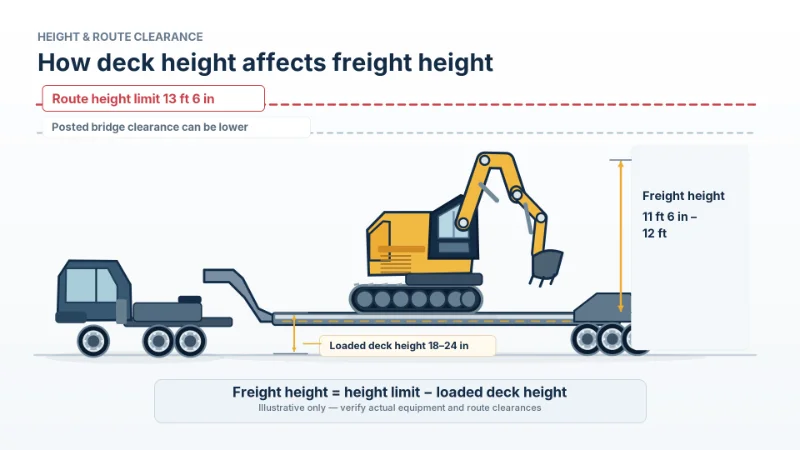
Every inch the deck sits higher under load is an inch taken from the machine, so ask for the loaded figure. A legal height limit is not a guarantee of physical clearance either, because posted bridge and tunnel clearances on some routes sit below the state limit. Width is a separate problem. A machine whose blade or tracks exceed 102 in is oversize on any trailer, however low the deck.
How Genron’s Hydraulic-Neck Build Reads Against These Figures
Genron’s Lowboy Gooseneck Trailer listing gives the figures below for its hydraulic-neck build. Read against the US limits, they show which questions a spec sheet still leaves open.
| Listed item | Product page figure | Read against the US figures |
|---|---|---|
| Overall size (L × W × H) | 14,000 × 3,000 × 1,650 mm | Length is about 45.9 ft; the height is an overall dimension, not the loaded deck height |
| Width | 3,000 mm (about 118 in) | About 16 in over the 102-in (2,590 mm) federal standard, so a US move at this width needs an oversize permit; width is a build option |
| Gooseneck | Hydraulic | Front drive-on loading; the tractor needs a wet kit with matching pressure and flow, or a pony motor |
| Axles and tyres | 3 or 4 axles; 8.25R20 tyres, 12 or 16 | Axle count sets axle-group loads and bridge spacing; tyre size feeds into loaded deck height |
| Kingpin | 3.5-inch, JOST | The tractor needs a 3.5-inch fifth wheel; a 2-inch coupling will not accept it |
| Not listed | Loaded deck height, tare, rated or concentrated capacity, well length | Confirmed per order |
The four unlisted figures are the inputs to the height subtraction and the payload check. They are the first numbers to request for any RGN quote.
Rated Tonnage Versus Legal RGN Payload
An RGN’s legal payload on a non-permit move is the lowest of several limits, each checked with actual vehicle weights and the machine’s position in the well. Those limits are the 80,000-lb gross weight, the 20,000-lb single-axle and 34,000-lb tandem limits, the federal bridge formula and the trailer’s own rating. Set DSV’s 42,000-lb planning payload against the gross limit and the gap implies about 38,000 lb of tractor-plus-trailer weight in that figure, before axle loads are checked.
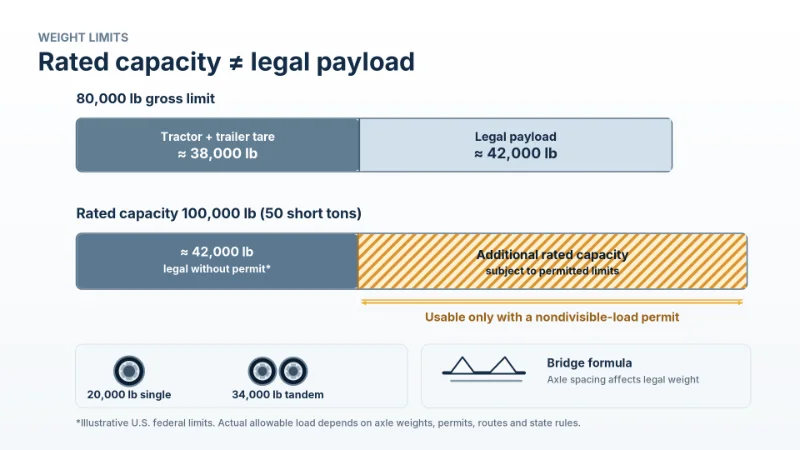
The rating barely matters on a legal move. A trailer rated at 50 US short tons (100,000 lb) still moves about the same 42,000 lb, and a 50-tonne metric rating of about 110,000 lb changes nothing either. The extra rating becomes usable only when a state issues an overweight permit for a nondivisible load. FHWA’s permit guidance defines that as a load that cannot be split without compromising its use, destroying its value or taking more than 8 work hours to dismantle. A tracked excavator usually qualifies. A stack of steel plates does not.
Ratings themselves need reading. Some makers state capacity as a concentrated load over a set span; one hydraulic detachable gooseneck described by CCJ is rated at 120,000 lb in 10 ft with an 18-in deck. Ask what span a tonnage figure assumes. A machine that bears on a short footprint loads the main beams harder than the same weight spread along the well.
Tare comes off payload pound for pound on an 80,000-lb move, so a hydraulic neck or an added axle line has to earn its weight in loading time or permitted capacity. Bookings made against a trailer’s rated tonnage instead of the move’s legal payload usually meet the gap at the scale or the permit desk. The load then has to be re-permitted or moved to a trailer with more axles. State overweight permits, escort requirements and route surveys take over beyond these limits, and each state sets its own, so they sit outside the figures in this article.
Loads That Actually Need a Removable Gooseneck
A removable gooseneck earns its extra weight and detaching time when the machine is tall enough that every inch of deck height counts. The same holds when it sits low enough to ground on rear ramps, or needs a short, low-angle path onto the deck. Crawler excavators, dozers and crawler cranes fit that description most often, because their height and weight press against both legal limits at once.
When the machine fits under the route’s height limit on a step deck and clears its loading ramps, a step deck or a fixed-neck lowboy with rear ramps is usually the simpler and cheaper choice. An RGN then adds detaching time and tare without solving a real constraint. A fuller side-by-side of fixed-neck and removable designs is in Lowboy vs. RGN Trailers.
Transport height and operating weight are the first screen. They decide whether a move can be legal at all and which permit path applies. Width, load distribution across the axle groups and the loading method are then checked together with them. Neck type, deck length and axle count come last, since they are chosen to carry those figures and cannot be changed economically once built.
RGN Terms Buyers and Brokers Use Differently
RGN quotes and load postings often use the same words for different measurements, and each mismatch below has one question that resolves it before a booking or an order.
| Word or phrase | What it usually means | Question that normalises it |
|---|---|---|
| RGN / lowboy / lowbed | RGN names the removable-neck type; lowboy and lowbed name the whole family | Is the neck fixed, hydraulic removable or mechanical removable? |
| “xx-ton RGN” | Structural rating of the trailer | What legal payload results with the actual tractor, and over what span is the rating stated? |
| Deck height | Often the unloaded figure | What is the deck height at rated load? |
| Trailer length | Overall length including the neck | What is the well length the machine must fit inside? |
| Width | Deck width only | What is the machine’s widest point, including blade and attachments? |
Two Numbers Behind Every RGN Decision
An RGN trailer is defined by its detachable neck, but the decision to use one rests on two numbers. Loaded deck height sets the tallest machine a legal move can carry. Legal payload, the lowest of the gross, axle, bridge and structural limits, sets the heaviest. Rated tonnage only comes into play once a nondivisible-load permit does.
When we prepare an RGN specification, we check loaded deck height and tare against the destination’s height, width and axle-load rules before discussing neck type or axle count. Our listed hydraulic build is 3,000 mm wide, so an order for legal-width North American service is specified at 102 in. If your tallest machine stands above about 11 ft 6 in loaded, or lacks the clearance for rear ramps, start from its transport height, operating weight and track footprint plus the route and destination market. Then compare them with the deck and neck options of our Lowboy Gooseneck Trailer.
FAQ
Removable gooseneck. On a load board, the three letters request a trailer type with an expected footprint; make and rating are agreed separately.
No single overall length applies, because neck type, deck sections and any extendable well all change it. The 48-ft figure in federal rules is the shortest semitrailer length states must allow on the National Network, not a typical RGN length. Longer combinations depend on each state’s rules.
No. A load can move without one when it stays within 102 in of width, the route’s height limit and actual clearances, length and overhang limits, 80,000 lb gross, the axle limits and the bridge formula. RGN loads often need permits because the machines are large; the trailer type alone does not trigger one.
Yes. Crane-lifted cargo such as tanks or transformers can sit in the well, where the low deck keeps overall height down. For those loads the removable neck adds little; tie-down points and loaded deck height matter more.