When buyers search “fence trailer height,” the answer sits inside a semi-trailer procurement decision — not a catalog dimension. Fence trailer height, understood as a system covering side board height, stake pocket placement, cargo stake gauge, and headboard dimension, determines load containment capacity, regulatory compliance, and the structural integrity of the trailer under transit conditions. This article maps those components to the correct specification decision, covering how cargo characteristics set the minimum board height, how target-market regulations cap that height, and how to communicate your specification to a Chinese manufacturer without ambiguity.
What ‘Fence Height’ Means in Trailer Procurement
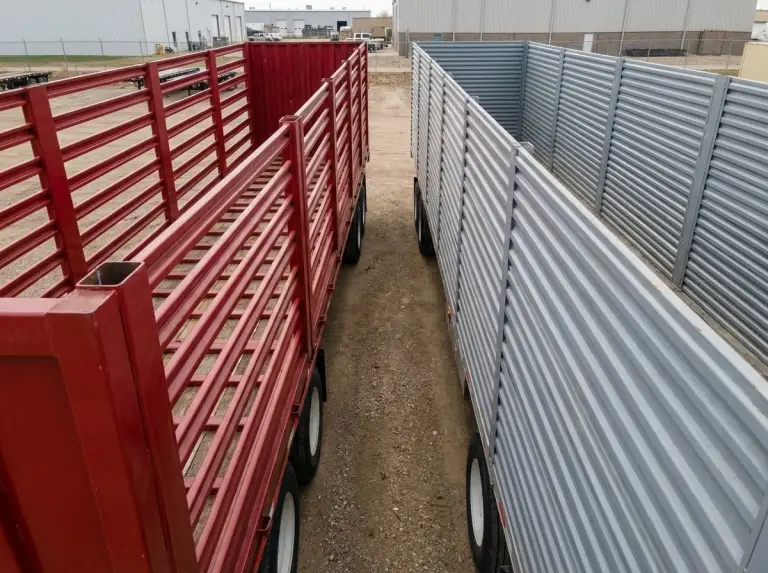
In trailer procurement, “fence height” refers to the side board and stake pocket system that determines load containment capacity — not a residential measurement or a catalog dimension. When a procurement manager asks about fence height, the actual decision involves four interconnected components: side board height, stake pocket placement, cargo stake gauge, and headboard height.
Each variable drives a downstream consequence. Side board height determines load containment volume. Stake pocket spacing governs lateral load displacement resistance. Headboard height controls forward surge under braking — a 200 mm headboard that works for palletized machinery will fail to contain loose grain shifting forward under emergency braking, even if the side boards are correctly specified. These are not independent cosmetic measurements.
A frequently observed source of build error in trailer sourcing is treating fence height as a single dimension rather than a system specification. In Genron’s sourcing work, the most common single-parameter failure is a buyer specifying board height in millimeters while leaving stake pocket spacing and weld grade to the manufacturer’s drawing default — a gap that shows up as lateral displacement damage after the first rough-road corridor.
How Cargo Type Sets Your Minimum Side Board Height
Minimum side board height varies by cargo density, center-of-gravity position, and displacement risk under transit conditions. The logic runs in reverse from what most catalog-driven buyers expect: start with what the cargo does under load shift, then determine the minimum wall height that contains it.
The classification boundary matters more than individual numbers. Packaged or unitized cargo — palletized goods, crated machinery, bundled steel — relies primarily on stakes as anchor points for strap restraint. Side boards serve as lateral edge guides at most, and their height matters less than stake pocket position and strap angle. Once cargo transitions to loose, granular, or settlement-prone material, the board becomes the primary containment wall, and its height must be calculated from load volume and CoG position.
The table below maps cargo categories to minimum recommended side board height ranges, based on Genron’s review of standard manufacturer drawings from five Chinese trailer production facilities and cross-referenced against cargo-securing guidelines from target operating markets. These ranges are indicative; final dimensions require confirmation against your specific cargo parameters, destination-market regulations, and manufacturer engineering review.
| Cargo Category | Examples | Minimum Side Board Height | Governing Risk |
|---|---|---|---|
| Unitized machinery and crated equipment | Crated industrial equipment, large fabrications | No boards required (stakes and straps only) | Lateral shift under strap failure |
| Palletized packaged goods with stable stack geometry | Bagged cement on pallets, boxed goods in stable formation | 300–450 mm | Stack edge displacement |
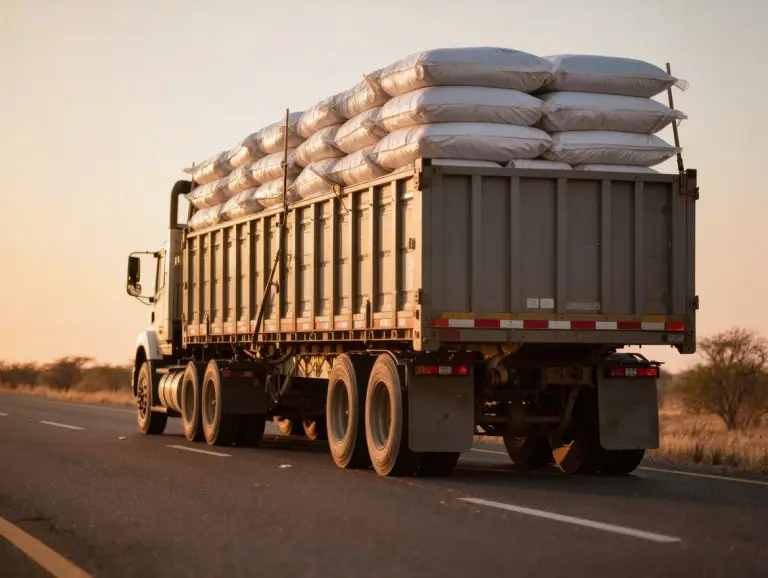
| Bagged or bundled goods without pallet base | Loose cement bags, fertilizer sacks | 300–450 mm | Bag roll, stack collapse |
| Agricultural produce | Root vegetables, fruit boxes | 450–600 mm | Load settlement, produce shift |
| Bulk construction materials | Sand, gravel, crushed stone | 600–900 mm | Volume overflow, CoG rise |
| Bulk minerals and ore | Iron ore, coal, bauxite | 800–1,200 mm | High density, severe CoG displacement |
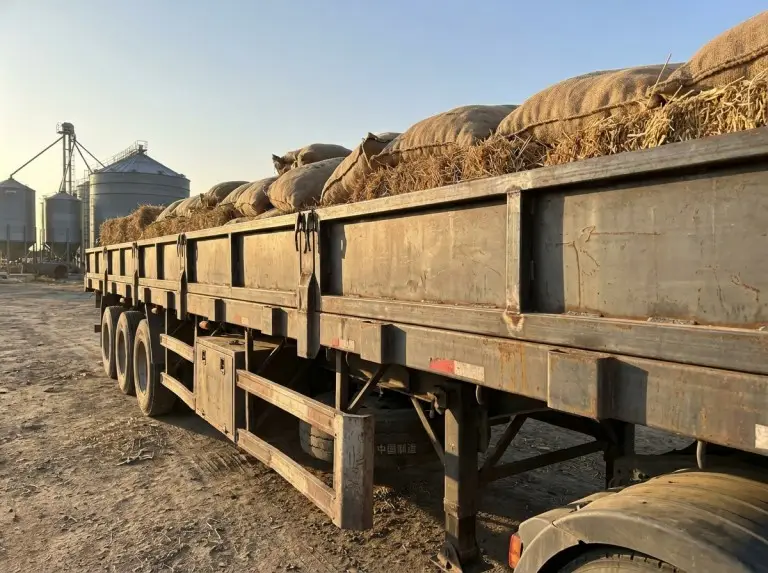
| Loose agricultural bulk | Grain, silage, chaff | 700–1,100 mm | Flow behavior under braking |
Understanding fence semi-trailer specifications before ordering helps procurement teams align board height requirements with the trailer’s structural design from the start.
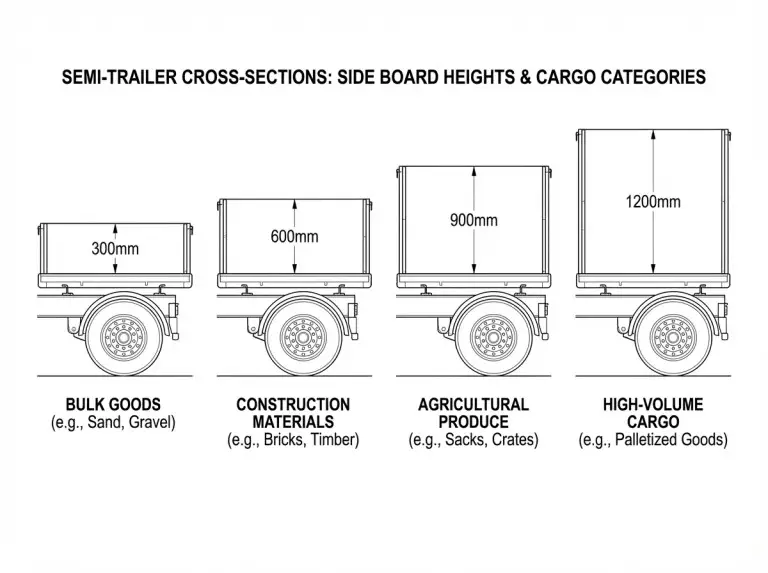
Standard Boards (300–600 mm): Where This Range Works and Where It Fails
Side board heights in the 300–600 mm range suit palletized or bagged cargo where the stack has predictable geometry and the primary risk is lateral edge displacement rather than volume overflow. This range functions as a guide rail, not a containment wall.
The failure mode is consistent: buyers underspec this range because the trailer looks adequate at loading. Bags of cement stacked three rows high and 450 mm to the top board appear contained in the yard. After 80 km of unpaved road, vibration causes the stack to settle and shift outward. A 450 mm board provides almost no resistance once the load surface has moved past vertical. The damage — crushed bags, shifted load, strap failure — appears at the first sharp curve after the rough section, not at the point of settlement.
In one sourcing project Genron supported on an East African agricultural corridor, a buyer specified 400 mm boards for bagged fertilizer based on a prior shipment that had used the same height on paved roads. The transit route included 200 km of unpaved secondary road. Post-delivery inspection found board deflection and one stake pocket weld failure on the rear-left position. The root cause was a combination of underspecified board height and a 3 mm steel sheet gauge that matched the manufacturer’s drawing default for standard cargo — not the load density or vibration conditions of that corridor.
High-Side Boards (600–1,200 mm) for Bulk Cargo
The 600 mm mark is the structural classification boundary in standard Chinese manufacturer drawings, based on Genron’s review of production drawings from five facilities in Shandong and Henan provinces. Below this threshold, most manufacturers apply their standard stake gauge and pocket weld specification. Above it, a separate structural calculation is typically required — covering stake wall thickness, pocket weld length, and floor beam section reinforcement.
Buyers specifying loads above 600 mm must confirm that the manufacturer’s structural upgrade addresses the actual load profile, not only the height dimension. A 900 mm board on a standard-gauge stake pocket designed for 600 mm service will show pocket weld fatigue within 50–80 loaded cycles on rough routes. The board height appears correct; the failure is in the stake-to-floor connection that the height number alone does not capture.
For buyers comparing fence trailer vs side wall trailer configurations, the high-side board range is where the structural difference between the two designs becomes most consequential. The key distinction: fence trailer boards are typically removable and rely on the stake-to-pocket connection as the primary load-bearing joint; side wall trailers integrate the panel into a continuous structural frame. For loose bulk cargo at 800 mm or above, the side wall configuration generally provides more consistent load containment under repeated lateral cycling.
For bulk mineral loads at 800 mm and above, board gauge should be specified at 4–5 mm steel sheet, depending on load density and transport vibration conditions. The 3 mm default in standard manufacturer drawings is appropriate for packaged cargo applications; it is insufficient for iron ore or coal on rough corridors.
Flatbed with No Boards: When Stakes Take Over
Heavy machinery, construction equipment, and oversized fabricated structures do not use side boards. The load exceeds what any board system could restrain, and the containment strategy shifts entirely to chain binders and ratchet straps anchored at stake pockets.
For this cargo category, fence trailer height becomes a question of stake pocket position, stake protrusion height above deck, and tie-down angle. A stake protruding 150 mm above deck creates a different restraint geometry than one at 300 mm — the difference affects strap angle and the effective vertical and horizontal force components on every load shift event. Stake pocket spacing should be specified center-to-center in millimeters; Chinese manufacturer drawing defaults for standard cargo trailers typically place pockets at 600–800 mm center-to-center spacing, but heavy machinery transport may require closer spacing or additional mid-span pockets depending on load footprint.
Specify stake pocket spacing and stake protrusion height explicitly for any machinery transport application. Do not accept “standard spacing” as a written specification.
Regulatory Height Limits by Target Market
Total vehicle height ceilings, axle load limits, and national road traffic acts set the maximum permissible side board configuration in each operating market. Adding taller side boards increases trailer tare weight, raises the combined center of gravity, and may push total vehicle height beyond the legal ceiling. In each section below, “total vehicle height” refers to the combined height of the tractor and loaded trailer — the figure that determines whether a given side board configuration is legally compliant on a specific corridor.
Africa: Height Limits and Load Caps
Road freight regulations in Sub-Saharan Africa vary significantly by corridor and country. Most member states of the Tripartite Free Trade Area apply maximum gross vehicle mass limits and total vehicle height ceilings; however, specific values differ by country and ratification status. Total vehicle height limits across the region are most frequently cited in the 4.0–4.3 m range in logistics partner documentation and corridor-specific freight guides reviewed by Genron, but buyers must obtain written confirmation from their logistics partner for each specific corridor and country, as national implementation and enforcement vary materially.
East African Community member states have harmonized axle load standards at the framework level, with specific limits and overload enforcement intensity varying by member state. The consequence for trailer specification is direct: a 1,200 mm high-side board configuration on a standard cargo trailer adds meaningful tare weight and raises the loaded CoG. On East and Southern African corridors with active weigh-bridge enforcement — including the Northern and Central corridors — over-gross penalties are severe enough that the board height decision must include a payload trade-off calculation, not only a cargo containment calculation.
Southeast Asia: ASEAN Baseline and Local Variance
ASEAN harmonized standards establish a baseline total vehicle height limit of 4.0 m for most member states, per the ASEAN Framework Agreement on the Facilitation of Goods in Transit. Enforcement intensity and corridor-specific limits differ meaningfully across the region — Vietnam, Thailand, and Indonesia each apply national implementation rules that diverge from the regional baseline in specific respects. Buyers must confirm corridor-specific requirements with a local logistics partner rather than relying on the regional baseline figure alone.
Middle East and Latin America: Compliance Basics
Several GCC member states operate permit systems for loads exceeding standard height thresholds, subject to route, cargo type, and prior application requirements. In Latin America, Brazil’s ABNT NBR cargo securing standards govern minimum stake and side board specifications acceptable for legal operation. These requirements diverge from Chinese GB standard defaults and must be confirmed with a local logistics partner before finalizing the build specification.
For all target markets: obtain a written regulatory cross-reference from your logistics partner before finalizing the build spec. A trailer that clears customs at one port may fail inspection at an inland checkpoint under a different authority’s interpretation of the same regulation.
How to Specify Fence Trailer Height Without Ambiguity
Fence height specification to a Chinese manufacturer requires explicit millimeter dimensions and a complete structural parameter list submitted before production begins. Default drawings from Chinese manufacturers follow GB standards, which diverge from destination-market requirements in three consistent areas: board height (typically defaulting to 400–500 mm for standard cargo trailer drawings and approximately 600 mm for high-side configurations, based on Genron’s drawing review across five production facilities), steel sheet gauge (typically 3 mm for standard board applications), and locking mechanism type (typically fixed weld unless otherwise specified). Each of these defaults is appropriate for certain applications and wrong for others. The only way to avoid receiving the wrong trailer is to replace the manufacturer’s default with your specification, in writing, before production begins.

Parameter Checklist Before Order Confirmation
Submit the following parameters in writing before order confirmation:
- Side board height in millimeters — measured from trailer deck surface to top of board
- Number of board sections (if plank-and-stake system) and individual plank height
- Stake pocket spacing along trailer length (center-to-center in millimeters)
- Stake material specification (steel grade) and minimum wall thickness
- Board material specification (steel grade, sheet gauge) and surface treatment
- Locking mechanism type — fixed weld, removable pin, or folding hinge with rated lock
- Headboard height and material specification
- Total trailer height at maximum board configuration (to cross-reference road legal ceiling for target corridor)
- Tare weight impact of board configuration versus base flatbed tare
Locking Fence Height in the Technical Annex
Each confirmed order Genron supports includes a technical annex attached to the purchase order covering the following minimum elements:
- Full millimeter dimension with tolerance range (e.g., “Side board height: 800 mm ±10 mm, measured from deck surface to top board edge”)
- Reference drawing number with revision date
- Material grade and gauge with Chinese GB equivalent cited
- Locking or removal mechanism described and diagrammed
- Stake pocket spacing specified center-to-center
- Written manufacturer confirmation required before production release
Require the manufacturer to return a signed copy with their production engineer’s name and date. This creates the accountability reference point for any delivery inspection dispute.
Stake pocket weld quality warrants separate written confirmation. In Genron’s project experience, pockets that fail under lateral loading cycles on rough routes consistently show insufficient weld length or weld penetration — not weld bead appearance, which looks acceptable on visual inspection. Request weld inspection documentation or photographic verification as part of pre-shipment quality checks. For side wall trailer load capacity requirements in bulk cargo applications, the structural specification of stakes and pockets is as important as the board height dimension itself.
Conclusion
Cargo fence trailer height — specified correctly as side board height, stake pocket configuration, headboard dimension, and associated structural parameters — is a procurement decision with direct consequences for load containment, regulatory compliance, and trailer longevity. The minimum required height is governed by cargo density, load profile, and displacement behavior under transit conditions. The maximum permissible height is capped by road regulations in your target operating market, which vary by country and corridor and must be confirmed in writing with a local logistics partner before the build spec is finalized.
The consistent pattern in orders that proceed without rework: every fence height parameter is locked in writing before the first weld is made. Parameters left to manufacturer drawing defaults — board gauge, stake pocket spacing, weld specification — are where delivery disputes start, not board height itself.
If your procurement process would benefit from a structured technical review before the order is confirmed, explore our full range of Fence Semi Trailer configurations or reach out — our team is glad to work through the parameters with you.
FAQ
No. Grain flows laterally under braking and settles under vibration. A static fill height of 700 mm translates to outward pressure well above that point after rough-road transit. Spec boards based on maximum expected cargo behavior in motion, not yard fill level.
Ask for the stake wall thickness, pocket weld length, and floor beam section in writing. If the quote only states board height and total price, the structure has not been recalculated — the manufacturer has added taller boards to a standard-gauge frame. Request the updated drawing with revision date before accepting the quote.
Inland checkpoints, in most cases. Port clearance typically focuses on documentation. Cargo securing and height compliance tend to be inspected at weigh-bridge stations on interior corridors, where enforcement authority and criteria differ from the port of entry. A trailer that clears the port can still be flagged 300 km into the route under a different authority’s interpretation.
The manufacturer builds to their drawing default on every parameter you didn’t specify. Board height will likely match. Stake pocket spacing, sheet gauge, and weld spec will not. These gaps don’t appear on visual inspection — they show up as pocket weld fatigue or board deflection after the first loaded rough-road run, at which point correction requires structural rework, not a simple adjustment.