Buyers looking at flatbed semi trailers for sale should pay as much attention to deck height as overall length. At Genron, we build custom semi-trailers, including flatbed semi-trailers. We see the same issue often. The trailer seems close enough, but the freight ends up too tall, too slow to load, or too costly to run.
Both trailer styles handle construction, heavy equipment, and agricultural freight. The deck layout affects usable freight height, loading methods, and needs for special routing or permits.
This guide keeps things practical. We compare deck height, freight height, payload margin, and loading access. Then we give a simple checklist to pick the right platform for your job.
Deck Height, Freight Height, and Clearance
Pick the right trailer by seeing height as a chain. Deck height plus freight height equals overall loaded height. If that total nears legal limits, your trip risks rise.
Most highway moves plan around a legal height of about 13 ft 6 in. Some areas allow up to 14 ft. If your loaded height gets close, you may need route restrictions, permits, escorts, or detours.
You control deck height with your trailer choice. A flatbed deck sits higher off the ground. It works well for general loading but limits tall freight. A step deck lowers the main area. It gives more height room without changing the freight.
Weight planning uses similar logic. Many target a gross limit of 80,000 lb. Your legal payload depends on tractor, trailer tare weight, axle count, and local rules. For selection, remember this. A heavier trailer reduces payload margin on the same route.

Standard Deck for Standard Loads
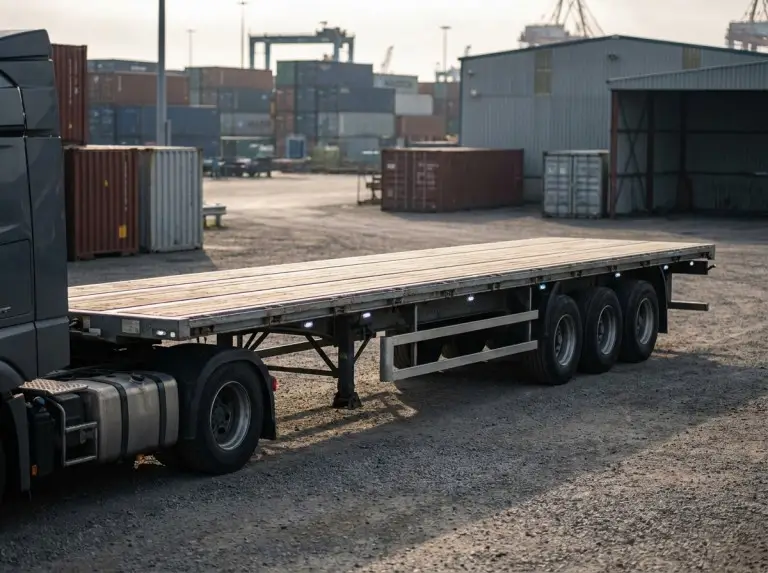
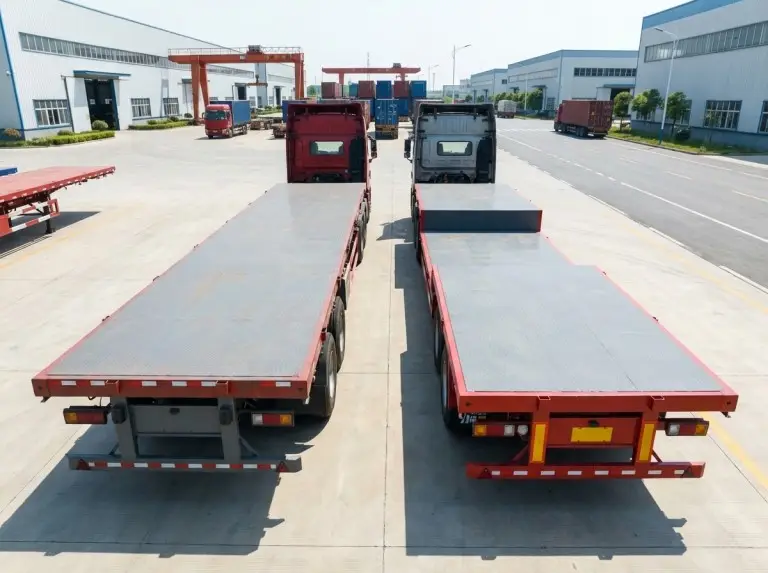
A flatbed is the simplest open-deck trailer. It remains the default when freight height is not an issue. It has one continuous deck, no sidewalls, and no roof. You can load from the sides, rear, and often above.
Most flatbeds fit a standard size. They run about 48–53 ft long and 8 ft 6 in wide. The deck height is often around 5 ft. Exact builds vary by suspension, tire size, and frame design.
That deck height sets standard freight height limits. People choose flatbeds when freight stays around 8 ft 6 in or under local thresholds. This keeps overall loaded height away from bridge and wire issues.
Flatbeds work best for long, wide, dense, or awkward freight that is not tall. Examples include bundled materials, palletized loads with tarps for weather protection, steel products, jobsite supplies, and machine components below height limits.
Loading flexibility stands out as a flatbed strength. Forklifts load from the sides easily on the continuous deck. Crane loading is simple too. The deck stays open, and tie-downs are easy to access.
The flatbed tradeoff is clear. Tall freight hits clearance limits fast. Making it legal may need more than a new strap plan. Tall freight is where step decks shine.

Lower Deck for Taller Freight
Choose a step deck when freight is too tall for a flatbed without risking overall height. It lowers the main loading area. This cuts total loaded height while keeping the same freight and similar trailer size.
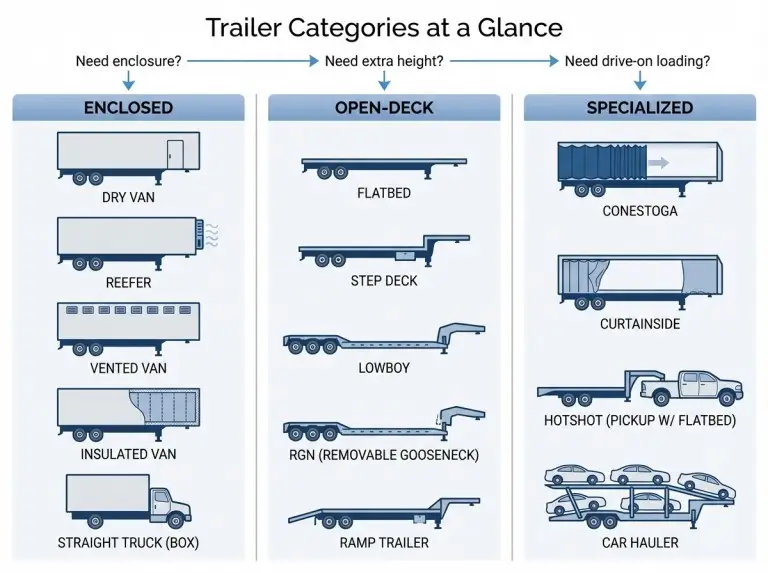
Naming varies in the field. We stay precise. A step deck, often called a drop deck, has two levels. A shorter upper deck and a longer lower deck. Some use “lowboy” loosely. But many reserve it for very low well designs or detachable neck gear. Always check what a supplier means.
Common step deck builds have an upper deck of 10–11 ft. The lower deck runs 37–42 ft. Lower deck height is often 3 ft 5 in to 3 ft 6 in. This lets it carry taller freight easily.
With the lower deck, step decks handle freight up to 10 ft to 10 ft 2 in. They stay in typical height limits on many routes. That extra room can avoid permits.
Step decks support easy equipment loading. Many include ramps. The lower deck cuts climb angle and ground distance. This helps when driving machines on or off, or when forklifts need better access.
People use step decks for tractors, excavators, skid steers, lifts, some construction and agricultural machines, and tall crated loads that exceed flatbed heights.
The main tradeoff is weight and complexity. Step decks weigh more than similar flatbeds due to transitions and reinforcement. This extra tare weight cuts payload margin under the same gross limit.

Fixed-Neck Step Deck
A fixed-neck step deck fits when you load from the rear or sides and want a simple, lighter setup. The neck stays permanent. This means fewer moving parts and easy maintenance.
This style suits fleets that load with rear ramps or side forklifts. It works when freight mix stays consistent and front access is not needed.
Gooseneck Step Deck
Choose a gooseneck when front transition clearance matters. It helps match tractor setups and loading preferences. It can improve how equipment sits across the deck break.
We see this as a fitment choice, not a better category. The right option depends on loading method, tractor pairing, and equipment weight and shape at the transition.
Removable Gooseneck (RGN) Step Deck
Select an RGN step deck when front loading or flexibility matters. Detaching the neck simplifies loading for some machines. It reduces need for high-angle ramps.
RGN setups suit frequent equipment moves where speed matters. They add complexity. We recommend them when loading benefits are real and consistent.
Further Reading: Lowboy vs. RGN Trailers: Complete Comparison Guide
Side-by-Side Comparison: Height, Payload Margin, and Loading Access
Many buyers see flatbed and step deck as similar. But deck geometry affects job costs. For freight near height limits, step deck helps clearance. For non-tall freight, flatbed aids payload and simplicity.
Here is a decision table we use to compare. See numbers as common ranges. Confirm exact build and route limits before deciding.
| Decision Factor | Flatbed Trailer | Step Deck Trailer | Double Drop (Reference Option) |
|---|---|---|---|
| Deck layout | Single continuous deck | Upper + lower deck | Deck + deep well |
| Typical deck height | ~5 ft | ~3 ft 5 in–3 ft 6 in (lower deck) | Well can be as low as ~22 in |
| Practical “standard” freight height behavior | Best when freight stays around 8 ft 6 in | Often supports ~10 ft–10 ft 2 in on lower deck | Can support taller freight, often up to ~11 ft 8 in |
| Loading access | Great for side loading; ramps optional | Better for driven equipment; ramps common | Specialized; chosen for tall/heavy needs |
| Payload margin under common gross limits | Often better due to lower tare | Often slightly less due to higher tare | Often less; highly build-dependent |
| Best fit use cases | Standard-height materials and general freight | Taller equipment and high-cube freight | Extra-tall freight when step deck is not enough |
Loading and unloading show real differences. Flatbeds need more forklift lift height. They suit driving equipment up ramps less. Step decks shorten the climb and lower center of gravity for machines. This boosts stability during loading.
Compliance ties to height. Flatbeds with tall freight hit clearance and permit issues more. Step decks cut loaded height early in planning.

Match Your Freight to the Trailer
Choose right in minutes with a strict order. Avoid mixing variables. At Genron, we suggest four steps. Height first, then weight margin, loading method, route sensitivity.
Use this checklist as your filter:
- Freight height (the primary switch) If freight height pushes a flatbed close to common overall height limits, move to step deck.
- Freight weight and payload margin (the safety check) Confirm your expected gross plan; a heavier trailer can reduce payload margin.
- Loading method (the efficiency driver) If you need ramps or you regularly drive equipment on/off, step deck often saves time.
- Route clearance sensitivity (the risk control) If your routes include tight clearances, choose the trailer that lowers total height.
A quick rule we share with customers is this. If freight fits under standard height easily, flatbed is most economical. If freight is tall enough to cause clearance worry, step deck pays off in fewer issues.
When freight is taller than step deck handles, consider double drop next. We see it as targeted, not default. It affects tare weight, operations, and availability.
Conclusion
The right choice between flatbed and step deck starts with height. Then check weight margin and loading method. Flatbeds offer simplicity and payload efficiency for standard-height freight. Step decks prevent clearance problems and speed equipment loading.
At Genron, we do not force your freight into a catalog model. We start with your freight dimensions, loading method, and constraints. Then we build the flatbed or step deck that fits how you haul. For a fast spec, share your tallest freight height, heaviest piece weight, and preferred loading method.
Further Reading: How to Choose a Flatbed Trailer?
FAQ
Is a step deck the same as a drop deck?
Yes, in many markets the terms mean the same. But naming varies. Confirm the deck layout. An upper deck plus a lower deck defines it.
What is the main difference between a flatbed and a step deck?
The main difference is deck height. It affects how tall freight can be before overall height causes problems. Flatbeds sit higher. Step decks lower the main area to cut total loaded height.
How tall can freight be on a flatbed vs a step deck?
In daily planning, flatbeds suit freight around 8 ft 6 in. Step decks handle around 10 ft to 10 ft 2 in on the lower deck. Exact limits depend on overall loaded height and local rules.
Does a step deck carry less weight than a flatbed?
Often yes, because step deck structure weighs more. This cuts payload margin under the same gross limit. Real payload depends on tractor weight, trailer tare, axle setup, and compliance plan.
When should I consider a double drop instead of a step deck?
Consider a double drop when freight is too tall for step deck to fix clearance. It suits extra-tall freight, especially to stay under common height limits.
Which trailer is easier to load with a forklift?
Both work with forklifts. But step deck’s lower deck eases access in many yards. Flatbeds suit side loading well, especially for palletized or bundled freight without height issues.