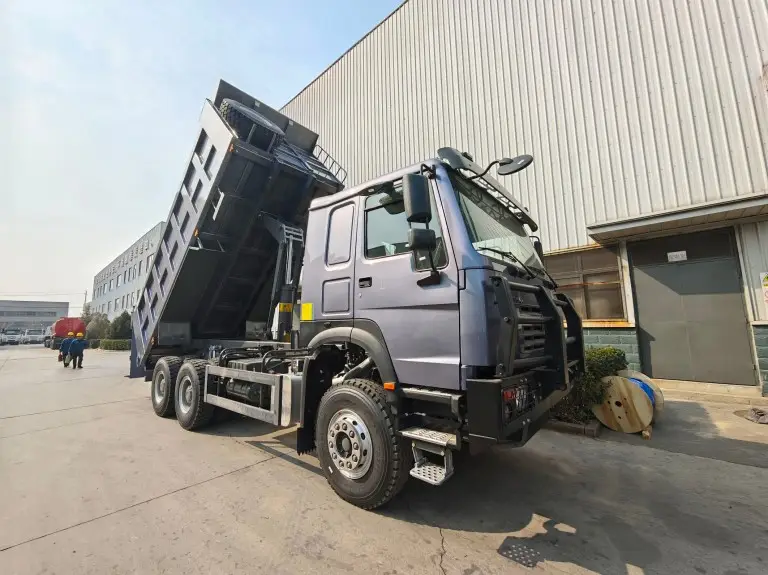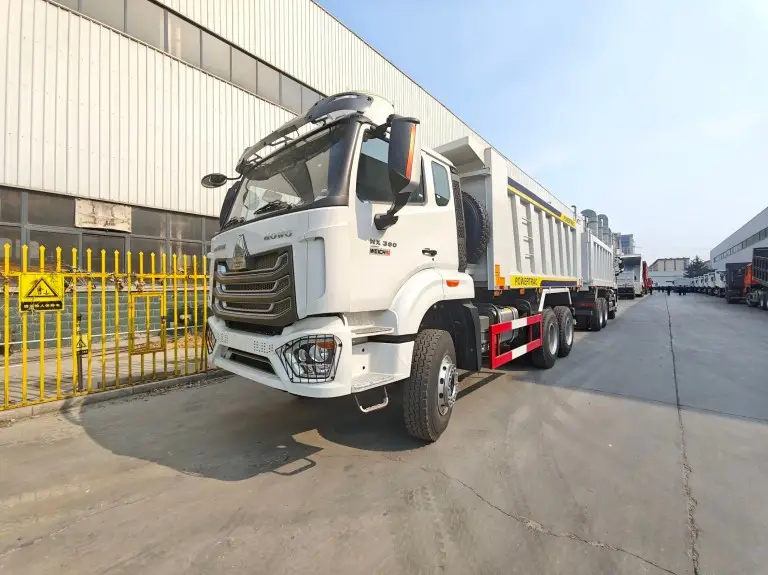
At Genron, we sell and customize HOWO trucks. Before we recommend a setup, we always compare 6×4 and 8×4 options. These trucks might look similar on paper. But they act very differently on the job.
You need to match the axle layout to your roads and payload goals. This protects your uptime and lowers your cost per ton. This guide focuses on the real differences between 6×4 and 8×4. It helps you make a smart choice for your daily work.
What “6×4” and “8×4” Mean on a HOWO Dump Truck?
The terms “6×4” and “8×4” tell you two things. First, how many wheel spots the truck has. Second, how many of those wheels have power. This shapes how much you can carry and where you can drive.
A HOWO 6×4 is usually a 3-axle truck. It has one steering axle in front and two drive axles in the rear. A HOWO 8×4 is usually a 4-axle truck. It has two steering axles in front and two drive axles in the rear.
That extra axle on the 8×4 does not add drive power. Instead, it helps share the load. It also puts more tire rubber on the ground.
In real work, the 8×4 carries heavier loads. It spreads weight better across more axles. However, the truck is longer. It needs more space to turn. It also weighs more when empty.
The 6×4 is easier to use on tight sites. It works well for short trips where you turn and park often.
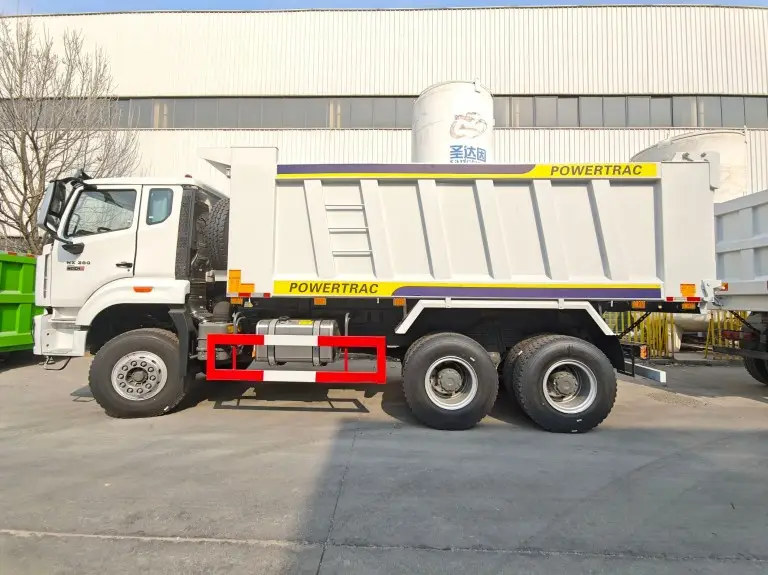
Main Differences Between HOWO 6×4 and 8×4
You can decide quickly by looking at four factors. These are payload, maneuverability, stability, and cost.
The 6×4 fits medium loads and tight roads. The 8×4 fits heavy loads and long hauls. Your dimensions, axle layout, and work cycle decide the winner.
Here is a simple comparison of typical setups.
|
Item |
HOWO 6×4 Dump Truck (Typical) |
HOWO 8×4 Dump Truck (Typical) |
What it means in the field |
|---|---|---|---|
|
Wheel layout |
10-wheel design |
12-wheel structure |
More wheels spread the load better. |
|
Axle configuration |
1 steering + 2 drive axles |
2 steering + 2 drive axles |
8×4 adds a load-sharing axle. |
|
Typical payload range |
~20–25 tons |
~30–40 tons |
Real payload depends on local laws. |
|
Typical dimensions |
~10.3m – 11m long |
~10.3m – 11.6m long |
8×4 needs more room to turn. |
|
Maneuverability |
Strong in tight areas |
Lower in confined areas |
6×4 turns faster. |
|
Stability (loaded) |
Good |
Better |
Extra axle helps when full. |
|
Engine (examples) |
~380 HP, Euro III |
~371 HP, Euro II |
Specs vary by market. |
|
Transmission |
HW19710 (10 speed) |
HW19710 (10 speed) |
Feel differs due to weight. |
|
Fuel behavior |
~23.8 L/100 km (at 50% load) |
Higher due to weight |
8×4 can win on cost-per-ton. |
|
Budget |
Lower upfront cost |
Higher upfront cost |
Payback depends on load size. |
Axle & Wheel Layout
The extra axle on an 8×4 changes how the truck handles stress. More axles mean more contact points. This lowers the stress on each individual axle. It improves stability when you dump or brake.
This is why people use the 8×4 for heavy work. It feels more solid when fully loaded.
A 6×4 has fewer axles for the same impacts. It is built for medium loads. This does not mean it is weak. It just means you must watch your payload limits. Many customers like the 6×4 for tight sites. On short trips, speed matters as much as load size.
Payload Range
In most setups, 6×4 trucks carry about 20 to 25 tons. 8×4 trucks often carry 30 to 40 tons.
Keep in mind the word “working.” Your legal payload depends on local rules. If your roads have strict limits, you might not use the full capacity of an 8×4. That changes your profit.
Choose based on what you can carry legally every day. If you haul heavy loads constantly, the 8×4 gives you a safety margin. If your loads are lighter and speed matters, the 6×4 works better.
Maneuverability
A short turning radius is a tool for productivity. A 6×4 turns easily into narrow gates. It climbs temporary ramps well. It parks quickly in crowded sites. This saves minutes every trip. Those minutes add up to hours each week.
An 8×4 is longer. It needs more space to turn. It moves slower in tight spots. This is fine on big open sites like quarries. But if you work in cities, maneuverability might be your most important factor.
Stability
Stability is about safety and wear. When you carry heavy rock or dirt, you need a stable truck. The 8×4 has a longer frame and an extra axle. This makes it stable under high loads. It helps during braking and cornering. It also helps when you lift the dump body.
The 6×4 is stable with normal loads. But it feels uneven loading more than the 8×4 does. If you load dense material, stability favors the 8×4. If your material is lighter and the site is small, the 6×4 is stable enough.
Cost Profile
A 6×4 costs less to buy. It also has fewer parts to break. You have fewer tires to buy. The suspension is simpler. For small projects, this keeps cash flow steady.
An 8×4 costs more upfront. It also costs more to run. It is heavier and has more tires. But it carries more. This can reduce the total number of trips you make.
Don’t just look at fuel per kilometer. Look at fuel per ton-kilometer. That is the real cost measure.
Powertrain Basics
Powertrain details matter, but maybe not how you think. In many markets, 6×4 and 8×4 trucks use similar engines. The exact rating depends on emissions rules.
What matters is torque. You need power when the truck is full. A high horsepower number does not always mean faster trips.
You might see an 8×4 with a 371 HP engine. A 6×4 might have a 380 HP engine. These are just examples. Markets vary. We always check the exact engine code and torque for your specific job.
The transmission is often the same. Both trucks often use the HW19710 gearbox. It has 10 forward gears and 2 reverse gears. It works well on mixed terrain. The difference you feel comes from the weight of the truck, not the gears.
Steering and braking are vital too. Both models use hydraulic power steering. This helps you control the truck at low speeds. Braking usually involves a dual-circuit air system. If you drive on steep hills, good brakes matter as much as a strong engine.
How We Help You Choose?
Here is a simple rule. Choose the 6×4 for tight sites and medium loads. Choose the 8×4 for heavy, long hauls.
This rule works in the real world. The right truck hits your tonnage goals with no hassle. We map the truck to your road width and grades first.
If you work in cities or on narrow mine roads, pick the 6×4. It is easier to place. It cycles faster. If your loads are medium size, the lower cost helps you profit sooner.
If you haul heavy dirt over long distances, pick the 8×4. It carries more. It stays stable. It burns more fuel per kilometer, but it moves more dirt per trip. This lowers your cost per ton.
You can check the math easily. Compare fuel per ton-kilometer. Divide your fuel use by your payload. Lower is better. If the 8×4 carries much more, it wins on efficiency.
Common Buying Mistakes and Quick Checks Before You Decide
Most bad purchases happen because the truck does not match the job.
First, do not confuse body volume with payload. Volume is just space. Payload is weight. Dense material fills the weight limit before it fills the space.
Second, do not ignore road width. A big truck that cannot turn is useless. We ask for your narrowest gate and tightest corner.
Third, do not choose based only on horsepower. Torque and gearing matter more. You need a truck that starts and stops well under load.
Here are 7 questions to help you decide:
- What material do you haul, and how heavy is it?
- What is your target payload, and what is the legal limit?
- How long is the trip, and how many trips do you make a day?
- What is the tightest turn or gate on your route?
- Are the roads paved or rough?
- Do you dump on flat ground or uneven dirt?
- What drives your profit: speed or fewer trips?
Conclusion
If you haul medium loads and work short trips, I recommend the HOWO 6×4 for its efficiency and lower upfront cost. If your project calls for heavy payloads and long hauls, I suggest the HOWO 8×4 for its unbeatable stability and capacity.
As your trusted partner at Genron, I take pride in offering top-quality Chinese trucks and the proven reliability of the HOWO dump truck. I’ll make sure your truck is customized for your actual roads, payloads, and job sites—because real-world results matter more than just specs on paper. Ready to boost your project’s performance? Let’s get started with the right HOWO dump truck for your business today!
FAQ
What’s the main difference between HOWO 6×4 and 8×4 dump trucks?
The main difference is the axle layout. A 6×4 has 3 axles. An 8×4 has 4 axles. The extra axle helps the 8×4 carry heavier loads safely.
Which one is better for city roads or narrow job sites?
A 6×4 is better for narrow roads. It is shorter and turns tighter. This helps in cities and small mines.
Does an 8×4 always cost less per ton because it carries more?
Not always. It only costs less if you can legally fill it up. If laws limit your load, the 8×4 loses its advantage.
Are the powertrain and spare parts totally different between the two?
No. They often share engines and transmissions. Parts like the HW19710 gearbox are common. Always check the specific build sheet to be sure.
How do I make the final choice if I’m still unsure?
Look at your constraints. Check your turning space and road limits. If the site is tight, go with 6×4. If the road is open and the load is heavy, go with 8×4.