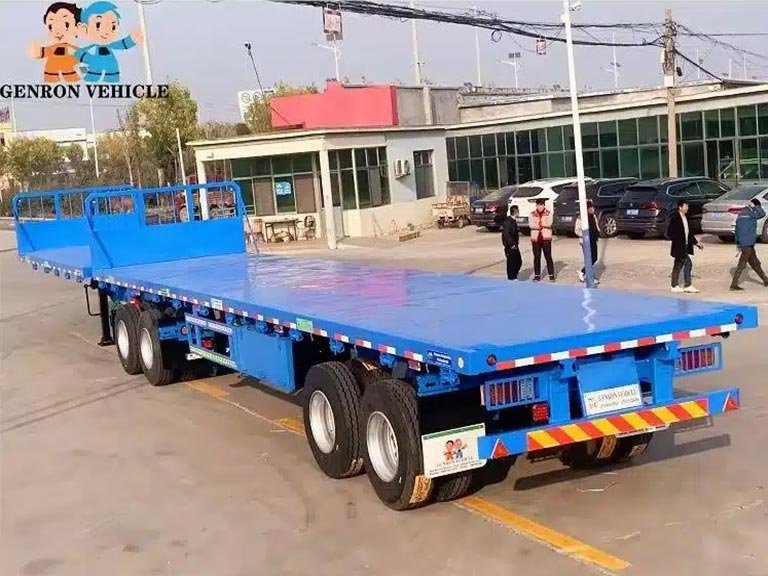
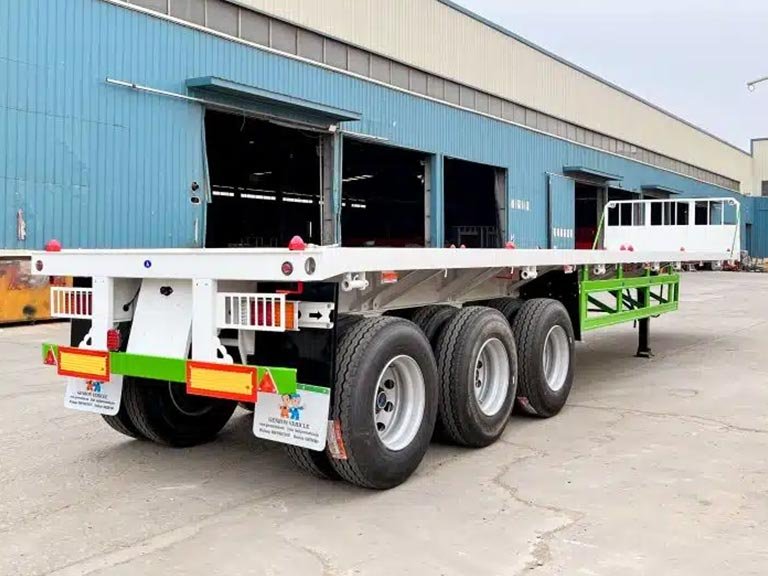
Across construction sites in West Africa, infrastructure projects in Southeast Asia, and industrial corridors in the Middle East, one trailer type carries more freight than any other: the flatbed trailer. Its open deck, flexible loading access, and adaptable configurations make it the first choice for steel, heavy machinery, oversized structural components, and palletized cargo that doesn’t fit inside an enclosed unit.
But the open deck design also means every dimension decision is visible and consequential. Length determines whether cargo overhangs. Deck height determines whether a load clears a bridge or needs a permit. Tare weight determines how much freight actually fits within legal gross weight limits. Get one of these wrong and the problem doesn’t surface until the truck reaches a weigh station — or the cargo doesn’t clear an overpass.
This guide covers the four core flatbed dimensions, how they vary across trailer types, the legal reference thresholds most commonly used in international specification work, and how cargo characteristics should align with trailer configuration before an order is placed. We manufacture and export flatbed trailers across more than 30 markets, and the specification errors covered here are ones we encounter routinely during drawing review.
Standard Flatbed Trailer Dimensions
A standard flatbed semi-trailer measures 48 to 53 feet (14.6–16.2 m) in length, 8.5 feet (102 in / 2.59 m) in width, and approximately 5 feet (1.52 m) in deck height, with practical freight capacity around 46,000–48,000 lbs (20,865–21,770 kg) — subject to trailer tare weight and axle configuration in the operating market.
These four numbers — length, width, deck height, and freight capacity — are the baseline for all flatbed specification work. They interact with each other in ways that make reading any single figure in isolation unreliable.
Tare weight is the variable most often dropped from the calculation. A standard flatbed weighs roughly 6,000 to 12,000 lbs before any cargo is loaded. Since gross combination weight on most road networks is capped at 80,000 lbs, the trailer’s own weight reduces available payload directly. A heavier tri-axle configuration or steel-reinforced deck can leave substantially less headroom for freight than the 48,000-lb figure suggests. We calculate net payload for each order against the specific trailer configuration and destination market weight limits — not against the headline freight capacity figure alone.
Flatbed trailer dimensions vary significantly by type, and each configuration solves a specific cargo height or length constraint that a standard flatbed cannot address within legal limits.
The table below reflects standard North American specification ranges, which serve as the most widely referenced international benchmarks. Exact dimensions depend on manufacturer, axle count, and the regulations of the destination market.
| Trailer Type | Length | Width | Deck Height | Max Cargo Height | Typical Payload |
|---|---|---|---|---|---|
| Standard Flatbed | 48–53 ft (14.6–16.2 m) | 8.5 ft (2.59 m) | ~5 ft (1.52 m) | ~8.5 ft (2.59 m) | ~46,000–48,000 lbs |
| Step Deck | 48–53 ft | 8.5 ft | ~3.4–3.6 ft lower deck | ~10 ft (3.05 m) | ~48,000 lbs |
| Extendable Flatbed | Up to 80 ft (24.4 m) | 8.5 ft | ~5 ft | ~8.5 ft | ~48,000 lbs |
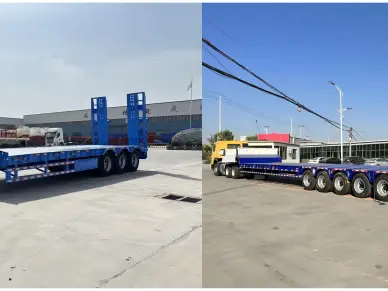
| Lowboy (Double Drop) | 24–29 ft well | 8.5 ft | 18–24 in (0.46–0.61 m) | ~11.5–12 ft (3.5–3.66 m) | ~40,000–45,000 lbs |
Legal limits in the destination market must be confirmed before the trailer is ordered. For a full breakdown of each type’s application and structural features, our guide to the 7 common types of flatbed trailers covers each variant in detail.
Step deck: A step deck trailer has two deck levels: an upper deck at standard height and a lower rear deck that drops to approximately 3.4 to 3.6 feet. That lower deck height allows cargo up to 10 feet tall to travel without a height permit on most routes — the key advantage over a standard flatbed for tall machinery, large structural frames, and industrial equipment that exceeds the 8.5-foot clearance envelope. The upper deck runs approximately 11 feet; the lower deck approximately 37 feet.

Extendable flatbed: The telescoping mechanism adds supported deck length, not legal payload capacity. The weight limit stays the same as a standard flatbed. In some configurations, the extendable structure increases tare weight, which reduces net freight capacity further. Axle spacing and bridge formula compliance must be checked before any long cargo is confirmed on this trailer type.
Lowboy (double drop): The double drop trailer positions the well deck at 18 to 24 inches off the ground by using two deck drops — one behind the gooseneck, one before the rear axles. That low deck height is what allows cargo up to 11.5 to 12 feet tall to remain within overall height limits on most routes. Payload capacity is lower than a standard flatbed because the heavier frame structure consumes more of the available gross weight. For capacity figures by axle configuration, our flatbed trailer load capacity guide covers the full breakdown.
Legal Load Limits and Permit Triggers
Legal load limits for flatbed trailers vary by country, state, and road corridor — there is no single global standard. The figures below reflect North American reference thresholds widely used as benchmarks in international specification work. We use these as the starting baseline and adjust for destination market requirements during the order and drawing review process.
In the United States, height limits are set at the state level, not federally. Many states use 13 feet 6 inches as the common maximum overall height; some allow up to 14 feet. Width above 8.5 feet, gross combination weight above 80,000 lbs on interstate highways, or loads that breach per-axle thresholds generally require oversize or overweight permits, route surveys, and in some cases escort vehicles.
Cargo overhang is governed by federal marking rules under 49 CFR §393.87. A rear projection beyond 4 feet or a side projection beyond 4 inches requires warning flags of at least 18 inches square. Maximum overhang distance, lighting requirements, and escort thresholds are then set by individual state and route conditions — not by a single federal rule.
Export market variation:For trailers operating outside North America, the applicable limits differ significantly by country, road class, and corridor. The table below reflects the dimension frameworks we most commonly encounter across Genron’s primary export markets.
| Market | Common Trailer Length | Width Limit | Notes |
|---|---|---|---|
| North America (reference) | 48–53 ft | 102 in (8.5 ft) | Height set by state; most use 13′6″ |
| European Union | 13.6 m | 2.55 m | EU Directive 96/53/EC |
| Sub-Saharan Africa | 12–14 m common | 2.5–2.6 m | Varies significantly by country |
| Southeast Asia | 12–14 m common | 2.4–2.5 m | Strict axle load limits in several markets |
We confirm destination market compliance — including axle load rules, road clearance limits, and permit conditions — as part of the specification process for every export order.
Matching Cargo to the Right Trailer Dimensions
The right flatbed trailer type for a given cargo depends on three variables checked in sequence: loaded height, total length, and weight distribution. Skipping any one of these — or checking them independently rather than together — is where most trailer type mismatches originate.
Height is the first filter. Cargo within 8.5 feet of height fits a standard flatbed without a height permit on most routes. Cargo between 8.5 and 10 feet moves to a step deck, which eliminates the permit requirement on most corridors without the added structural cost of a lowboy. Above 10 feet, a lowboy is typically required, and the route must be surveyed for overhead clearances before transport is confirmed. These thresholds apply to North American reference limits; destination market limits must be verified separately.
Length is the second check. Cargo within 53 feet with acceptable rear overhang fits a standard or step deck trailer. Extra-long items — structural beams, pipe strings, wind turbine components — need an extendable flatbed to provide full deck support along the cargo’s length. We specifically flag this for long, flexible cargo like pipe and fabricated steel sections during drawing review. Shipping those items with unsupported midspan on a fixed-length trailer leads to load deflection and flatbed load securement failure in transit — a preventable outcome with the right trailer configuration.
Weight distribution is the third check, and the one most often deferred until it causes a compliance problem. A load within total gross weight limits can still breach per-axle thresholds if the cargo’s center of gravity concentrates weight over a single axle group. We review axle load calculations for heavy or geometrically concentrated cargo before production drawings are approved. For a full decision framework covering trailer type, axle selection, and cargo compatibility, our guide on choosing the right flatbed trailer walks through each selection step in detail.
Conclusion
Flatbed trailer dimensions — length, width, deck height, tare weight, per-axle limits, and cargo overhang — interact across every specification decision, and the applicable legal thresholds depend on the destination market and operating route. Reading any single dimension in isolation, without cross-checking the others, is where most specification and compliance errors begin.
At Genron, we confirm trailer type, axle configuration, net payload availability, and destination market compliance before production drawings are approved. In projects where cargo data or market regulations weren’t established at the inquiry stage, we consistently find that one early verification step — loaded height against route clearance, or axle distribution against local per-axle limits — prevents scope changes that would otherwise add lead time and cost after delivery.
Share your cargo dimensions, weight, loading method, and target market with our team. We’ll confirm the right configuration before the order is placed.
FAQ
A standard flatbed semi-trailer is typically 48 to 53 feet long, 8.5 feet wide, and approximately 5 feet in deck height. Practical freight capacity runs around 46,000–48,000 lbs, depending on tare weight and axle configuration. These figures reflect North American standards used internationally as specification reference benchmarks, and legal limits in the operating market must be confirmed separately.
Deck height is the fixed distance from the ground to the trailer deck surface — approximately 5 feet on a standard flatbed. Maximum cargo height is the remaining clearance between the deck and the legal total height limit on the route. On a standard flatbed in a jurisdiction capping overall height at 13 feet 6 inches, that leaves roughly 8 feet 6 inches of usable vertical space above the deck — not the full road clearance figure. Treating total road height as cargo height is one of the most common flatbed specification errors.
A standard flatbed weighs approximately 6,000 to 12,000 lbs before any cargo is loaded. Since gross combination weight is capped at 80,000 lbs on most road networks, the trailer’s own weight directly reduces available payload. A heavier or multi-axle configuration leaves less headroom for freight. Net payload should always be calculated using the specific trailer’s tare weight — not the stated freight weight limit alone.
Using North American thresholds as a reference: a permit is typically required when overall height exceeds the state-specific limit (commonly 13 feet 6 inches, though this varies), width exceeds 8.5 feet, gross combination weight exceeds 80,000 lbs, or per-axle limits are breached. Rear overhang beyond 4 feet requires warning flags under federal marking rules. Maximum overhang, escort requirements, and exact thresholds vary by state and operating corridor. For export markets, applicable limits differ by country and must be confirmed locally before transport.
Legal dimension and weight limits vary significantly by destination. North American standards are widely referenced as benchmarks, but operating limits in sub-Saharan Africa, Southeast Asia, and the Middle East differ by country, road classification, and axle configuration. We confirm applicable limits for each destination market as part of the specification and ordering process, and we adjust trailer configuration to match local compliance requirements before production begins.