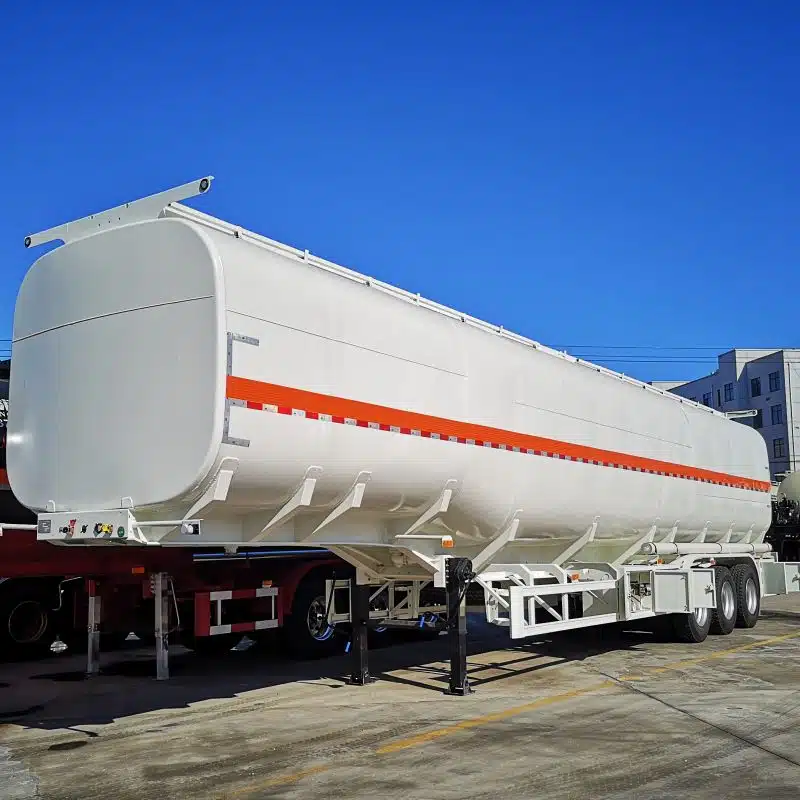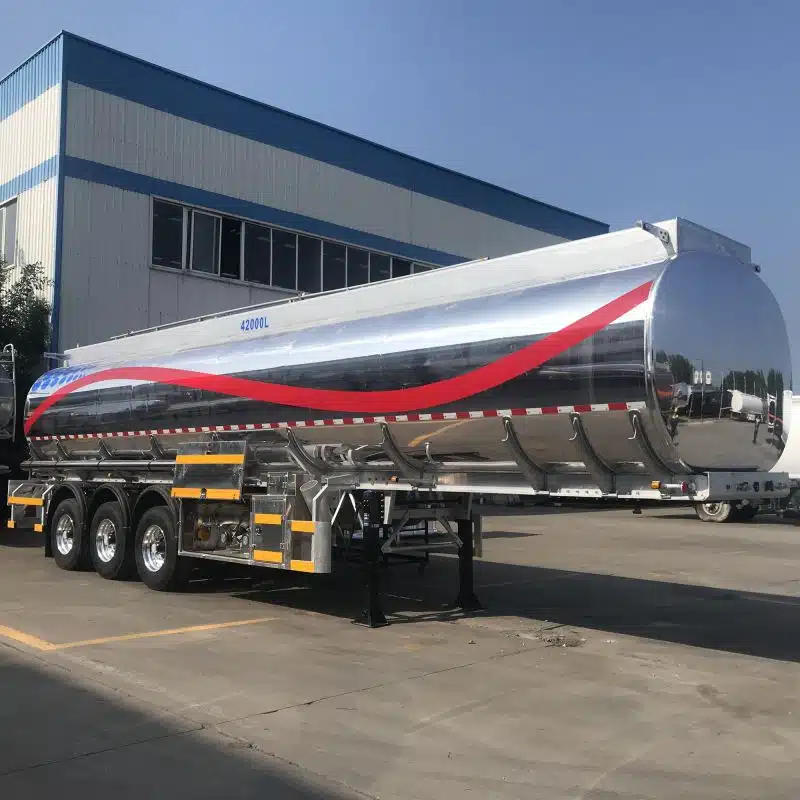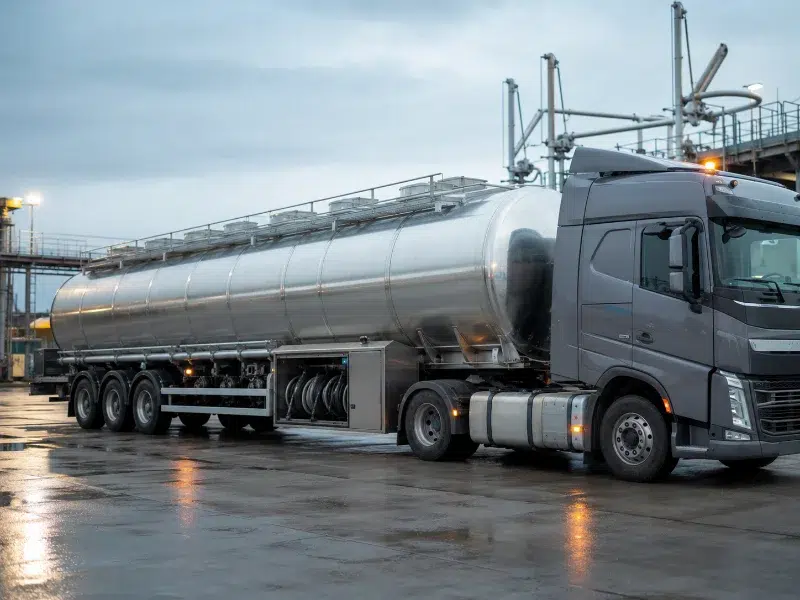
Un remolque cisterna es un semirremolque para combustibles refinados. Las especificaciones de los remolques cisterna se dividen en dos grupos: el material de la carcasa, el espesor de la pared y la posición de los mamparos se fijan en la certificación, mientras que la capacidad, el número de compartimentos y los accesorios permanecen configurables hasta que comienza la construcción. La entrada del producto en la Tabla de Materiales Peligrosos determina qué especificación de tanque de carga se aplica, no el nombre comercial del combustible. En la distribución de combustible en EE. UU., esa especificación suele ser la DOT 406, que no establece un volumen máximo de carga único. La capacidad de trabajo se deriva de la masa bruta combinada permitida de la ruta y la densidad del producto. La clasificación se cierra primero, porque la reclasificación de un tanque certificado está estrictamente controlada. La masa permitida se cierra a continuación: el volumen, el número de ejes y el material se derivan de ella.
| Dimensiones de especificación | Valor o variable rectora |
|---|---|
| banda MAWP | 2,65–4 psig (49 CFR 178.346-1(b)) |
| Carga al vacío | No permitido en esta especificación (49 CFR 178.346-1(c)) |
| Materiales de la concha | Aluminio, acero dulce, acero HSLA, acero inoxidable austenítico; el espesor mínimo varía según el material y la banda de capacidad nominal (49 CFR 178.346-2, Tablas I–II). |
| Espesor mínimo de la carcasa de aluminio | 0,160 pulgadas desde más de 4500 hasta 8000 galones de capacidad nominal; 0,173 pulgadas desde más de 8000 hasta 14000 galones (49 CFR 178.346-2, Tabla II) |
| Espacio máximo entre mamparos, deflectores o refuerzos anulares. | 60 en (49 CFR 178.346-2, Tabla II, nota 1) |
| Salidas inferiores | Válvulas de cierre que cumplen con 49 CFR 178.345-11 (49 CFR 173.242(b)(2)) |
| Número de compartimentos | Depende de los grados transportados por envío y de la secuencia de entrega. |
| Capacidad de trabajo | Depende de la masa bruta combinada permitida para la ruta y de la densidad del producto. |
Qué transporta un remolque cisterna de petróleo y qué reglamento establece los límites.
La autorización de tanques de carga para un cargamento determinado se realiza a través de la Tabla de Materiales Peligrosos en 49 CFR 172.101. Esa tabla nombra la sección de embalaje a granel que se aplica, y la sección enumera las especificaciones autorizadas del tanque. El nombre de envío adecuado, el número UN, el grupo de embalaje y los peligros subsidiarios determinan la ruta, por lo que la gasolina, el diésel, el queroseno, el combustible para aviones y petróleo crudo No compartas una respuesta automática.
| Sección de embalaje a granel mencionada en la entrada de HMT | Tanques de carga la sección autoriza | Consecuencia para el pedido |
|---|---|---|
| §173.241 (líquidos de bajo riesgo) | DOT 406, DOT 407, DOT 412, tanques de carga MC antiguos y ciertos tanques que no cumplen con las especificaciones. | La elección de las especificaciones está determinada por los demás cargamentos de la flota, ya que esta entrada por sí sola impone pocas restricciones. |
| §173.242 (líquidos de riesgo medio) | DOT 406, DOT 407, DOT 412, más MC 306, MC 307, MC 312, MC 330, MC 331 | El DOT 406 es la opción comercial habitual para la distribución de combustible por carretera que se realiza en esta ruta, y es una de las opciones autorizadas entre varias. |
| §173.243 (líquidos de alto riesgo, riesgos duales moderados) | DOT 407 y DOT 412 a una presión de diseño de al menos 25 psig, además de MC 304, MC 307, MC 310, MC 311, MC 312, MC 330, MC 331 | El DOT 406 no figura en esta lista, por lo que un cargamento que se dirija a esta ruta no puede viajar en un tanque DOT 406, independientemente de su nombre comercial. |
Especificación DOT 406 Establece una MAWP entre 2,65 y 4 psig y prohíbe la construcción con carga de vacío. La base de la especificación queda efectivamente fijada en la fabricación. Las reparaciones, alteraciones y actualizaciones de componentes están sujetas a un estricto control en 49 CFR 180.405, y ninguna de ellas permite automáticamente que un tanque se reclasifique en otra familia de especificaciones. Las unidades MC 306 antiguas siguen siendo legales en servicio solo mientras continúen cumpliendo con la misma norma.
Fuera de Estados Unidos, se aplica un régimen diferente. El ADR, el acuerdo europeo que regula el transporte por carretera de mercancías peligrosas, asigna códigos de tanque según la descripción de la sustancia; en otros lugares, rige una homologación nacional, y la autoridad de registro decide cuál. Confirme el régimen por escrito antes de la fabricación, ya que el certificado de fábrica debe coincidir con la información del registro.
Por qué la cifra de 9000 galones no es un límite de especificación
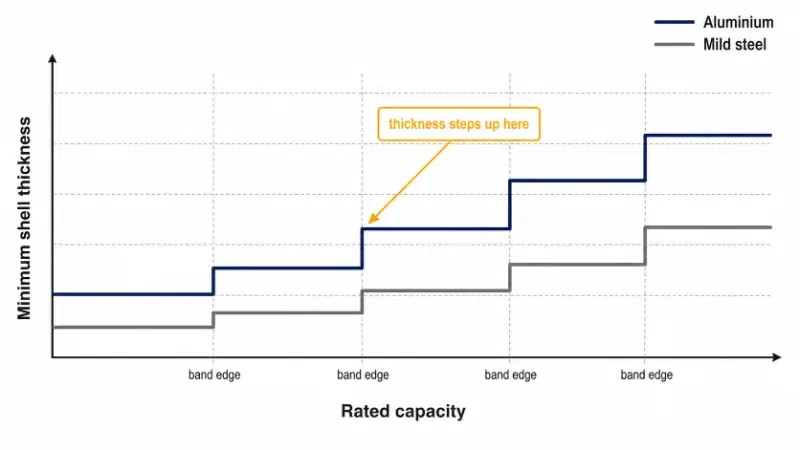
El techo de 9000 galones citado para los camiones cisterna de combustible de carretera proviene de la ley de peso y la densidad del producto; DOT 406 no prescribe un único volumen máximo de carga. En cambio, prescribe bandas de espesor mínimo de pared que aumentan a medida que aumenta la capacidad nominal. El metal sigue al volumen. En el aluminio, Tabla II de 49 CFR 178.346-2 Requiere 0,160 pulgadas de espesor de la carcasa hasta una capacidad nominal de 8000 galones y 0,173 pulgadas por encima de esa capacidad.
La capacidad práctica se ve limitada por esos rangos de espesor, junto con las interrupciones del servicio, la carga por eje, los límites de los puentes, las dimensiones de los vehículos y la normativa de peso específica de la ruta. Cualquiera de estos factores puede imponerse antes que los demás, por lo que una cifra de volumen resulta poco útil hasta que se especifique la restricción determinante.
Calcule el escalón de espesor antes de firmar un volumen. Cruzar el borde de la banda de 8000 galones aumenta la sección mínima de la carcasa en aproximadamente 8% en toda la carcasa, en un tanque que también gana área de superficie. Por lo tanto, el volumen especificado unos cientos de galones más allá de un borde de banda puede devolver una carga útil incremental menor de lo que sugiere el aumento nominal. El área de la carcasa adicional, el material más grueso, los accesorios adicionales y la distribución del eje entran en el cálculo de la tara. Verificar la capacidad nominal con respecto a los bordes de banda en las Tablas I y II antes de emitir un plano no cuesta nada; encontrar el escalón después significa fabricar una nueva carcasa. Verificamos esa posición de banda como parte de la emisión del plano, porque el lugar más barato para perder carga útil es una cifra de volumen elegida para redondez.
Capacidad de trabajo como resultado de la ley del peso y la densidad del producto.
La capacidad útil de un remolque cisterna de petróleo es el volumen que cabe dentro de la masa bruta combinada permitida, una vez restados la masa del tractor, la tara del remolque y la densidad del producto. Por lo tanto, un mismo depósito produce diferentes litros útiles para gasolina y para diésel. La relación se puede aproximar de la siguiente manera.
Volumen útil ≈ (masa bruta combinada permitida − masa del tractor − tara del remolque) ÷ densidad del producto
La capacidad de carga útil de 34 000 kg que se muestra aquí es una ilustración simplificada para un mercado operativo de mayor GCM y no representa una combinación estándar para el transporte interestatal en EE. UU.; utilice sus propias cifras. La gasolina, con una densidad de aproximadamente 0,75 kg/L, proporciona unos 45 300 L. El diésel, con una densidad de aproximadamente 0,84 kg/L, proporciona unos 40 500 L en el mismo tanque. La diferencia de casi 4800 L se debe a la densidad, no al equipo. Un tanque con capacidad para gasolina tiene un compartimento con menos capacidad para diésel. En el transporte interestatal en EE. UU., el límite de peso bruto se alcanza mucho antes, por lo que se solicita un tanque más pequeño o se transporta parcialmente lleno.
La aproximación supone un tanque lleno a su volumen nominal y un límite bruto que se activa primero, lo que convierte ambas cifras en litros en ejemplos prácticos basados en densidades publicadas y no en predicciones de rendimiento. La fórmula ignora la interrupción requerida por encima de la superficie del líquido y cualquier límite de ajuste eje por eje o fórmula de puente que se active antes, por lo que el resultado debe considerarse como un límite superior. Dimensiones generales del remolque Siga el mismo procedimiento a la inversa. Una vez fijado el volumen, los límites dimensionales de la ruta y el volumen por unidad de longitud de la sección transversal elegida definen el volumen máximo. El número de ejes se determina según cómo se debe distribuir esa masa. Confirme el permiso para la ruta prevista con la autoridad vial antes de fijar el volumen. A partir de ese momento, los tres elementos dejan de moverse simultáneamente. La selección del tractor y la autorización del peso de la ruta son procedimientos independientes que requieren sus propias aprobaciones, y ninguno se basa en un plano del tanque.
Material de la carcasa más allá del argumento de la carga útil
El material de la carcasa sacrifica capacidad de carga por resistencia a la corrosión y facilidad de reparación, y esta ponderación varía según la proximidad de la ruta a su límite de peso. La capacidad de reparación local influye aún más. Para una capacidad nominal superior a 8000 galones, la Tabla II exige 0,129 pulgadas de acero dulce frente a 0,173 pulgadas de aluminio, lo que supone aproximadamente 341 TP5T más de sección de pared para la construcción en aluminio.
El peso es la mitad de la historia. Si comparamos las cifras de grosor con los metales, la caja de carga útil parece más modesta que su presentación habitual. Con aluminio cerca de 2,70 g/cm³ y acero cerca de 7,85 g/cm³, la carcasa más gruesa en un remolque cisterna de aluminio Aun así, el peso aproximado es de 461 TP5T, equivalente al del acero dulce con la misma geometría. El ahorro se acerca más a la mitad que a los dos tercios que implicaría una simple comparación de densidad. La diferencia se reduce aún más al considerar los accesorios y el tren de rodaje.
Si sus rutas se encuentran muy por debajo de la masa bruta permitida con frecuentes saltos cortos, el sobreprecio del aluminio implica una carga útil que nunca utilizará, y una construcción en acero al carbono es la respuesta correcta y más económica. Cuando el producto ataca al aluminio, el acero inoxidable austenítico se convierte en la solución, manteniendo su propio espesor y precio en las mismas tablas.
Compartimentos, mamparos y deflectores contra la secuencia de caída
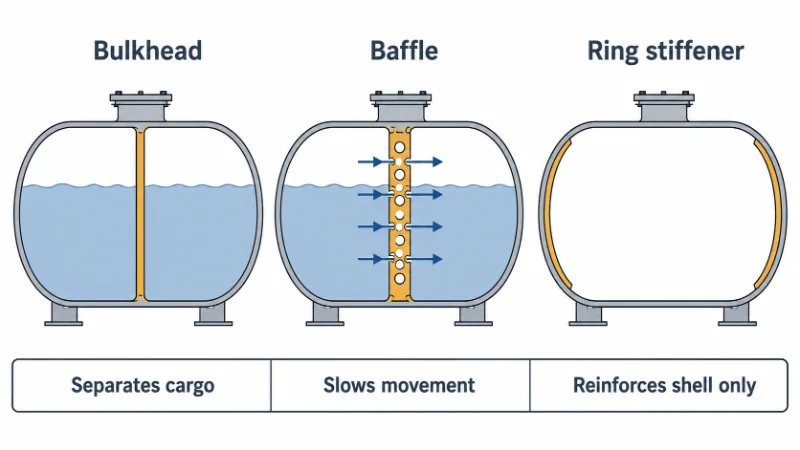
El número de compartimentos en un remolque cisterna de combustible depende de los tipos de combustible transportados por envío y de la secuencia de descarga. El refuerzo de la estructura se basa en la longitud del tanque, ya que la especificación limita la separación entre mamparos, deflectores y rigidizadores anulares a 60 pulgadas. Una estructura lo suficientemente larga como para requerir refuerzo a esa distancia lo soportará independientemente de que el diseño de los compartimentos sea amplio o reducido.
Lo que cambia con el diseño de compartimentos es la forma que adopta el refuerzo. Los mamparos crean compartimentos estancos. Los deflectores restringen el movimiento de líquidos sin separar la carga, por lo que los grados que no deben mezclarse deben ubicarse a ambos lados de un mamparo. Los refuerzos anulares refuerzan la estructura sin dividir el espacio de carga, por lo que un diseño de compartimentos más compacto aún puede cumplir con el requisito de separación. El ahorro derivado de un menor número de compartimentos se manifiesta en las tapas de acceso, las válvulas, las tuberías y el colector de recuperación de vapores, más que en el propio requisito de refuerzo.
Los límites de llenado por compartimento provienen de la regla de interrupción que se aplica al producto y jurisdicción, la cual se encuentra debajo del volumen de la placa de características. Confirme qué regla aplica la autoridad de registro antes de congelar los tamaños de los compartimentos. Comparamos el plan de compartimentos con el patrón de entrega que realiza la flota, ya que un plan que coincida con la lista de productos pero no con la orden de entrega obliga a reordenar las entregas o a realizar cargas parciales. En las unidades que operan en terminales polvorientas y con alta temperatura ambiente, con varias entregas por turno, los sellos de las tapas de los tanques y las válvulas de recuperación de vapores suelen ser los primeros accesorios que necesitan revisarse. Su conteo se deriva del plan de compartimentos.
Qué verificar antes de que el remolque salga del depósito.
La aceptación de un nuevo remolque cisterna de combustible depende del certificado del fabricante, la prueba y la inspección previas, y los accesorios de interfaz. La lista exacta varía según el mercado de matriculación y los puntos de carga. Pueden aplicarse inspecciones adicionales del vehículo, del sistema de medición y de la interfaz de la terminal.
- Certificado del fabricante y placa de especificaciones. El material, el espesor, la presión máxima de trabajo admisible (MAWP) y los datos de diseño deben coincidir con el plano que usted aprobó, ya que la placa es lo que lee un inspector al borde de la carretera.
- Pruebas y revisiones de referencia. Bajo 49 CFR 180.407, Las fechas de re-prueba se calculan a partir del intervalo especificado, tomando como referencia la inspección más reciente o la fecha de certificación; por lo tanto, obtenga esa fecha por escrito. Un tanque que haya estado fuera de servicio para materiales peligrosos durante un año o más debe someterse a una prueba de presión antes de volver a utilizarse.
- Conjunto de documentos para el registro en destino. Además del certificado del fabricante, las autoridades de registro suelen solicitar el plano del tanque, los registros de materiales y soldaduras, el informe de la prueba de presión o fugas, y los certificados de ejes y frenos. Confirme que se dispone de la documentación requerida antes del envío de la unidad y verifique que las marcas de especificación permanezcan legibles después del transporte.
- Certificado de aprobación del tanque donde rige un código de tanque ADR o una aprobación nacional, indicando el código que requiere la entrada de carga.
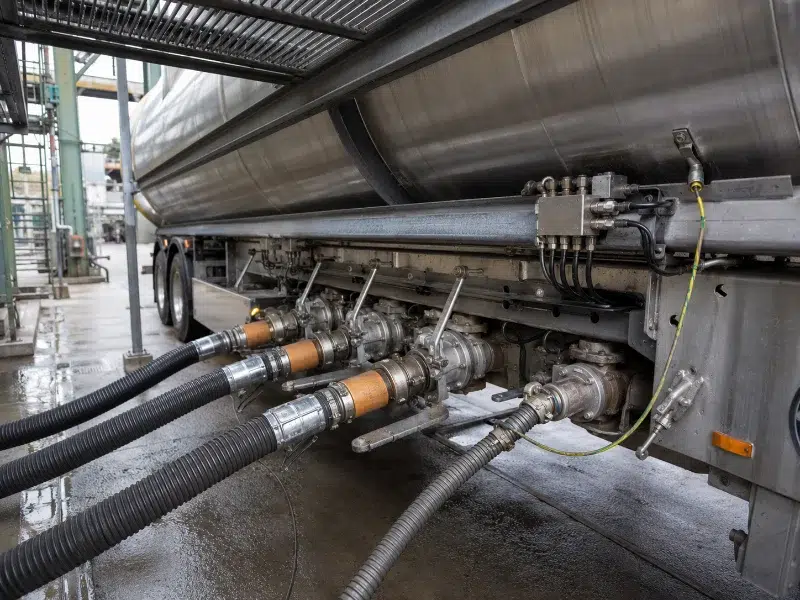
- Cargando comprobación de la interfaz. Disposición de la válvula de cierre de salida inferior, adaptadores de carga inferior y conexión de recuperación de vapor, adaptados al terminal donde se realiza la carga.
- Comprobación de apagado de emergencia, operado desde la posición desde la que un inspector lo probará.
¿Qué se cierra primero?: la clasificación, luego la masa permitida.
La clasificación y la masa bruta permitida son los dos primeros parámetros que se definen en un pedido de remolque cisterna para petróleo, y ambos deben coincidir antes de poder calcular el precio del resto. La clasificación se define primero, ya que la reclasificación entre familias de especificaciones está sujeta a un estricto control una vez que se certifica un tanque. La masa permitida se define a continuación, puesto que el volumen, el número de ejes y el material de la carcasa se derivan de ella, y si se modifica posteriormente, se modifican los tres parámetros.
Que una construcción supere su primer ciclo de inspección depende de detalles que solo los datos del proyecto pueden determinar: el estándar del adaptador de la terminal, la norma de interrupción que aplica la autoridad de registro y el entorno en el que se estaciona el tanque. Antes de cotizar, ajustamos el plano a la masa bruta permitida para su ruta, de modo que el volumen indicado en el pedido sea el que usted puede transportar legalmente.
Cinco decisiones mueven el precio más que el resto, y lo mueven en direcciones predecibles. El material de la carcasa y su banda de espesor establecen el costo del metal y la penalización por tara en conjunto. El número de compartimentos multiplica las tapas de los orificios de acceso, las válvulas de ventilación, las válvulas inferiores y el colector de recuperación de vapores, por lo que impulsa el costo más rápidamente que el volumen. El número de ejes y el tipo de suspensión se derivan de la masa permitida, y conllevan tanto el costo de compra como el de los neumáticos. El equipo de descarga se escala con el proceso de carga y descarga La flota incluye adaptadores, medidores, bombas y carretes de manguera. El proceso de certificación incrementa los costos y el tiempo de ejecución cuando se requiere un inspector registrado o la aprobación del mercado de destino.
El montaje depende de la perspectiva. Una flota que reemplaza unidades ya conoce sus rutas y patrones de entrega. Un importador que especifica para un mercado define primero el régimen de homologación. Un ingeniero que revisa las especificaciones de otra persona trabaja a partir de la placa de características.
Ninguna especificación de remolque para petróleo se completa sin los nueve elementos que se detallan a continuación, y cada uno de ellos influye en la estructura, el plano de compartimentos o el grupo de ejes. Los elementos del 1 al 3 son los que realizan la mayor parte del trabajo: definen la familia de especificaciones y el volumen, y el resto se ajusta dentro de ellos.
- Lista de productos con los grados transportados en un solo envío, y cuáles de ellos nunca deben compartir un compartimento.
- Entrada HMT o sección de embalaje a granel en la que se clasifican sus productos, donde se conoce
- Masa combinada bruta permitida para la ruta prevista, más los límites de ejes y puentes que se aplican dentro de ella.
- Marca y configuración del tractor, con masa en vacío.
- Registro del mercado y el régimen al que se aplica: número de especificación DOT, código de tanque ADR o aprobación nacional.
- Interfaz del terminal de carga: adaptador de carga inferior estándar, conexión de recuperación de vapor, sistema de medición.
- Patrón de caída: caídas por turno y volumen típico por caída
- Regla de interrupción que la autoridad aplica a sus productos
- Entorno de estacionamiento y carga, incluyendo si el tanque permanece cargado durante la noche, además de la capacidad disponible localmente para reparar el material de la carcasa elegido.
Si sus grados y masa permitida ya están definidos, compare esas dos cifras con una hoja de construcción. Petróleo Trailer Esta página contiene la tabla de configuración y los precios actuales correspondientes. Si la masa permitida para su ruta aún no está confirmada, confírmela primero con la autoridad vial, ya que el volumen y el número de ejes se transfieren conjuntamente.
PREGUNTAS FRECUENTES
Ambos términos describen la misma clase de equipo. La documentación de registro e inspección utiliza la designación de especificación, así que cítela al escribir a la autoridad competente.
No automáticamente. Un tanque DOT 406 puede estar autorizado para ciertas cargas de productos químicos si la entrada HMT clasifica el embalaje a granel según el §173.242 y se cumplen los requisitos de presión y compatibilidad de materiales. Cambiarle la marca a un tanque DOT 407 o DOT 412 es un asunto aparte con sus propios requisitos de diseño y pruebas.
Las obligaciones de recuperación de vapores se aplican a la terminal de carga y a la normativa local sobre emisiones, no al remolque. Confirme el requisito con el operador de la terminal y la autoridad medioambiental para cada punto de carga, ya que una misma flota puede tener obligaciones diferentes en distintas rutas.
Los plazos de validez según la norma 49 CFR 180.407 comienzan a contar desde la fecha de certificación, por lo que una unidad fabricada meses antes de su envío llega con parte de su plazo de validez ya transcurrido. Por lo tanto, dos unidades entregadas la misma semana pueden tener vencimientos en años diferentes.
Los cambios de producto dentro de un compartimento dependen de la compatibilidad de los residuos y de la capacidad de limpieza disponible entre cargas, además de lo que permita la entrada HMT aplicable para ambas cargas.
Publicaciones relacionadas
- Tamaños de remolques cisterna de combustible: Niveles de capacidad según el caso de uso. — toma la aritmética de capacidad anterior y la asigna a niveles de capacidad específicos según el caso de uso.
- ¿Cuáles son las características de seguridad de un remolque cisterna? — amplía los elementos de cierre de emergencia y válvula inferior de la lista de aceptación al paquete de seguridad completo.
- ¿Cómo funciona un remolque cisterna? — la cuestión previa que subyace a las decisiones sobre compartimentos y descargas que se tratan aquí
- ¿Cómo transportar materiales peligrosos en un remolque cisterna de combustible? — traslada la lógica de clasificación a las obligaciones de cumplimiento que se aplican en tránsito.
- ¿Cómo mantener un remolque cisterna de combustible? — ¿Qué sucede entre los intervalos de inspección establecidos en 49 CFR 180.407?