For road transport on flatbed and lowbed trailers, semi-automatic twist locks are the standard specification — they engage automatically under container weight and require a deliberate manual release, which functions as a built-in verification step before the container is freed. Fully automatic units are designed for terminal throughput, not highway vibration profiles. Manual locks place retention entirely on operator discipline at every cycle, making them the highest-risk option in regular road transport operations.
This guide is a procurement evaluation tool covering mechanism selection, installation verification, rejection criteria, and supplier documentation requirements. It applies to flatbed and lowbed road trailer configurations only — it does not cover marine container stacking, rail intermodal, or port-side securing systems, where load profiles and regulatory frameworks differ substantially.
Three decisions shape twist lock procurement for road trailers: mechanism type (semi-automatic vs. manual vs. fully automatic), mounting configuration (retractable vs. non-retractable), and supplier qualification (which documents confirm road transport suitability beyond ISO dimensional compliance). This guide addresses all three in sequence.
Semi-Automatic vs. Fully Automatic: Which Twist Lock Belongs on a Road Trailer?
Twist lock selection for road trailers depends on the loading environment, operator exposure risk, and whether manual intervention at the corner fitting is operationally acceptable. Three mechanism types are available in the market, each fitting a different duty profile. The number of twist lock positions per trailer follows directly from flatbed dimensions and the container length being carried.
- Manual twist locks require the operator to rotate the cone head by hand — before and after loading. They offer no automatic engagement and carry no cost premium, but in most operating contexts they also carry the highest operator-dependent risk in road transport — because retention depends entirely on operator discipline at every loading cycle.
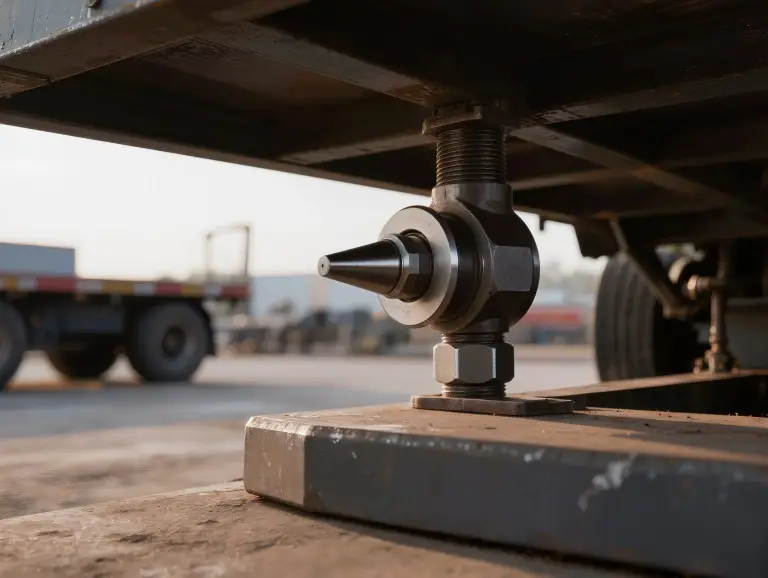
- Semi-automatic twist locks engage automatically when the container is lowered onto the trailer. The cone head rotates and locks under the container’s weight. Unlocking requires a manual handle release. This is the standard choice for most flatbed and lowbed road trailer applications.
- Fully automatic twist locks engage and disengage without manual intervention. They are designed for high-cycle environments such as container terminals. On road trailers, fully automatic mechanisms can introduce unintended release risk if the locking mechanism is not rated and verified for highway vibration profiles.
For procurement evaluation, the standard specification for flatbed and lowbed road trailers is semi-automatic.
The Misconception That Any ISO-Compatible Twist Lock Will Do
ISO corner fitting compatibility is a dimensional test, not a performance qualification — and this distinction creates real procurement risk that suppliers rarely volunteer. A twist lock that seats correctly in an ISO 1161-compliant corner casting has passed only one test: it fits. It has not been tested under road transport inertia loading, nor has it been validated for the specific cone geometry, locking mechanism type, or fatigue cycle demands of highway transport.
The misconception is commercially convenient for suppliers. A product described as “ISO-compatible” sounds compliant. Procurement evaluators who have encountered cargo displacement events caused by dimensionally correct but dynamically undersized twist locks recognize this distinction immediately — fitting and performing are not the same qualification. A twist lock specced for marine stacking — where loads are primarily vertical and static — can fail under the lateral and braking inertia forces common in road transport, even if it seats perfectly in the corner casting.
Three factors beyond dimensional fit must be evaluated for road transport suitability: the dynamic load rating under road-specific inertia profiles, the cone geometry’s compatibility with the container corner casting depth in service, and the locking mechanism’s resistance to vibration-induced release. None of these are confirmed by ISO 1161 dimensional compliance alone.
That gap between dimensional compliance and dynamic performance is where underspecified products most commonly enter service undetected — and it shapes the inspection and documentation requirements covered in every section that follows.
What Correct Installation Actually Looks Like — and What Creates Liability
Correct twist lock installation on a road trailer is verifiable at three checkpoints, each corresponding to a failure mode that creates cargo loss or legal exposure in heavy transport operations.
- Checkpoint 1 — Rotation angle confirmation. A fully locked semi-automatic twist lock has its cone head rotated 90° from the insertion position. Most units have a visual indicator line or color marker on the top of the cone. That indicator must be perpendicular to the container length axis after locking. If the rotation is incomplete, the container is not secured — it is resting on a partially engaged mechanism.
- Checkpoint 2 — Corner fitting clearance. The twist lock base plate must sit flush against the trailer deck. Any gap between the base plate and the deck surface indicates a mismatched profile or accumulated debris under the unit. A rocking base plate distributes load unevenly and accelerates fatigue cracking in the locking pin.
- Checkpoint 3 — Lock-state indicator confirmation. Before the vehicle moves, one more confirmation step is required at ground level. Reliable semi-automatic twist locks include a spring-loaded indicator pin or colored indicator window visible from ground level. Visual confirmation from the cab is not sufficient. After lowering the container, attempt to manually rotate each cone head — a fully locked semi-automatic unit resists hand rotation. If a cone head moves freely after container loading, that corner is unsecured. Container positioning before the locks engage is covered separately in the sequence for loading a flatbed.
Installation errors that create liability:
- Incomplete locking. The container loads the cone but rotation does not complete. The unit holds static weight but releases under braking inertia.
- Mismatched profiles. Using a twist lock with a cone geometry designed for a different corner casting depth. The cone seats at an incorrect angle and does not generate full retention force.
- Mixed non-paired units. Combining twist locks from different manufacturers or product generations on the same container. Retention force, release load, and wear characteristics differ between units; mixed sets cannot be inspected or certified as a matched system.
With over 20 years of manufacturing flatbed and lowbed trailers for buyers across more than 30 countries, Genron’s production team has found that incomplete rotation at Checkpoint 1 is the installation error most consistently linked to load shift incidents reported by operators in the field — a pattern that makes the three-checkpoint sequence non-negotiable rather than advisory.
Twist lock verification is one checkpoint within a broader load securement process that governs how every load leaves the yard. Whether a unit passes all three checkpoints depends partly on the product itself — which is where rejection criteria enter the evaluation.
Retractable vs. Non-Retractable: The Second Selection Dimension
Mechanism type — semi-automatic vs. manual — is the primary selection axis, but mounting configuration is the practical decision that follows immediately for flatbed and lowbed trailers.
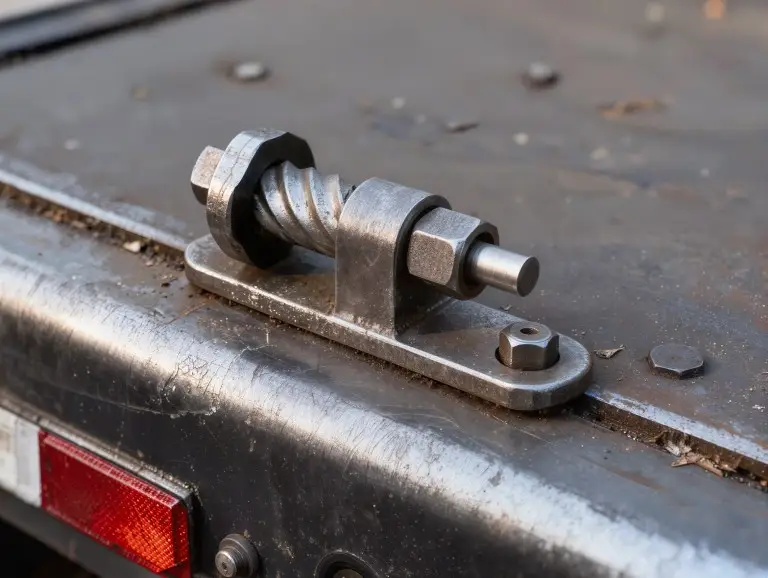
Non-retractable twist locks are permanently mounted above deck level. Their securing head remains in the raised position at all times. They are the simpler, more durable option for dedicated container trailers — trailers that carry ISO containers exclusively and do not need to accommodate general cargo between container loads.
Retractable twist locks fold below deck level when not in use, creating a flat loading surface. When container transport is required, the securing head is raised and locked into the operational position. The practical case for retractable units is trailer versatility: a flatbed that carries both containerized and non-containerized cargo can switch configurations without changing hardware.
The trade-off is mechanical complexity. Retractable units have more moving parts than non-retractable equivalents, which introduces additional inspection points and a higher maintenance frequency. For dedicated container routes — where the trailer will rarely or never carry general cargo — non-retractable units reduce maintenance burden without sacrificing function.
The retractable vs. non-retractable selection should be resolved at the specification stage, before purchase, because retrofitting twist locks to an existing trailer frame requires structural re-engineering of load distribution points — a cost-intensive modification that purpose-built trailers avoid entirely. Buyers running dedicated container routes often reach this question from the opposite direction — starting with whether a skeleton trailer removes the decision entirely.
Inspection Rejection Standards: When a Twist Lock Must Be Replaced
A twist lock must be removed from service when any of the following conditions are present, regardless of operational schedule or replacement lead time.
| Rejection Criterion | Observable Indicator | Risk If Continued |
|---|---|---|
| Visible cracking | Any crack in the cone head, shaft, or base plate | Sudden fracture under load |
| Cone head wear | A measurable loss of shoulder depth — typically a tenth or more of the nominal dimension, though the applicable rejection threshold must be confirmed against the specific product specification in service | Loss of retention force under dynamic load |
| Locking mechanism failure | Cone rotates freely in locked position; indicator pin does not return to locked state | Container not secured; zero retention force |
| Base plate deformation | Bent or warped base plate that prevents flush deck contact | Uneven load distribution; fatigue cracking |
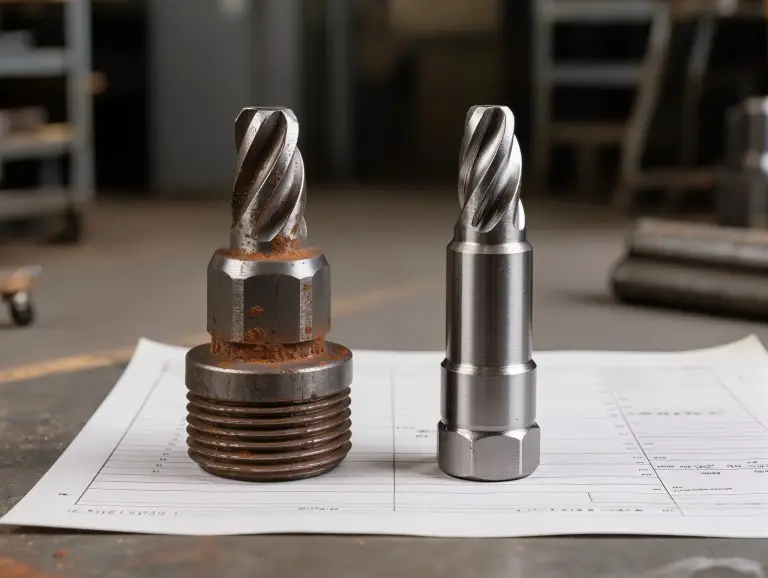
| Corrosion beyond surface level | Rust penetrating base material, visible pitting on cone shaft | Unpredictable fracture load |
| Missing or non-functional indicator | Indicator pin absent or jammed | Lock state unverifiable; inspection impossible |
When in doubt, replace. The cost of a twist lock is not comparable to the liability of a cargo displacement event in transit.
Rejection standards define when a unit must leave service. The documentation framework that follows defines what suppliers must prove before a unit enters service.
What Compliance Documents to Demand from a Chinese Trailer Manufacturer
Evaluating a Chinese trailer manufacturer’s twist lock supply starts with knowing which documents to demand — and why each one targets a different gap that dimensional compatibility leaves open. This guide covers twist lock selection for flatbed and lowbed configurations — container chassis selection follows a different specification path.
| Document Type | What It Verifies | Why It Matters |
|---|---|---|
| Third-party load test report | Static and dynamic load rating under rated test conditions | Confirms product performs under road transport forces, not just static load |
| Material traceability certificate | Steel grade and heat treatment records for cone head and locking pin | Identifies substituted or downgraded materials not visible on inspection |
| ISO 1161 dimensional compliance record | Corner fitting engagement geometry | Confirms fit — necessary but not sufficient alone |
| Fatigue cycle test report | Number of lock/unlock cycles tested without failure | Determines service life expectation under your operational cycle frequency |
| Surface treatment specification | Coating type, thickness, and salt-spray test results | Predicts corrosion performance in humid or coastal operating environments |
| Quality management system certificate | ISO 9001 or equivalent — confirms consistent manufacturing process | Reduces batch-to-batch variation risk |
The most consistently absent document across procurement evaluations is the dynamic load test report. Suppliers frequently provide static load ratings — which reflect port stacking performance — without independent testing of road-specific inertia loading. Request a third-party dynamic load test report, a material traceability certificate, and a fatigue cycle test report as the minimum set. Verify that the issuing test body is an accredited third-party laboratory — not the manufacturer’s own internal test facility.
Conclusion
For flatbed and lowbed road trailers, semi-automatic twist locks are the appropriate standard type, and ISO dimensional compatibility is a starting point, not a qualification. The documentation gap — specifically the absence of dynamic load test reports — is where road-unsuitable products most commonly enter service undetected. Requiring dynamic load test reports, material traceability records, and fatigue cycle data before purchase is the most reliable way to identify underspecified products at the qualification stage rather than after a transit incident.
At Genron, our specification process for flatbed and lowbed trailers built at our Qingdao production base applies this same documentation standard to every twist lock component we source. If you are evaluating a trailer configuration for container transport — or reviewing the twist lock specification on an existing unit — our technical team is available to walk through the documentation checklist and help you identify any gaps before purchase commitment.
FAQ
Retrofitting is structurally complex. Twist locks transfer the full container load through four corner points, so the trailer frame must be engineered for that load path from the start. Adding locks to an existing trailer requires structural assessment and potential frame reinforcement — cost and feasibility vary by trailer design. Specifying twist locks at the build stage is significantly more straightforward.
Because the dimensional fit to ISO 1161 corner castings is identical — the products look interchangeable. Marine-grade units are rated for vertical static loads, not road transport inertia. Always request a dynamic load test report specific to road transport conditions; a static-only rating does not confirm road suitability.
Mixed units differ in retention force, release load, and wear rate. A set of mixed units cannot be inspected or certified as a matched system — passing one unit does not validate the others. Use the same manufacturer and product batch across all four corner positions.
Check that the report is issued by an accredited third-party laboratory — not the manufacturer’s own internal test facility. The report should specify test conditions, load values, and the number of cycles tested. Reports without test methodology details or issued solely by the manufacturer should be treated as unverified.
Inspect before every load — check rotation angle, indicator pin state, and base plate flush contact. Conduct a more detailed inspection for wear, cracking, and corrosion at regular service intervals as defined by the manufacturer’s maintenance schedule. Any unit that fails a pre-load check must be removed from service immediately, regardless of service interval timing.