Dump trailer capacity has two separate measures: the volume of the body, and the payload the specific vehicle combination may carry under its ratings and the road limits on its routes. For any given material, the planning figure is the smaller of the two. Dense material such as gravel or wet sand reaches the weight limit with space still left in the body. Light material such as loose topsoil fills the body before the payload runs out. Volume follows from internal dimensions; allowable payload has to be established for the actual tractor and trailer.
What Dump Trailer Capacity Measures: Volume Versus Payload
Dump trailer capacity covers two independent limits on every tipping trailer: the internal volume of the body, and the payload allowed for the complete vehicle combination, with the binding limit set by the bulk density of the material loaded.
Volume comes out of geometry alone. Internal length, width and sidewall height give a figure in cubic yards or cubic metres, and nothing in that figure knows what is going into the body. Volume is blind to weight.
Payload is a longer chain, and one step is commonly skipped. Start from the manufacturer’s rated laden mass and the unladen mass of the exact configuration; the difference is the rated payload. Then work outward to the towing vehicle, coupling, tyres, axle-load distribution and the limits on the intended routes. On a semi-trailer the tractor carries part of the load through the kingpin, so trailer axle ratings alone do not establish the allowable payload.
Most disagreements between buyer and supplier come from treating those two chains as one number. A supplier describing a 30-cubic-metre body and a buyer hearing “30 tonnes a trip” are talking about unrelated constraints. Ask for volume, rated laden mass, as-equipped unladen mass and axle ratings on the same build sheet, and the ambiguity resolves in one document.
Calculating Body Volume, and Which “Full” the Number Refers To
Body volume for a rectangular tipping body is internal length times width times sidewall height, divided by 27 for cubic yards or read directly in metres for cubic metres, with tapered and half-round bodies calculated from actual internal geometry instead.
A 14-foot by 7-foot body with 2-foot sides works out at 196 cubic feet, or about 7.26 cubic yards. An 8.0-metre by 2.4-metre body with 1.5-metre sides comes to 28.8 cubic metres, which is about 37.7 cubic yards at 1.308 cubic yards per cubic metre. The same calculation covers small dump trailers and heavy tipping semi-trailers alike, though their weight ratings and road limits have to be checked separately.
One common claim about proportions is worth correcting. Increasing internal length, width or height by the same percentage increases volume by the same percentage. Sidewall height gets the attention because that is where the large percentage changes live. Adding a foot to a 2-foot wall is a 50 per cent change; adding a foot to a 14-foot body is around 7 per cent.
Two different things get published as “capacity,” and they belong to different categories. Struck and heaped are measurement states of the same body. Sideboard extensions change the body itself, after which struck and heaped both apply again to the enlarged volume. State which of these a quoted figure refers to before comparing it with anything.
A heaped rating should identify its calculation method or assumed heap profile. It does not guarantee the quantity retained in transport: moisture, grading, cohesion and road vibration all change the load profile, while containment, clearance and mass limits still apply.
Why Rated Volume Is Rarely the Load You Carry
Material bulk density decides which of the two limits binds first, and every body has a density above which weight runs out before space does.
The crossover is worth calculating once, because it belongs to your trailer rather than to the material. Divide the allowable payload by the usable body volume and the result is the break-even bulk density. Take a hypothetical combination with an allowable payload already verified at 40 tonnes, on a body with 30 cubic metres of usable volume. Divide 40,000 by 30 and the break-even lands at roughly 1,330 kg per cubic metre. Above that density the body fills only partly before the weight limit arrives. Below it, the body fills first and the remaining payload goes unused.

Run your own numbers through the same division: allowable payload in kilograms divided by usable body volume in cubic metres equals the density at which your trailer switches from volume-limited to weight-limited.
For planning a specific load, take the smaller of two figures: the usable body volume, and the allowable payload divided by the material’s as-loaded bulk density. Bulk density here means the material as it sits in the body, which is a different value from the density of the solid particles.
| Material | lb/yd³ | Approx. kg/m³ | Illustrative volume at 40 t (m³) | Main variables |
|---|---|---|---|---|
| Topsoil (loose) | 2,050 | 1,216 | 32.9 | moisture, organic content |
| Limestone (crushed) | 2,565 | 1,522 | 26.3 | gradation, source quarry |
| Crushed stone (average) | 2,700 | 1,602 | 25.0 | stone type, particle size |
| Sand (dry) | 2,750 | 1,632 | 24.5 | grain size, residual moisture |
| Sand (wet) | 3,300 | 1,958 | 20.4 | free water held between grains |
| Gravel (wet) 3/4″ | 3,375 | 2,002 | 20.0 | rainfall, drainage before loading |
Pounds per cubic yard from a cubic yardage chart compiled from EPA and NTEA figures. Metric conversions and the 40-tonne column are calculated here from an illustrative payload figure; they are planning estimates, not loading authorisations. Demolition rubble is excluded. Use a measured loose bulk density for the actual material, and verify gross and axle masses for the specific combination before operating.
We compare an allowable payload against the density range of the dominant material before quoting a body volume, because the two rarely point at the same trailer. Take a volume off a brochure without checking which material it was sized against, and one of two outcomes follows. A body too large for dense material reaches its weight limit only partly filled. A body too small for low-density material fills up with payload left unused. Correcting either afterwards means a sidewall or body change.
The Legal Ceiling Above the Body: Axle, Combination and Bridge Limits
Legal mass limits set the upper bound on what a tipping trailer may carry on a public road, and the governing figures come from every jurisdiction and route the combination will operate on.
South Africa shows how the ceilings interact. The National Road Traffic Regulations, 2000, made under Act 93 of 1996, govern axle massloads, axle unit massloads, vehicle mass and combination mass on South African public roads. Regulation 237 sets a general maximum combination mass of 56,000 kg. Read that as a ceiling on the whole combination. The permissible mass for a particular combination is the lowest of several limits, and often sits well below it.

Three of those limits deserve attention at specification stage. Permissible axle massload and permissible axle unit massload are separate provisions, so individual axle ratings cannot simply be added up to establish road capacity. Bridge-loading requirements tie the allowance to the spread between axle groups, which makes wheelbase part of the capacity question. Power-to-mass and drive-axle ratios can cap the combination lower again, depending on the tractor. Confirm the current figures with the road traffic authority for each intended operating jurisdiction and route before fixing a body size.
One weight relationship follows from all of this and cuts against buying volume for its own sake. At an unchanged permissible gross mass, every kilogram of unladen mass reduces the mass available for cargo. Steel is paid for in payload: taller sidewalls, a longer body, a heavier floor. Whether the extra volume is usable at all depends on whether the material is light enough to fill it before the mass ceiling arrives.
How Discharge Type Changes the Capacity Question
Discharge method changes body geometry, unladen mass and the ground conditions a trailer can unload on, so the type carrying most on paper is not always the one completing the most trips.
Small bumper-pull dump trailers sit outside this comparison. Coupling type puts them in a different weight class, and the tow vehicle’s rating usually settles their capacity question before body volume does. The three heavy dump trailer types below compete for the same work.
| Type | How it discharges | What usually binds first | Suited to | Where it stops being the right choice |
|---|---|---|---|---|
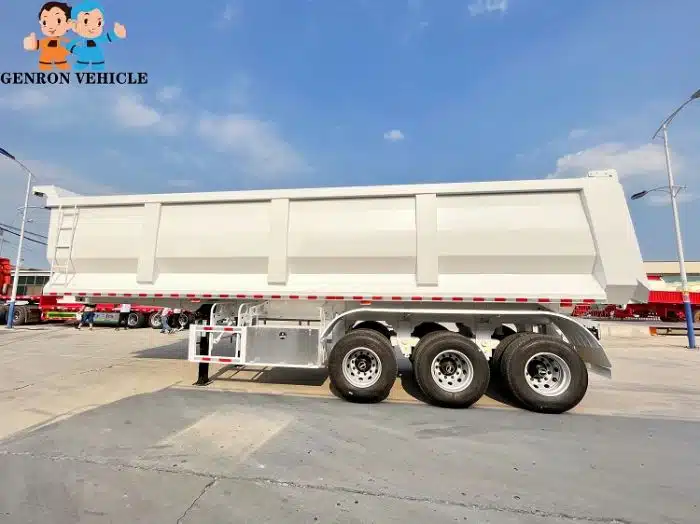
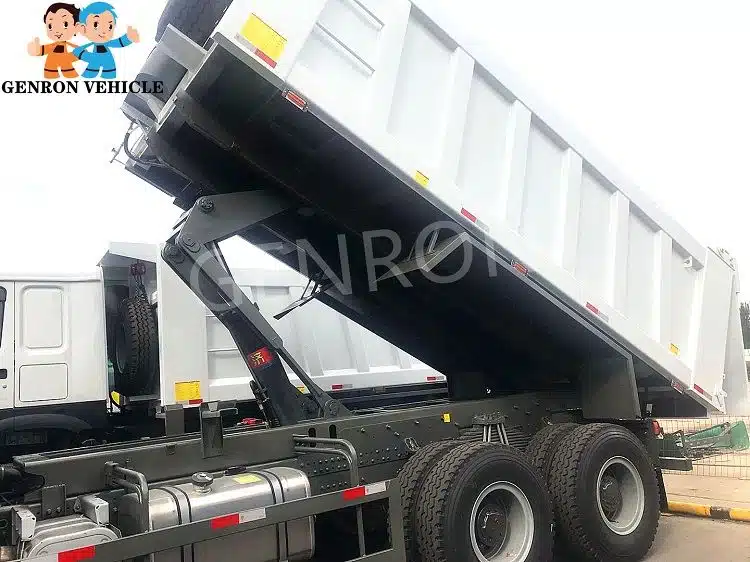
| Rear (end) dump semi-trailer | Body pivots at the rear and tips vertically | Payload on aggregate, volume on light spoil | Quarry to plant, road base, bulk earthmoving | Low overhead clearance, or soft or cross-sloped discharge ground |
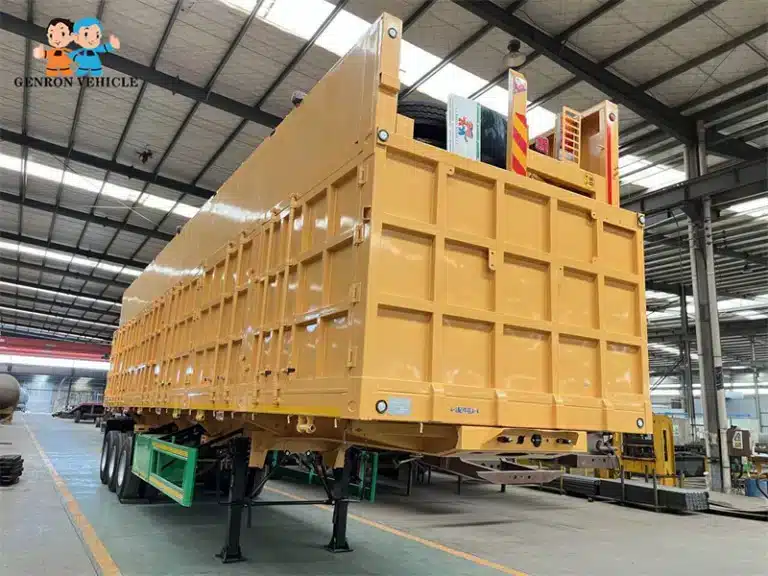
| Side tipper semi-trailer | Body rotates sideways without full-height lift | Payload, plus bearing capacity on the tipping side | Roadside spreading and lateral discharge where side clearance and ground are adequate | Deep-pit tipping, or sites without room alongside |
| Belly (bottom) dump semi-trailer | Gates open through the floor while the unit moves | Payload, and gate clearance under the hopper | Laying windrows of free-flowing aggregate | Sticky, cohesive or oversized material that bridges the gates |
Side tipping does not remove the need to check ground stability, lateral clearance and overhead hazards before discharge. A rear dump at full tip height raises its own centre of gravity, which makes ground flatness part of its operating envelope. Ground conditions decide that one. Sizing figures settle what goes into the body. Whether a raised body is stable on the ground you discharge on is a separate check, made at each site. Neither question shows up in a cubic-metre number.

Where operations alternate between wet-season and dry-season material from the same pit, the loaded-height mark on the body is usually the first thing needing a recheck. The same volume changes mass with moisture.
Sizing to the Job: Which Variable to Lock First
Sizing starts from the two variables fixed outside the purchase, the allowable payload for the actual combination on its intended routes and the bulk density range of the materials hauled, because body volume and sidewall height follow from them.
Payload and density have to converge together rather than resolve in sequence. Lock those two first, for two reasons: both feed the body decision, and neither is under your control once the trailer is built. Sidewall height and floor plate thickness are physical decisions of the same kind, easy to revise on a drawing and expensive to revise on a welded body. Get those two right and the rest of the specification is arithmetic.
Material properties and discharge-site constraints belong in the same early round. Floor specification, discharge type, tailgate arrangement and tipping gear all affect either unladen mass or unloading performance, so they belong alongside volume and payload rather than in a later round of options.
One case argues against a semi-trailer entirely. For short on-site hauls where material moves a few hundred metres, loading and discharge time dominates the cycle rather than travel. That is exactly where a large payload stops paying for itself. Compare a rigid tipper, an existing fleet unit and a new semi-trailer on your own loading, travel and discharge cycle before assuming that more payload lowers cost per tonne.
Before signing, request a build sheet for the exact configuration: rated laden mass, as-equipped unladen mass, axle ratings, internal body dimensions and the stated volume basis. For a semi-trailer, ask as well for a tractor-specific load-distribution assessment, and verify the limits on the routes you intend to run.
Settling Volume and Payload Before the Body Is Built
Dump trailer capacity comes down to which of two ceilings arrives first, and the crossover belongs to your own equipment rather than to the material. Establish the allowable payload for the actual combination on its intended routes, divide it by the usable body volume, and you have the density at which your trailer changes behaviour. Sidewall height, floor plate and tailgate type all follow from that figure.
Where a fleet handles several materials, compare them by trip frequency and operating requirement rather than sizing for the densest one by default. Larger bodies improve utilisation on low-density loads; dense loads then travel partly filled to stay within gross and axle limits. We compare axle, combination and bridge limits for the intended routes against the body volume before confirming a build sheet. Final confirmation of road-legal mass rests with the operator and the route.
If the materials you haul sit above your break-even density, size the body from payload divided by density and treat the published volume as a check figure. If they sit below it, specify against volume, and a taller sidewall earns the unladen mass it costs. Either way, bring your allowable payload, your material density range and your route limits into the conversation; our end dump trailers are configured from those three inputs.
FAQ
Sidewall height decides it. The same 14 by 7 footprint gives about 7.3 cubic yards with 24-inch sides and about 14.5 with 48-inch sides, which is why two sellers quote different numbers for what looks like the same trailer. Weight rating stays where it is.
Ask before you calculate. A short ton is 2,000 lb and a tonne is 1,000 kg, a difference of about 10 per cent. Spec sheets written for North American and for African or Southeast Asian markets often use different ones without labelling them, and that gap is wide enough to change an axle calculation.
Not as a guarantee of delivered quantity. Name the measurement state in the contract, and settle mass-based work on weighbridge tickets rather than on any catalogue figure.
Not by itself. Cylinder size sets what the body can lift and at what angle, not the certified weight ratings or the legal road payload. A load that is legal to transport is not automatically safe to tip.
Three triggers are worth watching: any change of quarry or borrow pit, any drift in weighbridge tickets against the same fill line, and the first loads after a seasonal change in stockpile moisture. Each shifts bulk density without changing anything visible in the body.
Related Posts
- How Does an End Dump Trailer Work? — the mechanism behind how discharge type changes body geometry and unladen mass.
- What Is the Weight Capacity of an End Dump Trailer? — takes the cross-type judgement here down to tonnage on a single model.
- What Size Is a Side Dump Trailer? — the dimension ranges behind the side tipper row in the discharge table.
- How to Load an End Dump Trailer? — the loading and axle-distribution practice this article deliberately leaves out.
- What Materials Can Be Transported Using an End Dump Trailer? — the material side of the density table above.