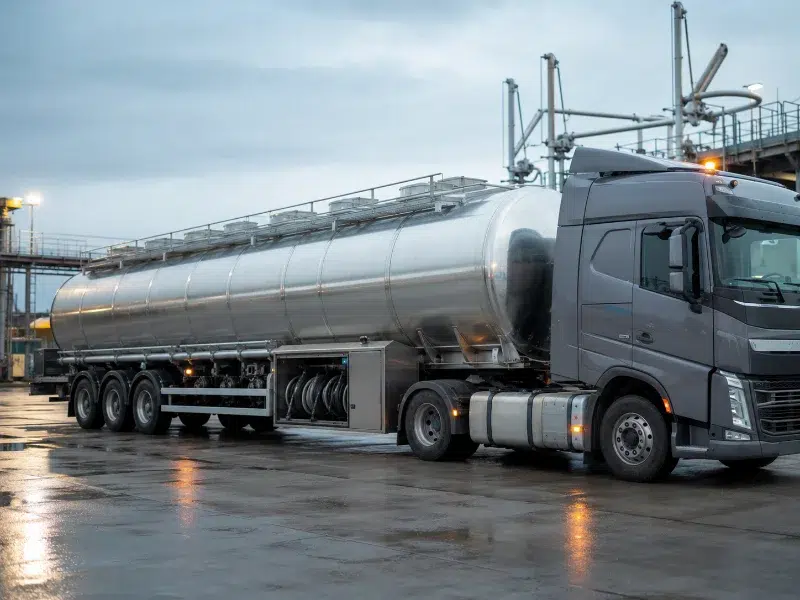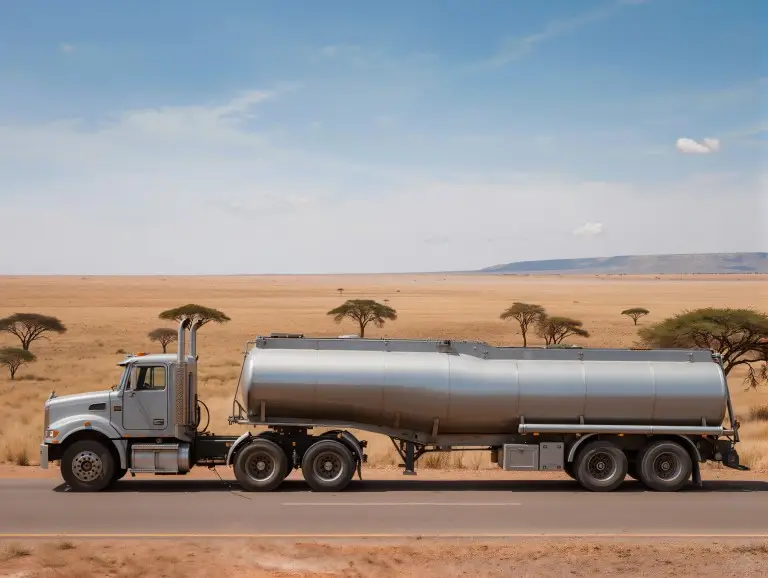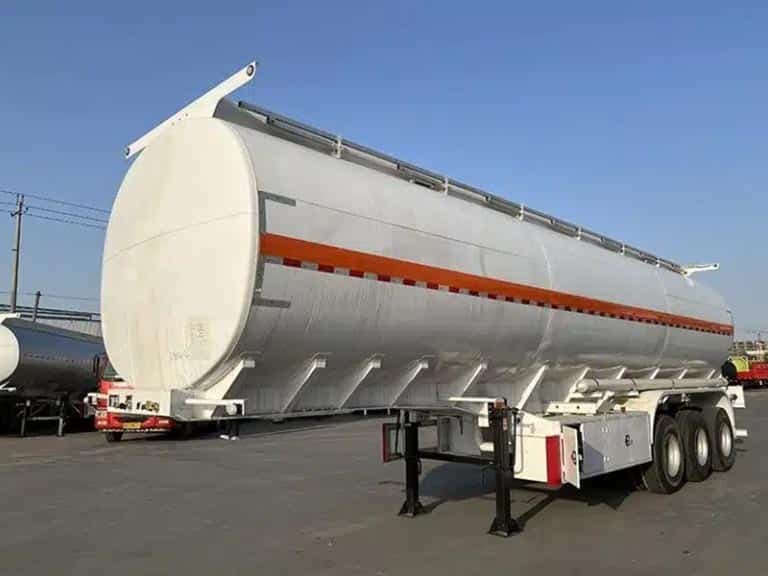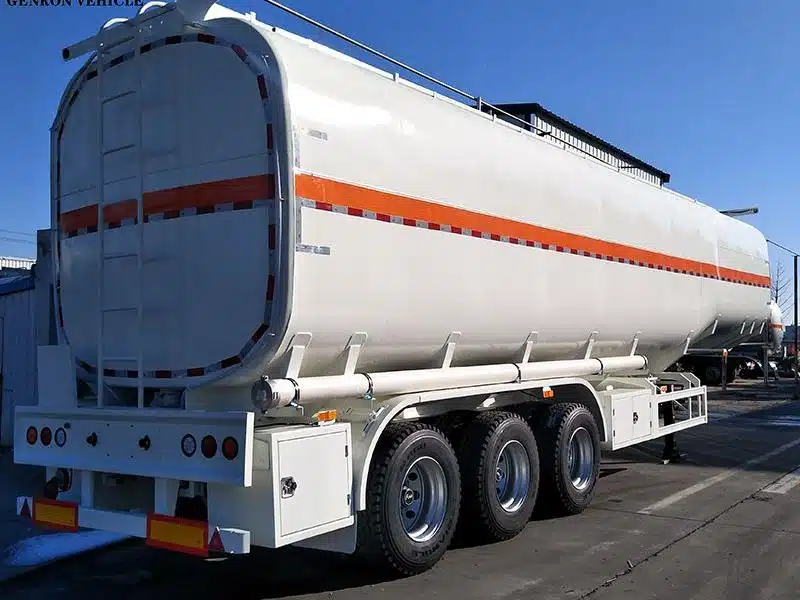
A fuel tanker trailer is a semi-trailer built around one or more permanently mounted cargo tanks for hauling gasoline, diesel and jet fuel in bulk. The specification it must be built to depends on the product’s shipping description and on the rules of the operating market. How much of that tank can legally be delivered is a second question. The answer is the lower of two numbers: the tank’s filling limit, and the vehicle’s legal gross, axle and bridge weights. Compartment count, material and loading hardware then follow from the products carried and the drop sizes on the route. Volume settles last.
What Counts as a Fuel Tanker Trailer?
A fuel tanker trailer is identified, for regulatory purposes, by the cargo tank specification it is built and marked to, and which specification applies depends on the product’s proper shipping description rather than its commercial name. Certification establishes what the tank may legally carry; it does not define the commercial term.
In United States service, the Hazardous Materials Table routes a product to its authorized specification through the proper shipping name, identification number, hazard class, packing group and bulk packaging reference. Special provisions can modify that result. Diesel shows why a trade name settles nothing on its own. Whether it moves as a Class 3 flammable liquid or as a combustible liquid turns on flash point and the conditions of carriage.
Specification DOT 406 covers most North American refined-fuel trailers, at a maximum allowable working pressure between 2.65 and 4 psig for flammable and combustible liquids. It permits several steels alongside aluminum, and it does not mandate an elliptical cross-section. The 5454-series aluminum shell, elliptical section and bottom-loading hardware familiar from that market are commercial conventions, not conditions of the specification. DOT 407 and DOT 412 carry higher pressure ratings and go with chemical and corrosive service.
| Market | Governing framework | Confirm before drawings are issued |
|---|---|---|
| United States | Specification cargo tanks under 49 CFR Part 178, Subpart J, selected via the Hazardous Materials Table | Shipping description, bulk packaging reference, special provisions |
| Canada | TC highway tanks under the standards referenced by the dangerous goods requirements, including CSA B620 and CSA B621 | Applicable TC tank specification, facility registration |
| ADR Contracting Parties and markets referencing ADR | ADR tank codes plus national requirements | Tank code, national approval, competent authority conditions |
Because the specification comes from what the trailer will carry, a late change to the product list wrecks work that a late change to volume leaves standing. Adding a second product is therefore a bigger event than adding a thousand gallons, even though volume is the number most buyers negotiate first. We check the shipping description and the governing framework against the buyer’s product list before releasing tank drawings, since that pair fixes the geometry and not the other way round.
This page stops at which framework applies and why. Plate thickness, valve arrangements and requalification parameters belong with the petroleum trailer specifications.

Main Parts of a Fuel Tanker Trailer and What Each One Fixes
A petroleum trailer is built from five groups of parts whose sizing depends on the products carried and the loading points served: the tank shell, the internal divisions, the top hardware, the discharge arrangement and the running gear.
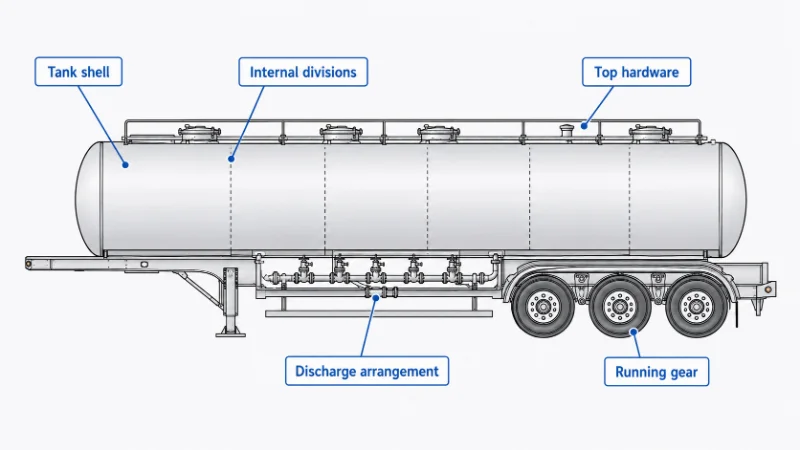
The shell sets material, thickness and tare weight, and with them the repair capability an operator needs in the market where the trailer works. Internal divisions decide how many products travel at once and how much the liquid moves in transit. Top hardware covers the manholes, fill covers and vapor connections, together with the rollover protection and the rest of the tanker’s safety features. Underneath sit the internal valve at each compartment outlet, the discharge piping, and the adapter that has to mate with the loading rack or the receiving tank. Running gear is sized against the weight the tank may legally carry, not the volume it holds.
Two Assumptions That Cost Fuel Tanker Buyers Money
Baffles and bulkheads solve different problems inside the tank, and rated volume is not deliverable payload; which confusion costs more depends on whether the operation runs one product or several.
A bulkhead is a liquid-tight transverse division that creates a separate cargo compartment. A baffle is a non-liquid-tight transverse partition, commonly perforated, that slows liquid movement inside a compartment without separating cargo. A heavily baffled single-compartment tank still hauls one product at a time. No number of baffles changes that.
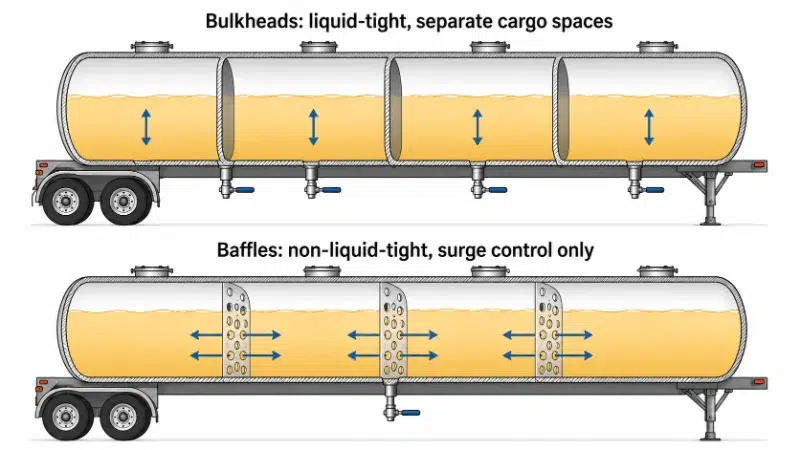
Part-filled compartments leave room for the liquid to move. What that produces is slosh and surge, and a loss of directional stability during braking, cornering and evasive maneuvers. It does not produce faster wear on seals or valve seats.
The second assumption is the expensive one. Volume describes the tank; mass is the legal limit, and the two line up only by coincidence.
How Much a Fuel Tanker Trailer Can Legally Deliver
Deliverable quantity is the lowest of four ceilings: the maximum payload marked on the specification plate, the legal gross weight for the route, the axle and bridge limits along it, and the volume that survives required outage and product fill limits.
Work them in that order. The specification plate states a maximum payload, and that figure caps the load whatever the volume suggests. Route weight comes next. On the United States Interstate System the federal limits run 80,000 lb gross, 20,000 lb on a single axle and 34,000 lb on a tandem. The Bridge Formula governs axle spacing on top of those. Other jurisdictions publish their own figures, and those have to be read for the actual route. Outage follows. Regulations require part of the tank to stay empty, commonly at least one percent for liquids that are not poisonous by inhalation, and product-specific fill limits apply on top. Only then does density convert the surviving mass allowance into a volume.
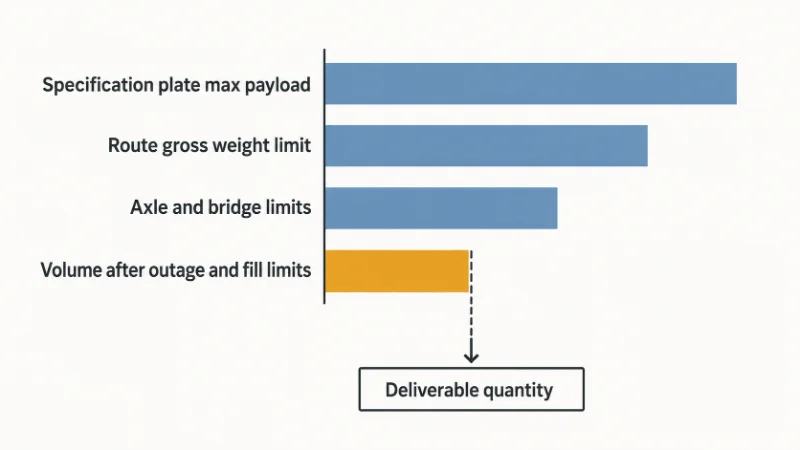
Run in that sequence, the arithmetic explains a result that usually gets blamed on manufacturing. Diesel is denser than gasoline, so a tank sized to hit the weight ceiling in gasoline service hits the same ceiling on less volume when it carries diesel. The unreachable top of the tank does not disappear; it keeps contributing its share of tare on every trip, loaded or empty. A trailer specified against a round capacity figure instead of the dominant product’s density hauls metal it can never legally fill. We compare the dominant product and the route’s weight limits against the volume a buyer asks for, because the two frequently point at different tanks.
Standard capacity tiers and overall dimensions vary by market, and they are worth checking against a dimensions reference instead of inferring them from a nominal volume figure.

What Each Extra Compartment on a Fuel Tanker Trailer Costs
Compartment count follows the delivery pattern rather than the number of fuel grades alone, since drop sizes, unloading sequence, axle load distribution and retained product all move the answer.
Each liquid-tight compartment typically requires its own fill, venting, internal valve and discharge arrangement, plus its own inspection interfaces. All of that is tare, and tare comes out of the same mass ceiling that caps the load. Flexibility bought at specification time gets paid for on every load, used or not. On a route that drops one product per trip, it never converts into revenue at all.
Multi-compartment layouts earn their weight where a single run delivers several grades, or where one trip serves stations with different orders. The sizing test is whether each compartment matches a drop the route actually makes; a compartment that never runs full carries its own hardware for nothing. Set compartment sizes from a round total volume instead of from real drop sizes, and the trailer runs part-filled most of the week. Drivers train to manage that condition, which makes it more than an efficiency loss.
On a used trailer, confirm compartment count from the specification plate, the tank data report and the piping arrangement together. Counting outlets alone can mislead, because fill, vent and discharge fittings do not map one-to-one across designs.
Which Variables to Confirm First
On a fuel tanker trailer order, two variables settle before all others: the authorized cargo tank specification for the products carried, and the governing weight limits on the dominant route. The first is fixed at manufacture; the second sets the ceiling that volume, compartment count and axle configuration all work beneath. Of everything on the order sheet, those two are the only entries that cannot be walked back.
After them the order runs: compartment layout, loading interface, material and thickness, then axle and suspension configuration for the destination market. Later changes to valves, outlets or load-retaining components can amount to a regulated modification rather than a parts swap, so they are cheaper to get right on the drawing.
Material sits below both. Aluminum tanker trailers in the 5454 series are the common choice in North American refined-fuel service because lower tare preserves payload under a fixed weight limit. The specification permits steels too, and buyers pick them where purchase price or local repair capability weighs more. Neither metal is universally more durable. Plate thickness, tank support and frame design, weld quality and the load spectrum decide that, and naming a metal settles none of them.
Where the loading points are covered gasoline terminals, the fittings and the vapor-tight condition of the tank have to match the rack. A specification mismatch usually surfaces at the loading interface, not at the delivery end.
There is also a case for not buying one at all. An operation that moves fuel a short distance to fixed jobsite or farm tanks is usually better served by a rigid tank truck or a smaller mounted tank. That holds wherever the work never involves terminal loading and never fills to a legal ceiling. A semi-trailer earns its cost where terminal loading, longer hauls and full legal payloads are part of the weekly pattern.

Advantages of Using Fuel Tanker Trailers
Fuel tanker trailers offer numerous advantages that make them an essential asset in the transportation industry. First, they are efficient for moving lots of fuel. This allows for bulk delivery of fuels like gasoline, diesel, and aviation fuel. It reduces the number of trips needed. This leads to reduced transportation costs, as fewer journeys translate to lower fuel consumption and less wear and tear on vehicles. In addition, fuel tanker trailers have extra safety features. These include emergency valves, rollover protection, and spill containment systems. They keep hazardous materials safe and cut the risk of accidents. They can handle many fuel types. These range from petroleum products to specialized fuels like jet fuel. This versatility in fuel types means they can meet different industry needs.
Common Uses and Applications
Fuel tanker trailers are vital. They transport gasoline, diesel, and other fuels to many places. These include gas stations, distribution centers, and industrial sites. They play a crucial role in the aviation industry. They deliver jet fuel to airports, ensuring a steady supply of aircraft. Fuel tanker trailers also help the agricultural sector. They are used to transport fuel to remote areas where farm machinery and vehicles operate. This supports farming and boosts productivity. Fuel tanker trailers are vital in the industry. They supply fuel to factories, construction sites, and mines. This keeps the machinery running smoothly. These trailers are crucial for keeping many industries running. They also provide a reliable way to deliver fuel to locations that may lack immediate access to fuel. Their ability to transport fuel safely and efficiently is key. It underpins their importance in supporting diverse economic activities.

Where to Start When Specifying a Fuel Tanker Trailer
A fuel tanker trailer order comes down to two prior questions: which cargo tank specification the products require, and how much mass the route allows. Volume, compartment layout and material are answers to those questions, not inputs to them.
When the specification gets settled after the geometry, the correction is rarely a small change order. Outlets, internal valves and load-retaining components sit inside the certified scope, and reworking them pulls testing and marking along with them. We align the product list and the route’s weight limits with the tank drawing before releasing it. What stays open after that depends on the operation: drop sizes, terminal interface, and the road conditions on the approach to each delivery point.
Three paths lead out of here. If the product list includes anything beyond refined fuels, resolve the shipping description first, because the answer may point at different equipment altogether. If the route’s weight limit binds first, work the volume backward from that limit at the density of the dominant product before discussing tank size. If both are already fixed, what remains is compartment layout and the fitting set, and the delivery schedule answers both.
FAQ
Not by adding fittings. Regulated pathways exist, among them variable-specification designs and the controlled modification or requalification of legacy tanks. Each one demands an authorized design basis, a registered facility, testing, documentation and updated markings. Without that, a tank stays bound to the specification it is marked to.
MC 306 tanks are no longer built new, and the units still working depend on having been maintained and requalified under the rules that apply to them. Ask a used-equipment seller for the requalification records, not just the marking.
Vapor collection obligations sit with facility categories and product classes, not with the trailer itself. A tanker that only loads at small depots, or delivers into farm and jobsite tanks, may fall outside them entirely. Adding the hardware later is possible, though it can reach components inside the certified scope.
The destination market’s weight and spacing rules set axle count, not the tank; the same volume runs on different axle counts in different jurisdictions.
Condition answers this one, not age: requalification results, remaining wall thickness, repair history, and the state of closures and valves. Regulations set inspection and test intervals by tank type and service instead of an expiry date, so a well-documented older tank can outlast a neglected newer one.