Low bed trailer dimensions depend on four connected variables: deck height, deck length, overall width, and axle spacing. No single number describes a trailer accurately without knowing the axle count and target payload. The term “low bed trailer” covers many semi-trailer types that share one key feature: a drop-deck platform sitting lower than the wheel hubs. This reduces total transport height so tall machinery can move within legal limits. Choosing dimensions without matching them to your payload, local road rules, and loading method causes mismatches. These mistakes often require costly changes or difficult permits before you can haul your first load.
The dimensions in this article apply to standard road-going low bed semi-trailers with 2, 3, and 4 axles. Trailers built for mine roads, ports, or modular hydraulic platform trailers (SPMTs) follow different rules and are not covered here.
What Low Bed Trailer Dimensions Actually Cover
Low bed trailer dimensions describe more than just the physical size of the trailer. They define the operating envelope—the specific cargo, routes, and loading conditions the trailer can handle legally. Four variables define a usable specification:
- Laden deck height: The height of the platform from the ground when fully loaded.
- Usable deck length: The flat loading area, not counting the gooseneck or ramps.
- Overall width
- Axle configuration
Each variable changes the others. For example, adding an axle to increase payload capacity also makes the trailer longer. This may shift how weight distributes on the kingpin, which changes how much cargo can hang over the deck.
Understanding this connection matters. Buyers often quote a single dimension—usually deck length—without checking the other three. This creates specifications that fit the cargo on paper but fail when facing real-world bridge heights or axle weight limits.
Why Deck Height Is the Most Misread Specification
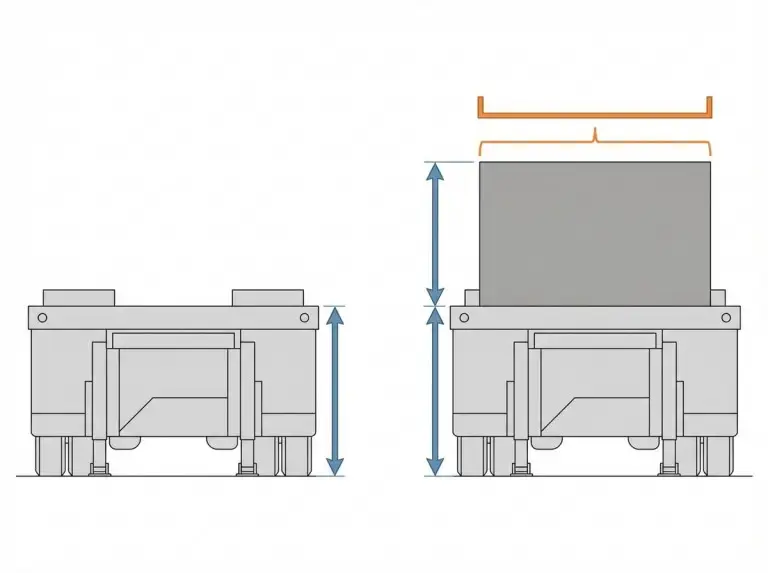
Deck height depends on axle setup, suspension type, and whether the trailer is empty or loaded. Quoting a single number without these details misleads buyers and route planners. In North America, the most common range is 18 to 24 inches (about 450 to 600 mm) measured at the loaded well. In Asia and Europe, spec sheets often list a floor-to-ground height of 750 to 1,250 mm measured unladen (empty). These numbers refer to different states and are not directly comparable.
If a team assumes a “1,000 mm deck height” from an unladen spec applies during transport, they will underestimate the total loaded height by 150 to 350 mm. This gap is enough to hit a bridge on restricted routes or void a permit based on wrong data. To verify this correctly, confirm the laden deck height at maximum payload. Then, add the tallest point of your cargo. Finally, compare that total against the route clearance limit, not the empty trailer height.
We always ask customers for both laden and unladen height requirements when reviewing drawings. The gap between them determines if a standard suspension works, or if you need a lower-profile hydraulic neck or air-ride setup.
Deck Length and Width by Axle Configuration
Axle count determines usable deck length and legal width. This drives payload rating, frame shape, and overall length. The table below shows common reference dimensions. Actual figures depend on the manufacturer’s design, beam materials, and specific cargo needs. Always verify these values against your application before ordering.
|
Configuration |
Overall Length (approx.) |
Usable Deck Length (approx.) |
Standard Width |
Typical Payload Range |
|---|---|---|---|---|
|
2-axle |
~13,000 mm |
8,500–9,500 mm |
2,500–3,000 mm |
Up to 40 t |
|
3-axle |
~13,500–14,000 mm |
9,000–10,000 mm |
2,500–3,000 mm |
40–60 t |
|
4-axle |
~15,500–16,000 mm |
10,500–12,000 mm |
2,500–3,000 mm |
60–100 t |
Most EU markets cap width at 2,550 mm without a permit. The United States caps it at 2,590 mm (102 inches). Anything wider requires a permit. Approval times and rules vary by state or country. Extendable decks can push usable length past 18,000 mm, but you must check this against axle spacing rules and maximum road train lengths in your area.
We design 2, 3, and 4-axle trailers with 500 mm main beam heights. We choose frame materials based on payload class. We confirm usable deck dimensions through structural analysis before production. We also match deck geometry to your specific cargo drawings rather than just using standard catalog sizes.
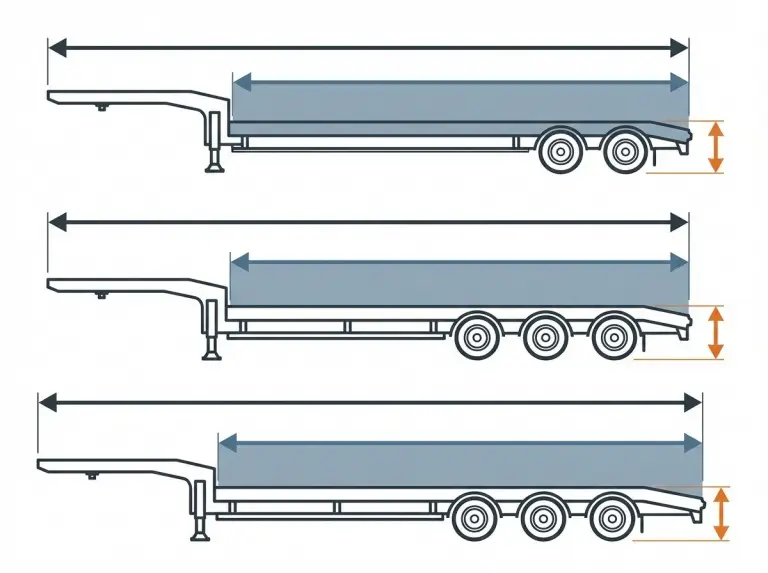
Main Low Bed Trailer Types and How Configuration Affects Dimensions
The type of low bed trailer determines the dimension range and how you load cargo. You must match these variables to your site conditions and equipment before choosing a configuration.
Standard Fixed-Neck Lowboy
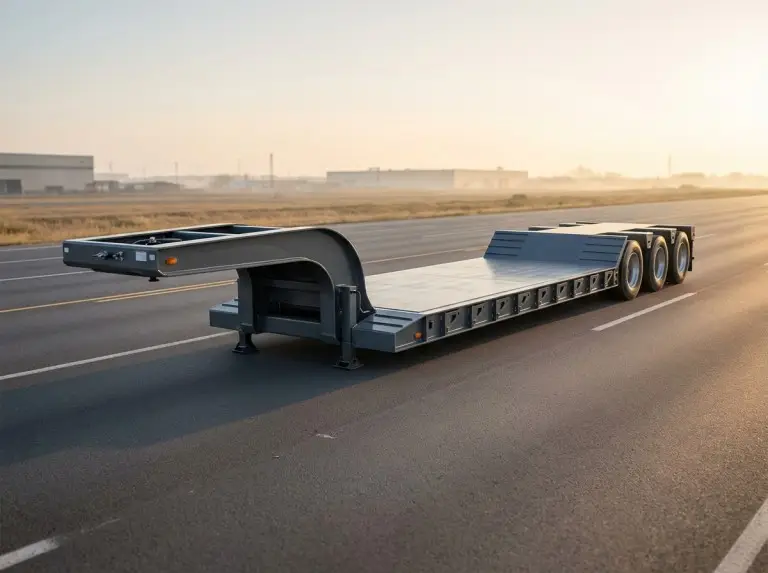
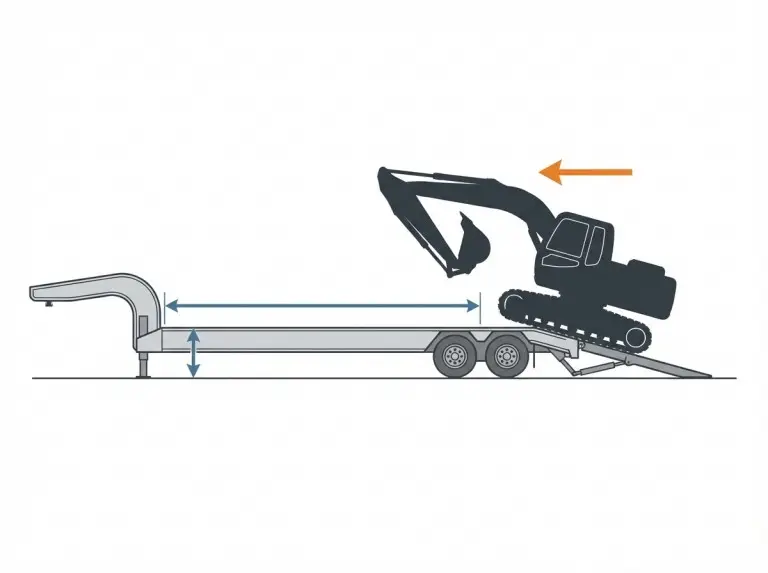
A fixed-neck lowboy has a permanently attached gooseneck. Its stepped frame puts the main deck below the wheel hubs. Usable deck length in the well usually runs 7,000 to 9,500 mm on a 2- or 3-axle unit. You load from the rear using mechanical ramps. This requires enough space for the ramps and a solid ground surface. The well height is very low—often 400 to 550 mm loaded. This suits tall machinery that fits under bridges but does not need to drive onto the trailer from the front.
Detachable Gooseneck (RGN) Low Bed Trailer
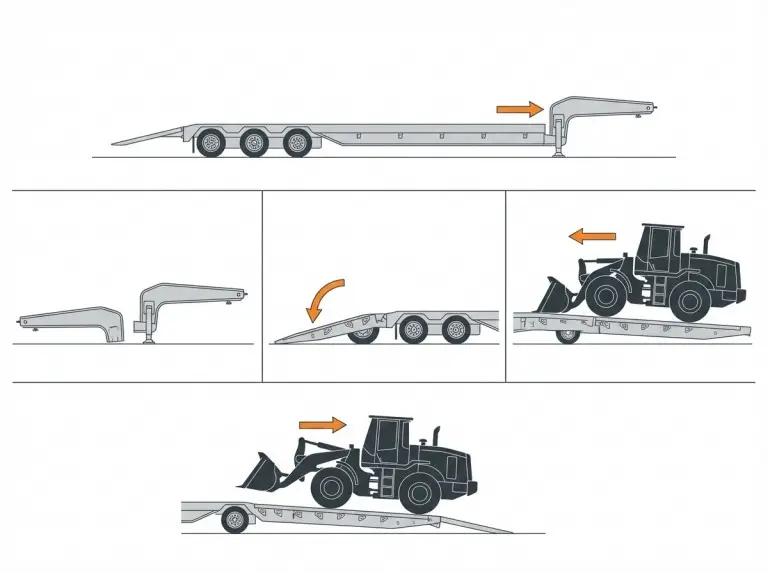
The removable gooseneck (RGN) lets the front section detach. The deck drops near the ground so equipment can drive directly onto the platform. You do not need cranes or extra ramps. The main deck height matches a fixed lowboy, but the loading method solves access problems at sites without lifting gear. Usable well length on standard RGN trailers ranges from 8,800 to 13,500 mm. Stretch versions extend this for longer cargo like crane booms or steel beams. Multi-axle RGNs can handle over 100 metric tons when axle groups are rated correctly and you have the right permits.
Extendable Low Bed Trailer
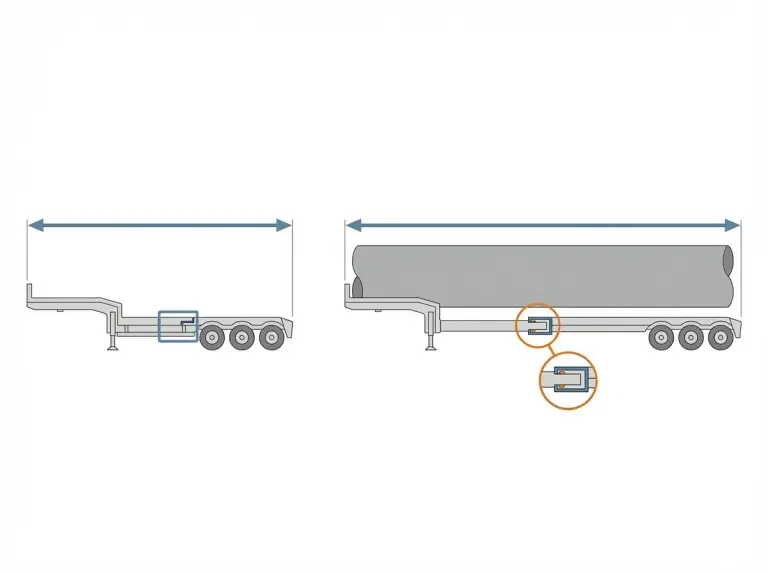
An extendable low bed trailer uses a telescoping chassis to increase deck length for oversized cargo. This is ideal for wind turbine parts, long pipes, and large steel structures. Deck length can range from 13,000 mm retracted to over 22,000 mm fully extended. You need a special transport permit for the extended setup in most markets. This often requires escort vehicles and a pre-approved route. Deck height and width stay the same; only the length changes the regulations.
Further Reading:What Is A Low Bed Semi Trailer?
How Regional Regulations Shape Permissible Dimensions
Legal trailer dimensions vary by country, state, and road type. You must confirm the operating region before finalizing dimensions. A trailer built for one market may need major changes to work in another.
In the United States, federal rules allow 102 inches (2,590 mm) width and 13 feet 6 inches (4,115 mm) total height without a special permit. However, states may have stricter rules for certain roads. In the European Union, the general limit is 2,550 mm width. Markets in Africa, Southeast Asia, and the Middle East have their own axle load limits and road rules.
Where roads are weak or axle load limits are low, we often find that 3- or 4-axle trailers with lighter individual axle loads are necessary. You must also check the trailer’s total length against bridge formulas for every route segment.
This article covers standard road transport. Superheavy hauls needing route surveys or modular platforms involve extra engineering. These should be handled as separate projects with qualified engineers.
Dimension Variables That Must Be Verified Before Ordering
Low bed trailer dimensions are not fixed, off-the-shelf numbers. You must confirm several variables based on your specific cargo and site to avoid mistakes. Verify these points actively:
- Cargo footprint: The length, width, and ground clearance of your equipment set the minimum deck length and maximum deck height.
- Cargo weight and center of gravity: Total weight and where it sits drive axle count, spacing, and kingpin load. All of these change the trailer’s size.
- Laden deck height: Calculate your target height by subtracting cargo height from the total allowed transport height. Verify this against suspension travel under load.
- Loading method and site constraints: Rear ramps need space to lower. Detachable goosenecks need space to detach and reconnect.
- Operating country regulations: Check maximum width, length, and axle load for your specific route, not just the national average.
- Road surface: Off-road or soft ground may need higher clearance or stronger suspension. This raises the empty deck height and changes the loaded range.
When teams order based only on weight capacity, they often get a trailer that can carry the load but is too high or too short. This leads to operational problems before the first delivery. Resolving this at the drawing stage is always cheaper than fixing it later.
Conclusion
Low bed trailer dimensions are defined by axle configuration, payload, cargo size, and where you operate. They are not just catalog numbers. Before locking in an order, verify laden deck height, usable deck length, and legal width for your route.
At Genron, we review cargo drawings and route needs before confirming specs. This prevents mismatches, especially where local road rules are complex. Checking these details early is far more efficient than fixing errors after delivery.
If you need a low bed trailer for heavy equipment or oversized cargo, share your dimensions, weight, and route with us. We will confirm the right axle setup and deck geometry for you. We will also identify any regulatory or site factors you need to know before production starts.
Further Reading:Heavy Haul Trailer Types
FAQ
What is the standard deck height of a low bed trailer?
Laden deck height is usually 450 to 600 mm for standard 2- to 3-axle trailers. Always plan using the laden height (fully loaded), not the unladen (empty) height found on spec sheets. Empty trailers sit 150 to 350 mm higher.
How long is a 3-axle low bed trailer?
A 3-axle low bed trailer is typically 13,500 to 14,000 mm long overall, with a usable deck of 9,000 to 10,000 mm. Exact numbers depend on the gooseneck and ramp design. Verify these against your cargo length before buying.
What is the maximum width of a low bed trailer without a permit?
Most US states allow 102 inches (2,590 mm). The EU generally limits width to 2,550 mm. Other markets differ, so confirm with local authorities for your specific route.
Can low bed trailer dimensions be customized?
Yes. We can adjust deck length, width, height, and axles within structural and legal limits. Decisions must match cargo needs and route rules. Customizing length without checking axle spacing laws causes compliance issues.
What payload can a 2-axle low bed trailer carry?
A standard 2-axle trailer usually carries up to 40 metric tons. This depends on axles, frame material, and road laws. The legal payload is often limited by road axle weight limits, not just the trailer’s strength.
What is the primary dimensional difference between a fixed-neck lowboy and an RGN trailer?
The overall length and deck space are similar. The main difference is the RGN drops to the ground for front loading. This removes the need for ramps. This affects site access, not the dimensions on the road.