Choosing between a gooseneck and a straight frame — and how a skeleton trailer is structured determines which fits — comes down to three variable: container height, route clearance limits, and how those trade off against tare weight and maintenance. Both designs use twist-lock corner fittings — defined in ISO 1161 — to secure ISO containers during transport. The structural difference is in the front section of the frame. That difference directly affects loaded vehicle height, tare weight, and inspection requirements.
Table of Contents
What Sets These Two Frame Types Apart
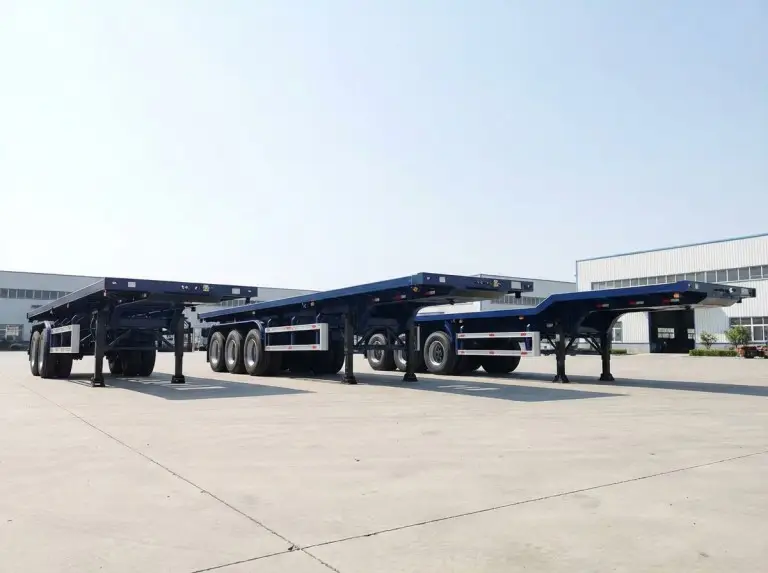
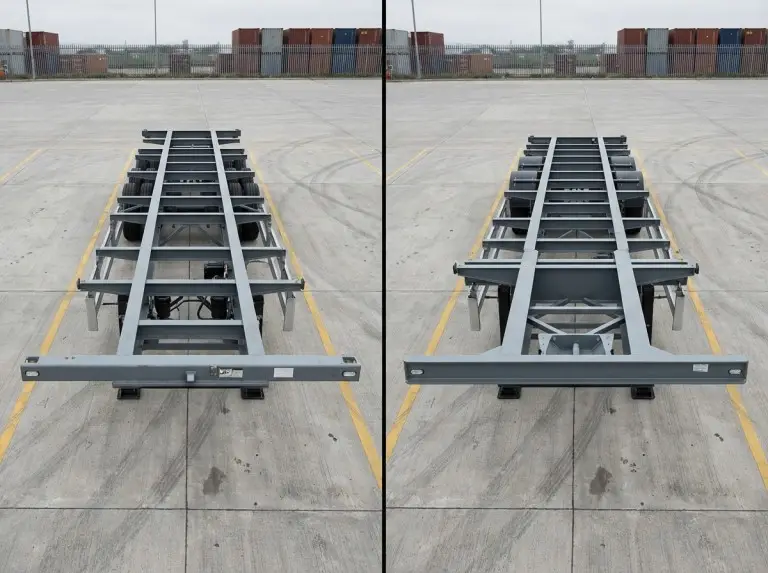
A straight frame and a gooseneck skeleton trailer share the same open-frame concept. Both carry containers at corner castings via twist locks. The difference is front-section geometry.
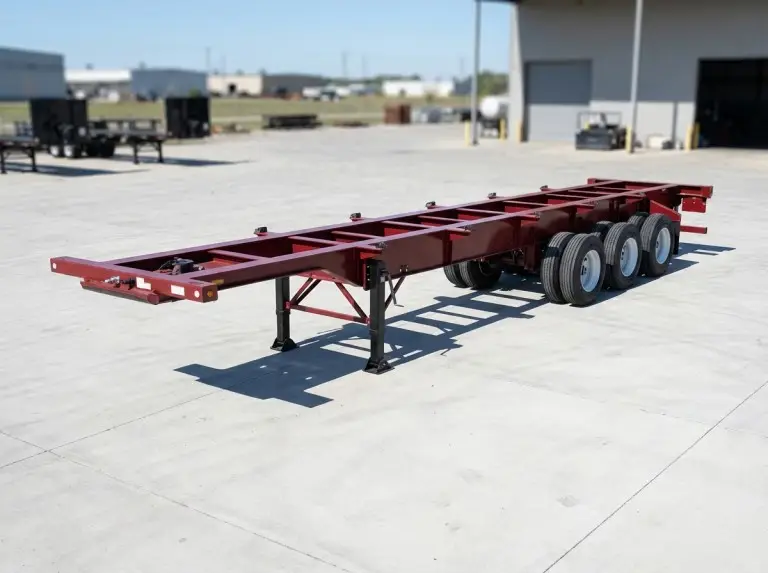
A straight frame runs level from the kingpin to the rear bolster. Deck height is consistent along the full trailer length. The geometry is simple — fewer stress points, lower tare weight, straightforward fabrication.
A gooseneck frame uses a stepped-down front section. The front drops before leveling out along the main load rails. That recess lowers the container and reduces total vehicle height when a tall container is loaded. ISO 1726-1 covers the gooseneck contour and coupling interface geometry. Note: ISO 1726-1 does not govern legal vehicle height or gross weight. Those are set by road transport regulations in each jurisdiction.
Both frames support standard ISO container lengths defined in ISO 668. Frame type affects loaded height — not container length range.
Why Gooseneck Is Not Always the Right Choice
Many buyers assume the gooseneck is the higher-spec option and therefore the safer default. For operations that do not need the clearance benefit, that assumption leads to over-specification.
A gooseneck frame is heavier than a straight-frame equivalent. The stepped transition zone needs more material to manage load paths at the frame corners. That adds tare weight and acquisition cost. For operations running standard-height ISO containers on open-clearance routes, that extra weight and cost delivers no benefit.
When the container mix is exclusively standard-height 20-foot and 40-foot ISO units on confirmed clear corridors, a straight-frame skeleton trailer delivers better payload efficiency and lower acquisition cost — with no compliance trade-off.
The gooseneck earns its place when the mix includes high-cube units, or when route clearance profiles cannot accommodate the full height a standard-deck trailer produces with a tall container loaded.
Frame Geometry, Tare Weight, and Maintenance
A straight frame carries load in a direct path from corner castings to the kingpin and axle group. Load paths are predictable. Tare weight is lower. Inspection points are fewer. Geometry is straightforward to evaluate during routine checks.
A gooseneck frame introduces a stepped transition at the front. That transition needs large-radius geometry and reinforced gussets to manage stress at the neck-to-rail junction. Well-engineered frames handle this reliably — but carry more material than the straight-frame equivalent.
In coastal or humid environments, weld seams and surface protection in the transition zone need more frequent inspection than a flat straight frame. Key inspection points on a gooseneck: transition zone welds, surface protection at the step corners, kingpin load transfer area, and locking pin condition on extendable variants.
Typical Specification Ranges
The table below gives illustrative ranges for 3-axle 40-foot skeleton trailers in export markets. Values vary with steel grade, axle brand, suspension type, tyre spec, and destination market rules. 改后Use these as starting references — not fixed design parameters. Exact figures vary by configuration; 40ft skeleton trailer dimensions covers the full breakdown of length, kingpin position, and axle spacing.
| Parameter | Straight Frame | Gooseneck |
|---|---|---|
| Overall length | 12,200–12,500 mm | 12,200–12,500 mm |
| Frame height (unloaded) | 1,470–1,560 mm | 1,250–1,380 mm (front section) |
| Gooseneck drop | — | ~200–300 mm (model-dependent) |
| Tare weight (3-axle) | 6,500–7,500 kg | 7,200–8,500 kg |
| Standard ISO container | 20 ft, 40 ft, 45 ft | 20 ft, 40 ft, 45 ft |
| High-cube container | Route verification required | Better suited on restricted routes |
| Kingpin position | 950–1,200 mm from front bolster | 950–1,200 mm from front bolster |
Legal height limits are jurisdiction-specific. In Europe, Directive 96/53/EC sets a general 4-metre maximum for standard vehicles. National exemptions and specific road classes apply. Other markets operate under separate rules. Verify compliance against each jurisdiction before deployment.
How the Loaded Height Calculation Works
Total vehicle height equals three inputs: tractor fifth wheel height, plus trailer frame height at the front section, plus container external height per ISO 668.
Standard ISO container height: 2,591 mm. High-cube container height: 2,896 mm.
An example using illustrative figures: a tractor with a 1,200 mm fifth wheel height, a straight-frame trailer with a 1,500 mm front rail height, and a standard container (2,591 mm) gives a combined height of roughly 4,091 mm. On a route with a 4,000 mm legal limit, that combination is marginal. Swap in a high-cube container (2,896 mm) and the total rises to roughly 4,396 mm — over the limit in most jurisdictions. Replace the straight frame with a gooseneck that drops 250 mm and the high-cube combination comes back to roughly 4,146 mm — within range on most open corridors, but still requiring route verification.
These are illustrative figures. Always use the actual fifth wheel height of the specific tractor, the confirmed frame height of the specific trailer model, and the container’s actual external height. We complete this calculation during drawing review before production begins.
How to Match Frame Type to Your Operation
Frame geometry is one input in a broader container chassis selection process. Work through these four before specifying.
- Container height profile:If the operation runs only standard-height ISO containers, a straight frame is the baseline. If the mix includes high-cube units — regularly or occasionally — evaluate the gooseneck against route clearance requirements for those loads.
- Route clearance limits:Confirm the lowest overhead structure on the planned corridor. Calculate total vehicle height using the actual tractor and trailer dimensions. A straight frame loaded with a high-cube container may or may not exceed the limit — it depends on the specific dimensional combination, not industry averages.
- Gross weight profile:If operations run close to legal gross vehicle weight limits, the lower tare weight of a straight-frame trailer means more usable payload. If payload margin is not a constraint, the tare weight difference matters less.
- Operating environment:Straight-frame trailers have fewer inspection points. Gooseneck trailers need closer attention to transition zone welds and surface protection, especially in humid or coastal environments. Both types are maintainable with standard workshop capability.
When teams specify a straight-frame trailer for a mix that includes high-cube containers — without verifying route clearances — the result is often a height violation at the first low structure or a terminal rejection. We prevent this by confirming the loaded height calculation during specification, not after delivery.
Conclusion
The choice between a gooseneck and a straight frame skeleton trailer is determined by container height, route clearance, and how those interact with tare weight and maintenance needs. Neither frame type is the universal answer — each is correct for a specific combination of container mix and operating environment.
At Genron, we build both straight-frame and gooseneck skeletal container semi trailers and recommend the configuration based on what the operation actually requires. In projects where the container mix spans standard and high-cube units on routes with overhead constraints, we find that loaded height — fifth wheel height plus trailer frame height plus container external height — must be confirmed against the actual route before the frame geometry is locked. That calculation often reveals the correct specification differs from the initial assumption. Catching that during drawing review prevents changes after manufacturing begins.
To start a specification review, share your container size and height profile, tractor fifth wheel height, primary route corridor, and any clearance-restricted segments. Our team will confirm the right frame geometry before any commitment is made — reach out to Genron to begin.
FAQ
What Is the Main Structural Difference Between the Two Frame Types?
Front-section geometry. A straight frame runs level from kingpin to rear bolster. A gooseneck steps down at the front — typically 200–300 mm, though the exact drop varies by model, axle layout, and fifth wheel height target. That lower front deck reduces total vehicle height when a tall container is loaded.
Can a Straight-Frame Trailer Legally Carry a High-Cube Container?
It depends. The key inputs are tractor fifth wheel height, trailer frame height, container external height, and the route’s overhead clearance limits. On routes with generous clearances, a straight-frame trailer may keep a high-cube load within legal limits. On restricted corridors, it may not. Calculate the loaded height for the specific combination before deployment.
Which Frame Type Has Lower Tare Weight?
Straight-frame skeleton trailers are generally lighter. The gooseneck transition zone needs more material, adding to tare weight. The typical difference is roughly 700–1,000 kg for equivalent 3-axle 40-foot configurations — though this varies by design. For operations near gross vehicle weight limits, that difference is usable payload.
What Are the Maintenance Differences?
Straight-frame trailers have fewer inspection points and simpler geometry. Gooseneck trailers require regular checks at transition zone welds, surface protection in the stepped section, and locking pin condition on extendable variants. Shorten the inspection interval in coastal or humid environments. Both types are maintainable with standard trailer workshop capability.
Do Legal Height Limits Apply the Same Way in All Markets?
No. Height limits are jurisdiction-specific. Europe uses Directive 96/53/EC as a framework, with a general 4-metre maximum subject to national rules. Other major export markets — including Africa, Southeast Asia, and the Middle East — operate under separate frameworks with different limits. Verify compliance for each jurisdiction on the planned route.