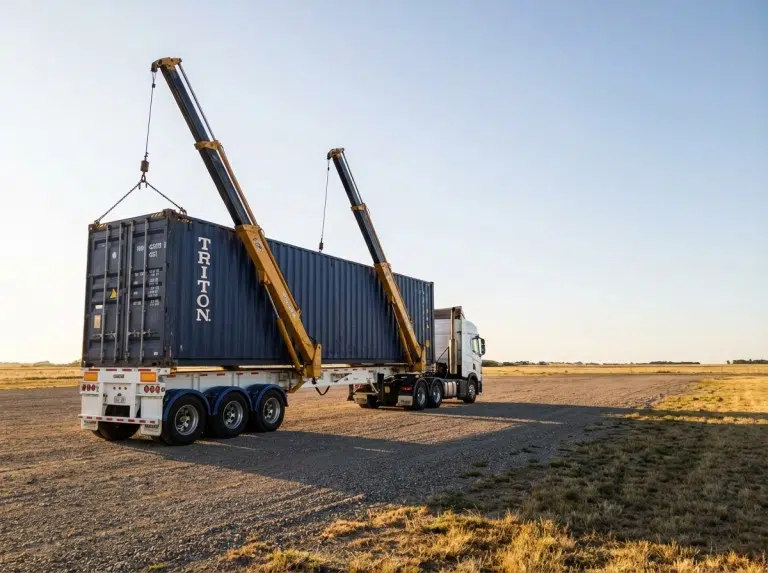
A sidelifter container trailer lifts, transports, and places ISO containers without any external crane. This gives it infrastructure independence that a flatbed trailer cannot provide. This article covers mechanical components, operating sequence, site requirements, and scenario comparisons for evaluation-stage buyers. It does not cover driver licensing, country-specific road permits, or maintenance procedures.
What a Sidelifter Is — and Why “Side Loader” Means the Same Thing
A sidelifter trailer combines a road-going chassis with an integrated hydraulic crane system. The cranes mount on both sides of the trailer frame. They lift ISO containers directly from the ground and load them onto the trailer’s own chassis — no fixed gantry, mobile crane, or reach stacker required at either end of the journey.
The terms “sidelifter,” “side lifter,” “side loader,” and “self-loading container trailer” all refer to the same equipment category. In manufacturing contexts, “sidelifter” is the dominant term. In logistics and transport, “side loader” appears more often. Both are used interchangeably throughout this article.
The core value is infrastructure independence. A sidelifter can collect or deliver a loaded container at a remote construction site, a rural depot, or an urban multi-drop point — without any pre-positioned lifting equipment at that location. A flatbed trailer requires external lifting equipment at both ends of every journey. That difference determines which sites each tool serves.
That distinction — integrated lift versus reliance on external equipment — is what the following sections address in detail.
The Mechanical System That Makes Self-Loading Possible
Four integrated components carry the load when a sidelifter operates at full capacity: twin crane arms, hydraulic cylinders, chassis load beams, and a twist-lock spreader bar. Their geometry and rated capacity vary by model and container type.
| Component | Function | Key Parameter (Typical Range) |
|---|---|---|
| Twin crane arms | Extend laterally over the container | Outreach: 3.5 m – 5.5 m per side, varies by model |
| Hydraulic cylinders | Provide vertical lift force | Operating pressure: ≈280 bar (28 MPa); verify against model specification |
| Chassis load beams | Distribute container weight across axles | Rated for 20 ft and 40 ft spans (standard); 45 ft and non-standard require dedicated configuration |
| Twist-lock spreader bar | Engage ISO corner castings | Adjustable for 20 ft, 40 ft, and 45 ft frames |
The two crane arms mount at each end of the trailer and operate in synchronized hydraulic pairs. When extended, they reach over the container from one side. The spreader bar drops into the corner castings and locks. Then the lift begins.
How Much Weight Can a Sidelifter Lift?
Standard sidelifters are rated up to 45 tonnes gross container weight. Some heavy-duty models reach 47 tonnes. Most standard configurations handle loaded 20 ft and 40 ft ISO containers within normal gross weight limits — up to 30.48 tonnes payload for a 20 ft box under ISO 668. Heavy-duty models can accommodate 45 ft containers and higher gross weights, provided the chassis and spreader bar are specified at time of order. We recommend confirming published load charts for any container above 34 tonnes gross.
Can a Sidelifter Double-Stack Containers?
Many models can stack one loaded container on top of another on the ground, reaching two containers’ height. This is useful for temporary site storage where yard space is limited. Double-stacking requires accessible ISO corner castings on both containers, sufficient ground bearing capacity for the combined load, and arm geometry that reaches the required lift height. Confirm stacking capability against the manufacturer’s specification for that specific unit.
One Common Assumption That Gets Buyers Into Trouble
Many buyers assume a sidelifter can operate anywhere a flatbed can park. This leads to site-readiness problems after procurement. A sidelifter only works where ground bearing capacity, operating gradient, and lateral clearance all fall within its specified envelope. Soft, waterlogged, or unconsolidated ground requires improvement work first. Overhead obstructions within the arm’s elevation arc are a hard stop.
Ground bearing capacity is the most underestimated variable. With arms fully extended under a loaded container, the force through the stabilizer pads can exceed the bearing capacity of unprepared soil, gravel shoulders, or temporary access roads. Buyers who judge a site “firm enough” by walking it — without measuring bearing capacity — often find that ground preparation adds significant cost and time after the unit arrives.
Most sidelifter configurations specify a maximum operating gradient of 2–5 degrees, though this varies by model. Exceeding that limit affects lift geometry and stability in ways that are not visible until the arms are extended under load. Confirm the rated gradient against the manufacturer’s specification before committing to a site.
Lateral clearance is the third constraint. Approximately 4–5.5 metres of unobstructed space is required on the crane side. Overhead clearance of 4.5–6 metres is needed at peak arm elevation above the container. These are industry-typical reference ranges — the exact values for a specific unit are in the manufacturer’s site preparation guide. Measure confined urban sites and covered loading bays against those figures before scheduling any lift.
At Genron, the questions we field most consistently from buyers at the evaluation stage — ground condition, lateral clearance, operating slope — are the same variables that determine whether a sidelifter is the right configuration, or whether a skeleton semi trailer for container transport better fits the delivery environment. Answering those questions before procurement prevents the most common post-delivery problems.
The Full Operating Sequence, Step by Step
The following applies to a standard ground-level pickup on firm, level ground. Site variations — soft surfaces, restricted clearance, container misalignment — will modify individual steps.
- Approach and position. Reverse the trailer alongside the container. Align the trailer centreline with the container’s length axis. Confirm sufficient lateral distance for full arm extension.
- Deploy stabilizer pads. Extend hydraulic outrigger pads to the ground on the lift side. Check ground conditions before proceeding.
- Extend crane arms. Both arms extend simultaneously over the container. Travel stops when the spreader bar sits above the corner castings.
- Lower spreader and engage twist-locks. The spreader descends into the ISO corner castings. Activate twist-lock engagement from the control panel. Confirm positive lock indicator before lifting.
- Lift. Hydraulic cylinders raise both arms in a synchronized stroke. The container clears the ground by a minimum safe margin — typically 150–300 mm — before lateral traverse begins.
- Lateral traverse. The arms retract toward the chassis. The container moves inward and descends onto the chassis load beams.
- Set and lock. Engage chassis twist-locks. The container is road-secured.
- Retract arms. Fold crane arms to transport position. Retract stabilizer pads. The unit is ready to move.
Unloading reverses steps 2 through 8 under comparable site conditions.
How Much Clear Space Does a Sidelifter Need?
On the operating side, plan for approximately 4–5.5 metres of lateral clearance from the trailer’s near edge to any fixed obstruction. Overhead, plan for 4.5–6 metres at peak arm elevation — the exact figure depends on arm geometry and container height (standard 8 ft 6 in versus high-cube 9 ft 6 in). These are industry-typical ranges. Confirm the specific values against the model’s site preparation guide before scheduling on any confined or covered site.
Site geometry is as important a procurement variable as lift capacity — the scenario comparison below makes that concrete.
When a Sidelifter Wins — and When It Doesn’t
Unlike a reach stacker, which performs best anchored to a prepared yard, the sidelifter’s advantage grows with route variability and unpredictable delivery points. Two axes determine the outcome: site infrastructure dependency and cycle-time efficiency against alternatives. Buyers comparing container chassis options for your fleet across multiple route types will find the scenario breakdown below a useful reference point.
| Scenario | Sidelifter | Flatbed + Mobile Crane | Reach Stacker | Skeletal Trailer |
|---|---|---|---|---|
| Remote site, no fixed equipment | Strong advantage | Requires crane mobilisation cost | Not applicable | Cannot self-load |
| Urban drop point, frequent stops | Strong advantage | Slow; crane hire per stop | Not applicable | Cannot self-load |
| High-volume yard, 50+ moves/day | Moderate; cycle time competitive | Dependent on crane availability | Faster cycle time at volume (varies by model and conditions) | Requires yard equipment |
| Confined site with soft ground | Risky; ground prep required | Depends on crane outrigger load | Requires hard standing | No ground load issue |
| 45 ft or non-standard containers | Model-dependent | Flexible with correct spreader | Model-dependent | Requires separate lift |
The sidelifter wins at remote sites where crane hire is expensive or unavailable, and on urban multi-drop routes where fast stop-and-lift cuts dwell time per delivery. It loses ground when a static yard already runs a reach stacker at high utilisation, or when ground conditions are consistently poor — both cases call for a different tool or prior site improvement. Budget is usually the next variable — container chassis trailer cost breaks down the key pricing factors across chassis types.
The flatbed column in the table above reflects the most common alternative buyers weigh against a sidelifter. Skeleton Trailer vs Flatbed Trailer covers that comparison in full if it remains an open question for your fleet.
Conclusion
Buyers who check site geometry, daily move volume, and ground conditions before procurement make faster, more confident decisions. The site geometry check — lateral clearance and ground bearing capacity in particular — is the step most often skipped and most likely to cause problems after delivery.
Genron is a semi-trailer manufacturer and skeletal trailer manufacturer specialising in sidelifter container trailers, skeleton semi trailers, and related container transport solutions. The parameters in this article are industry-typical reference values. Actual lift ratings, outreach dimensions, and cycle times vary by model. Contact our team to request model-specific specification sheets or to discuss which configuration fits your site before finalising any procurement decision.
FAQ
For yards handling fewer than 20–30 moves per day, a sidelifter is usually the more practical choice. It combines road transport and yard handling in one unit, removing the need for separate yard equipment. Above roughly 50 moves per day, a reach stacker’s shorter cycle time makes it more efficient for static yard work.
With an experienced operator on prepared ground, expect 2–4 minutes per cycle. Under standard field conditions — varying ground, alignment corrections, operator experience — plan for 10–20 minutes. Use the shorter figure only once site-specific data confirms it is achievable.
Standard configurations cover 20 ft and 40 ft ISO containers. Many models extend to 45 ft with an adjustable spreader bar, if specified at order. High-cube containers (9 ft 6 in) are compatible with most models — confirm peak arm elevation against the spec sheet. Open-top, flat-rack, and tank containers require individual assessment.
Only if the specific model is rated for it — never assume. Heavy-duty models rated above standard capacity are available, but must be ordered with that specification. Operating above the rated lift capacity risks structural overload and voids warranties. Confirm the rated capacity and any derating factors in writing before procurement.