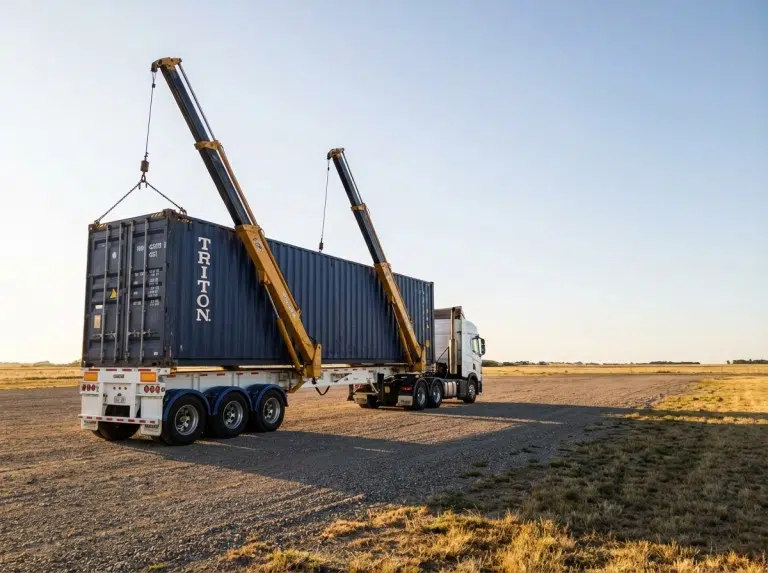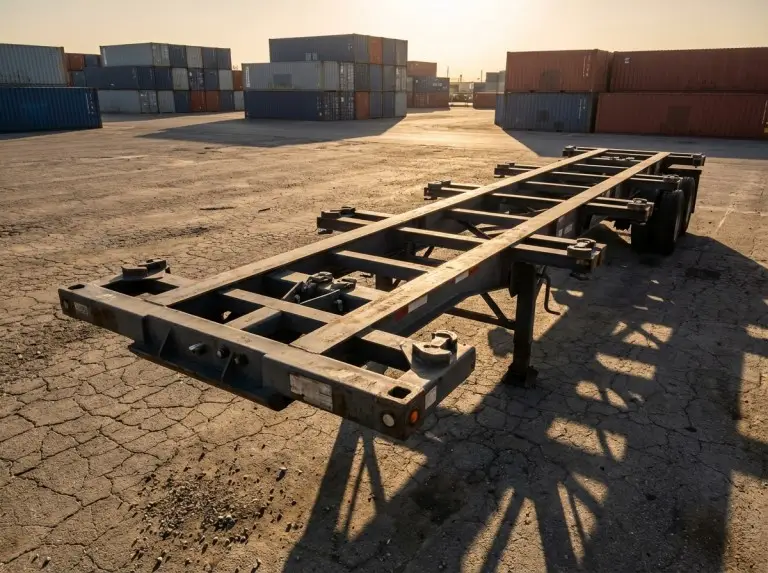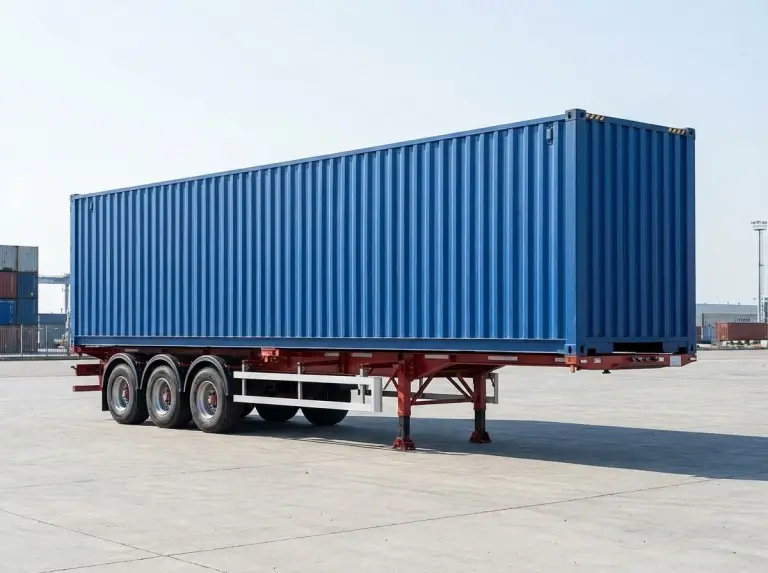
Skeleton semi trailer is a lightweight, open-frame chassis built to carry shipping containers. The correct specification depends on container size, axle count, route weight limits, and coupling compatibility. Unlike flatbed or enclosed trailers, it has no floor panels or sidewalls. The frame uses twist locks to grip the container’s corner fittings (defined in ISO 1161) and hold it in place during transit. At Genron, we design and build skeleton semi trailers for port drayage, road freight, and intermodal logistics.
The name “skeleton” comes from its stripped-down frame. This frame has two long I-beams joined by cross members and welded end beams, all made from high-strength steel. Twist locks sit at fixed points that match the corner fitting locations in ISO 668. A skeleton semi trailer can carry one 20-foot container, one 40-foot or 45-foot container, or two 20-foot containers in tandem (end-to-end).
Lower tare weight means more payload per trip within legal weight limits. But the actual payload allowed on any route depends on axle group limits, bridge formula rules, and local gross weight laws — not on the trailer’s rated capacity alone.
Common Errors in Skeleton Trailer Selection
Skeleton trailer load capacity depends on axle rating, suspension type, tire spec, and local road laws — not just the catalog payload figure. The most common mistake we see is assuming a trailer rated for a given tonnage can legally carry that weight on every route.
Legal weight limits vary widely between countries. They often differ between states or provinces in the same country. ISO 1726-1 (mechanical coupling between tractors and semi trailers) notes that it does not set maximum mass or dimension limits — local laws govern these. When buyers pick a trailer based on rated payload alone, they risk overloading fines, faster suspension wear, or early beam fatigue. We flag this in every spec review and ask customers to confirm their route’s weight limits before we lock the design.
Another common error involves container size terms. Standard skeleton trailers carry ISO 668 series 1 containers — mainly 20-foot, 40-foot, and sometimes 45-foot units. But 48-foot and 53-foot containers are domestic sizes used mostly in North America. They fall outside ISO 668 series 1. Treating a 53-foot domestic chassis as equal to an ISO series 1 chassis leads to wrong twist lock layouts and potential non-compliance. We keep these two product families separate and explain the difference early in each inquiry.
This article covers standard road-going skeleton semi trailers for commercial container transport. It does not cover terminal-only yard chassis, offshore container frames, or heavy-duty mining or military configurations.
Key Structural Components
Skeleton trailer durability depends on main beam steel grade, welding quality, cross-member layout, and suspension match to the duty cycle.
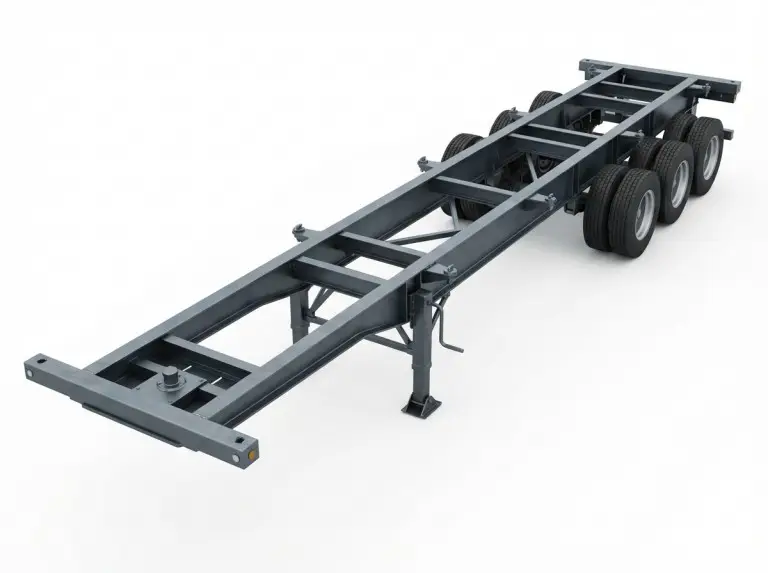
The main beam carries most of the load. We make main beams from high-strength low-alloy steel plate. Grade, yield strength, and thickness are set per each model’s design load — not picked from a generic list. Higher-grade steel gives longer fatigue life under repeated loading. But the grade must match the welding method and heat input to avoid brittle zones near welds. Main beam height of 450 mm to 500 mm is common for 40-foot models. The final size depends on target payload, axle spacing, kingpin load, and frame analysis results.
Cross members join the two main beams and spread loads sideways. Their spacing and shape affect how stiff the frame is against twisting. A stiffer frame handles rough roads better but sends more vibration to the container. We set this balance during design based on road profile and container type.
The kingpin links the trailer to the tractor’s fifth wheel. Sizing follows UN Regulation No. 55. Standard sizes are 2-inch (50 mm) and 3.5-inch (90 mm). The right choice depends on gross combination mass and regional coupling rules. A wrong kingpin adds stress at the coupling point, so it must be checked against the tractor’s fifth wheel before production.
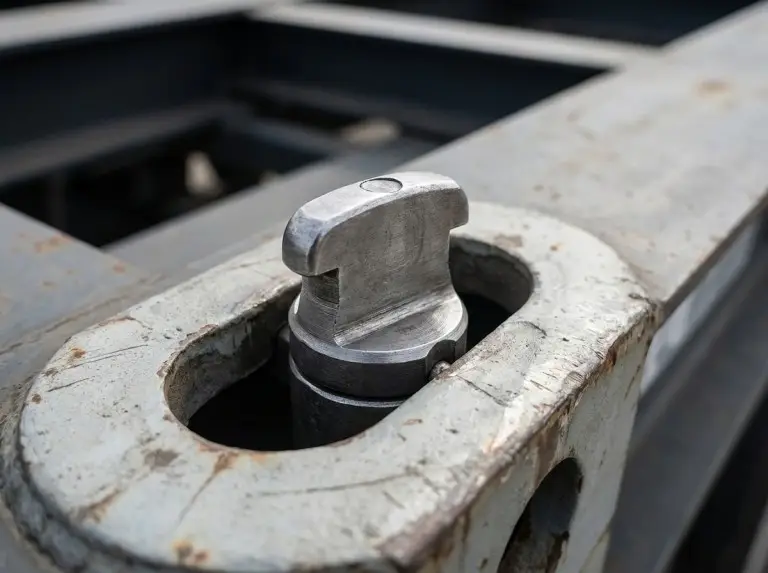
Twist locks grip the container’s corner fittings. ISO 1161 defines these fittings’ size, function, and strength. A skeleton trailer has 4 to 12 twist locks placed to match corner fitting spots for different container lengths (per ISO 668). Fixed locks at the front and rear give permanent mount points. Folding locks in the middle drop below the frame to clear longer containers. The securing setup must also follow ISO 3874, which governs container restraint on transport gear.
Landing gear holds up the front of the trailer when detached from the tractor. Manual crank-down gear is standard. The gear rating must match the front load when the trailer is loaded and standing alone.
Skeleton Trailer Types by Frame Design
The right type depends on fleet patterns, container mix, and route limits.
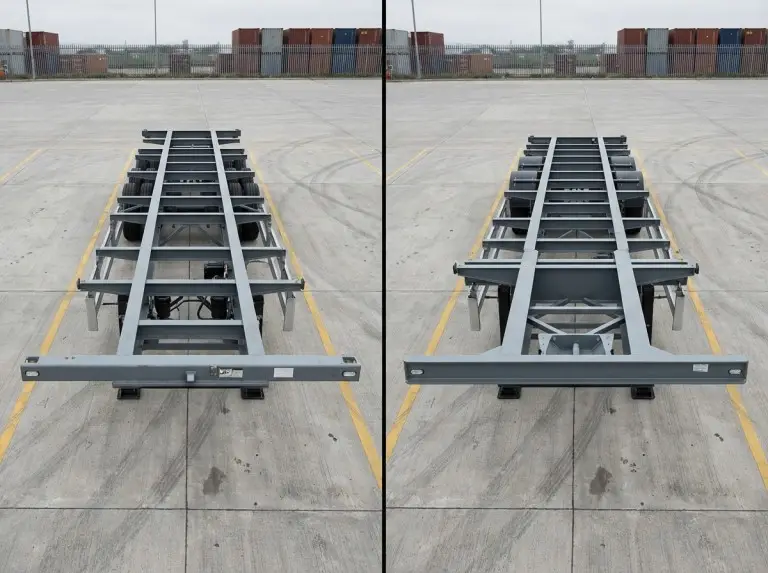
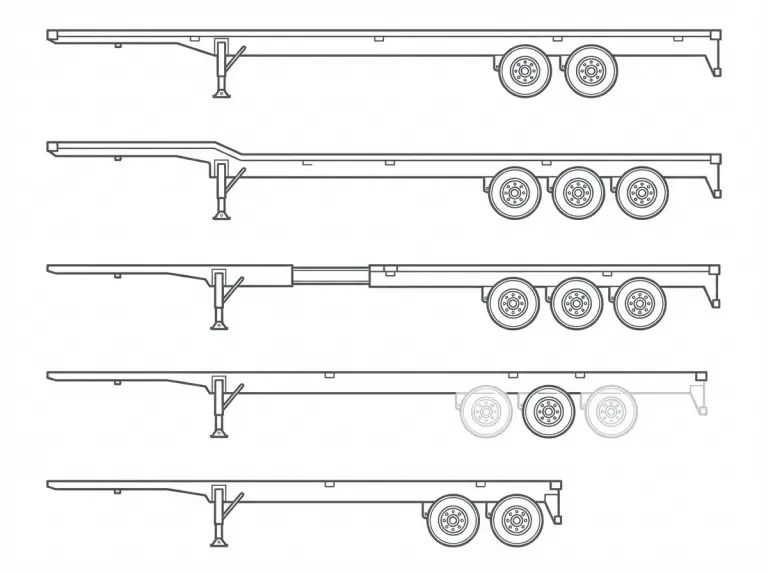
- Fixed-Length Skeleton Trailer:The most common type. A rigid chassis that carries one 40-foot or two 20-foot containers in tandem. Twist locks sit at 20-foot and 40-foot ISO intervals. We build this as our core model. It covers most port-to-depot runs for ISO series 1 containers. Fixed frames are lighter and easier to maintain than adjustable types.
- Gooseneck Skeleton Trailer: This type has a stepped-down front section that lowers the deck height. ISO 668 lists gooseneck tunnels as a feature for certain high-cube 40-foot and 45-foot containers. The lower deck helps meet height limits on certain routes. The coupling geometry should be checked against ISO 1726-1. The trade-off is a slightly heavier and more complex frame.
- Extendable (Telescopic) Skeleton Trailer: Uses a sliding frame section to adjust length for 20-foot, 30-foot, 40-foot, or 45-foot containers on one chassis. The slide mechanism needs more frequent checks on locking pins, rails, and hydraulics (if fitted). Best for fleets with a wide container mix that want fewer trailer types.
- Slider (Adjustable Bogie) Trailer: The rear bogie moves along the frame to shift weight between axle groups. Useful for meeting bridge formula rules and for adjusting axle loads when container weights change between trips. Also helps with tight-space turning in terminals.
- Dedicated 20-Foot Skeleton Trailer: A shorter chassis made only for 20-foot containers. More compact and easier to turn in crowded ports and city zones. Best when a fleet mostly runs 20-foot units and rarely needs 40-foot capacity.
Axle, Suspension, Brake, and Tire Choices
These four variables should be driven by payload needs, road conditions, regulations, and tractor fleet fit — not by catalog defaults.
Skeleton trailers come with 2, 3, or 4 axles. Two axles suit light loads or empty runs. Three axles are the standard for loaded 40-foot work in markets with 8–10 tonne per-axle limits. Four axles serve the heaviest loads or markets with strict per-axle rules. A lifting axle lets the driver raise one axle when running light, saving tire wear and fuel. Axle count and spacing must match the route’s weight rules and bridge formula.
Leaf spring suspension is tough, cheap, and suits rough roads. Air suspension gives a smoother ride, adjustable height, and better cargo protection — but costs more to buy and fix. In our experience, the right pick depends on balancing upfront cost against long-term wear, tire life, and cargo risk. There is no one-size-fits-all answer.
Brake systems on O3/O4 trailers must meet destination market rules. In UNECE markets, UN Regulation No. 13 sets the framework, including ABS rules. Drum brakes are cheaper. Disc brakes stop faster and perform better under heavy use. The trailer’s electrical connector should meet ISO 7638-1. All brake details must be confirmed against local rules and tractor fleet specs before ordering.
Tires can be single or dual per axle end. Duals spread load and add backup but weigh more. Single wide-base tires cut rolling resistance and weight but lack backup. Radial tires are the highway standard. Bias-ply tires show up where low replacement cost matters most.
Port, Highway, and Intermodal Uses
Each setting puts different demands on the trailer.
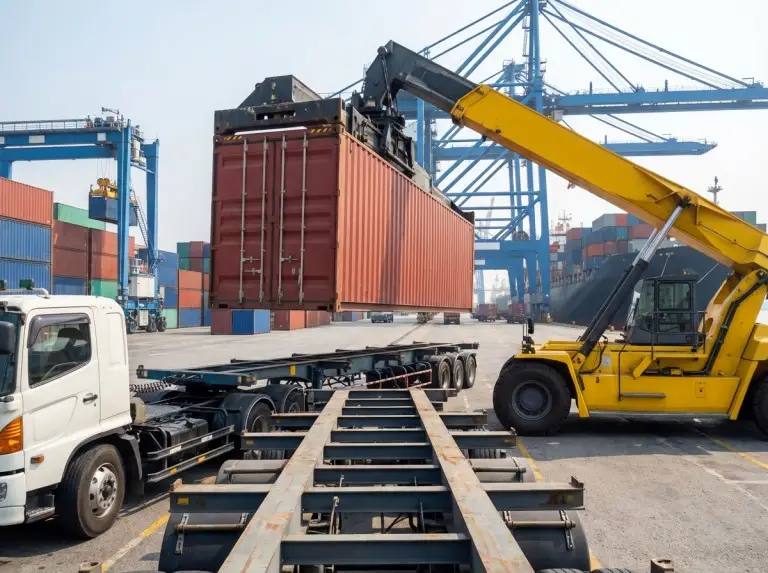
Port drayage means short moves between cranes, yards, and gates. Trailers face constant loading cycles from reach stackers and straddle carriers. These machines put repeated impact loads through the twist locks. We reinforce stress points on port-use trailers to stretch inspection intervals.
Long-haul road freight demands steady performance from suspension, tires, and brakes over long distances. Air suspension and radial tires cut fuel use on good highways. Brake spec — including UN R13 compliance where required — affects both safety and insurance.
Intermodal work moves containers between road, rail, and sea at hub terminals. Fast twist lock action reduces dwell time. The trailer must fit the handling gear and stacking setup at each transfer point.
Verifying the Spec Before Production
Getting the spec right before cutting steel prevents costly rework after delivery.
Start with the container profile. A fleet using only 40-foot boxes needs a different twist lock layout and frame length than one mixing 20-foot and 40-foot loads. We set twist lock spots and frame size to the customer’s confirmed container mix during drawing review, based on ISO 668 fitting locations.
Payload and gross weight must be legal in every region the trailer will run. The same trailer may pass in one country but break rules in another. We require route-specific weight confirmations before design freeze.
Road and climate conditions affect steel choice and coating. Coastal zones need extra corrosion protection. Rough roads may call for stronger cross members and tougher suspension. We adjust based on the environment described at order time.
Coupling fit — kingpin size (UN R55), fifth-wheel geometry (ISO 1726-1), and brake connector (ISO 7638-1) — must match the customer’s tractors. Mismatched coupling parts are one of the most avoidable yet persistent post-delivery problems in international trailer sales.
Conclusion
Choosing the right skeleton semi trailer means resolving linked variables: frame type matched to container sizes (ISO 668), axle count checked against route weight rules, suspension and brakes meeting local laws, and coupling parts confirmed against the tractor fleet.
At Genron, we build every project around pre-production checks that close these gaps before fabrication. In our experience, the biggest problems come not from making the trailer but from locking specs too early — especially when axle load splits have not been checked against the route’s bridge formula, or when coupling fit has been assumed rather than confirmed. We spend engineering time at the drawing stage to catch these issues before steel is cut.
To get started, share your container sizes and weights, route weight limits, tractor coupling specs, and any road or climate factors. We review these against our design platform and confirm a spec that fits before production begins. Reach out to Genron to request a review.
FAQ
Standard models carry ISO 668 series 1 containers: mainly 20-foot and 40-foot, with some handling 45-foot. The 48-foot and 53-foot sizes are domestic (non-ISO) types used mostly in North America. These need separate chassis models.
It depends on payload and local per-axle weight limits. Two axles handle light loads. Three axles cover most loaded 40-foot work. Four axles serve the heaviest loads or strictest weight rules. Always check the route’s bridge formula before deciding.
A skeleton trailer has an open frame with no deck. It uses twist locks to hold the container through ISO 1161 corner fittings. A flatbed has a solid platform for containers, loose cargo, or machines. Skeleton trailers are lighter and cheaper for pure container work. Flatbeds are more flexible for mixed loads.
Yes. Air suspension absorbs more vibration and suits sensitive cargo. Leaf spring suspension handles rough roads and heavy cycles better at lower cost. Match the choice to cargo type, route, and fleet maintenance ability.
Rules depend on the destination market. In UNECE markets, UN Regulation No. 13 covers O3/O4 trailers, including ABS. Other regions use their own standards. Brake type, ABS setup, and connector standard must match local rules and the tractor fleet.