Accurate 53′ truck trailer dimensions, like other tractor trailer sizes, are the foundation of successful North American freight planning. The rule is simple: the numbers on paper must match the specific trailer body and door opening used for the load. The label “53-foot trailer” describes the overall exterior length, not the guaranteed interior usable space. At Genron, we use these precise definitions during quoting and loading reviews. This consistent approach reduces the risk of dock-side rework and costly rebooking.
53′ Trailer Dimensions and What Each Number Represents
Reliable load planning for 53′ dry vans depends on distinguishing between three key measurements: exterior size, interior usable space, and rear door opening clearance. Exterior length and width determine if the truck fits the route and the dock. Overall exterior height matters just as much, which is why teams often ask how tall is a semi truck before committing to routes with tight overhead clearances.Interior usable dimensions and door opening dimensions control what can physically enter the trailer and how you can arrange the pallets.
A 53′ dry van is standardly defined as 53 feet in exterior length and 102 inches in exterior width, a baseline width tractor trailer specification used for lane and dock constraints.However, interior dimensions vary significantly based on body design and liner configuration. While published references often cite an interior length of 52’6″–52’7″, width of 99–100 inches, and height of 110–111 inches, these are just planning baselines. You must always verify them on the actual unit.
Rear door opening dimensions create a separate constraint that is often smaller than the interior dimensions. Because door hardware and trailer designs vary, sources report different typical door openings. This makes it critical to measure or confirm the door opening width and height on the spec sheet before you commit to shipping tall or wide freight.
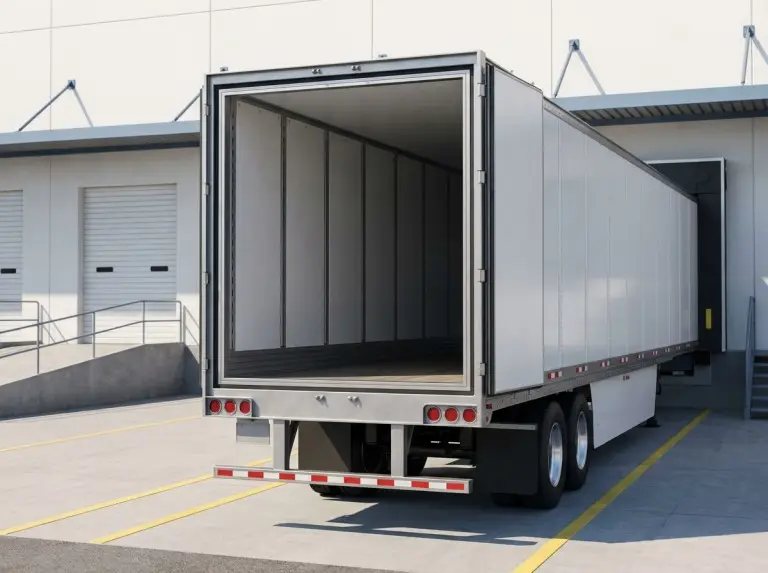
Typical 53′ dry van planning references (verify on the actual trailer before booking):
Measurement point | Typical reference value | Why it matters in loading |
|---|---|---|
Exterior length | 53 ft (16.15 m) | Vehicle footprint and yard positioning |
Exterior width | 102 in (2.59 m) | Lane and dock constraints |
Overall exterior height | 13 ft 6 in (4.11 m) | Overhead clearance planning |
Interior usable length | ~52 ft 6 in to 52 ft 7 in (about 16.0 m) | Floor positions, pallet rows, freight length fit |
Interior usable width | ~99–100 in (about 2.51–2.54 m) | Two-across pallet feasibility |
Interior usable height | ~110–111 in (about 2.79–2.82 m) | Stack height feasibility |
Rear door opening width | Often smaller than interior width | “Will it pass through the door” constraint |
Rear door opening height | Often smaller than interior height | Tall freight and double-stack feasibility |
Wheel well intrusions and interior pinch points are another common reason loads fit on paper but fail at the dock. Wheel housings, scuff liners, and logistics posts can reduce usable width at the floor line or create snag points for long, rigid items. A pre-load check should confirm the narrowest usable width and door opening, rather than relying solely on the widest interior section.
Common Misreads of 53′ Trailer Dimensions That Break Load Plans
Most errors in 53′ trailer loading stem from using the wrong dimension definition, not from bad math. A load plan that assumes “53 feet” is the interior usable length will overestimate floor positions and lead to last-minute rework. Similarly, ignoring door opening dimensions can result in rejected freight that fits inside the trailer but cannot pass through the rear frame.
The most frequent misreads we encounter with 53′ dry van planning include:
- Treating “53 ft” as interior usable length instead of exterior length.
- Using interior height calculations while ignoring a smaller door opening height.
- Assuming interior width always supports two-across pallets without checking for liners and posts.
- Using cubic feet calculations as if they guarantee available pallet positions.
- Planning pallet counts without reconciling total weight and weight distribution.
These errors are preventable. The shipper must document the specific measurement points upfront. Using a consistent measurement checklist is far more effective than adding arbitrary safety “buffers” that may still miss the real restriction.
Main Types of 53′ Trailers and Their Typical Uses
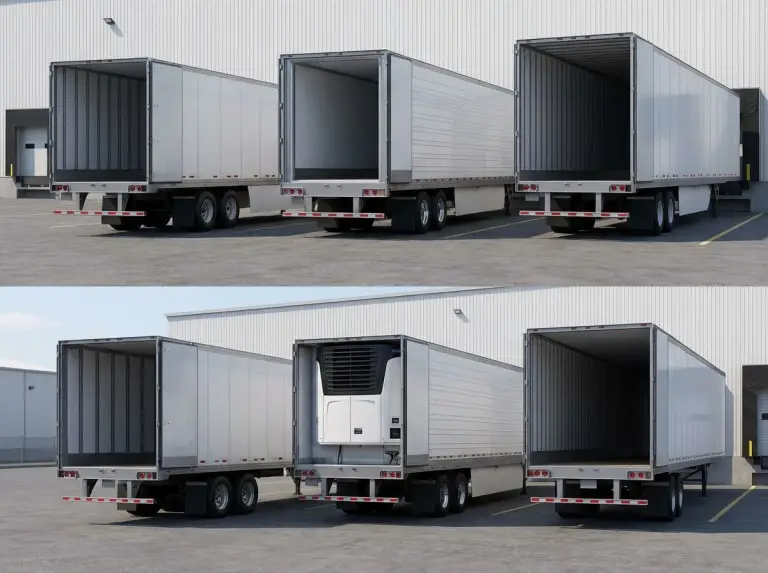
Correct 53′ truck trailer dimensions depend heavily on the trailer type. Construction differences directly impact interior usable space and loading constraints. A 53′ dry van serves as the baseline for general palletized freight. In contrast, a 53′ refrigerated trailer typically sacrifices interior space to accommodate insulation and equipment, which alters usable width and nose clearance.
53′ dry van trailer
A 53′ dry van trailer is the industry standard for domestic highway shipping. These trailers typically support fast dock loading and offer predictable floor layouts for GMA pallets. However, interior liners, logistics posts, and wheel wells can still reduce usable width, making measured confirmation necessary.
53′ refrigerated trailer
A 53′ reefer trailer trades usable interior space for insulated walls and refrigeration components. When planning a reefer load, you must confirm the usable interior width and length at the nose. Insulation and front-mounted equipment can significantly reduce usable volume compared to a standard dry van.
53′ high-cube dry van trailer
A 53′ high-cube dry van provides additional interior height for lightweight, high-volume freight. When using a high-cube, you should confirm both the interior usable height and the door opening height. Door hardware and frame design can still cap the effective loading clearance. The safest practice is to treat “high cube” as a configuration label that still requires verification.
How We Estimate Cube and Pallet Count From 53′ Trailer Interior Dimensions
Accurate pallet and cube estimates for 53′ trailer load planning require three consistent inputs: trailer interior usable dimensions, pallet footprint, and the loading pattern. Pallet count is never a single fixed number because turning and pinwheeling pallets changes how their edges consume trailer length. Your planning method should remain transparent so teams can audit the count if the trailer specs change.
Cubic feet is a volume estimate, not a floor-position plan. This calculation is useful for comparing packaging density across shipments and detecting when “air” drives up costs. A standard calculation multiplies length by width by height using consistent units. Many references divide cubic inches by 1,728 to convert to cubic feet.
A practical pallet plan starts with 48″×40″ GMA pallets, as this footprint dominates North American freight. A standard 53′ dry van generally offers 636 inches of usable length and about 100 inches of usable interior width. This explains why straight-loading typically produces 13 rows and two-across placement.
Common 48″×40″ GMA pallet outcomes on a 53′ dry van (verify with usable interior dimensions):
Loading method | How pallets consume trailer length | Typical planning result |
|---|---|---|
Straight | 48″ along trailer length | 26 pallets (13 rows × 2) |
Turned | 40″ along trailer length | 30 pallets (15 rows × 2) |
Pinwheel | Alternating straight and turned | Often around 28 pallets |
Non-square pallets necessitate “turned” and “pinwheel” methods. ATS highlights several other common pallet sizes used in shipping, including 42×42, 36×36, 48×48, and 48×45. Therefore, a planning model must accept specific pallet dimensions as inputs rather than hard-coding a single answer.
Double-stacking must be treated as a verification step, not an automatic multiplier. It requires sufficient interior height and door opening height, along with product stability and acceptable compression strength. Furthermore, a double-stack plan must remain within legal payload limits after accounting for the weight of pallets, packaging, and dunnage.
How We Verify Payload and Clearance Before Loading a 53′ Trailer
A correct 53′ trailer load plan can still fail if you do not verify payload or clearance limits for the specific route and trailer. U.S. references commonly cite an 80,000-pound gross vehicle weight limit for the tractor-trailer combination without special permits. This makes the tractor weight and empty trailer weight critical factors in cargo weight planning.
Payload planning should use a range rather than one “golden rule” number when equipment is unconfirmed. ATS notes that maximum cargo weight on a 53′ dry van falls in a broad band depending on the trailer and commodity. Other sources cite similar variances, so the safest approach is to confirm tare weights and legal limits for the actual combination.
Weight distribution is also a practical dimension problem because it changes how pallets must be arranged. ATS explicitly warns that concentrating heavy pallets in one zone creates safety and damage risks, even if the total weight is within limits. A heavy-freight plan must treat “even distribution” as a mandatory check, not a preference.
Pre-loading verification checklist for a 53′ trailer:
- Confirm interior usable length, width, and height on the assigned trailer.
- Confirm rear door opening width and height, not just interior clearance.
- Confirm narrow points such as wheel well intrusion and liner or post configurations.
- Confirm pallet footprint and whether pallets can be handled from all four sides for turned loading.
- Confirm total shipment weight, estimated payload allowance, and a distribution plan for heavy pallets.
- Confirm any tall-freight clearance risks using measured door opening height and interior height.
Conclusion
At Genron, we understand that the key to accurately answering questions about 53′ semi-trailer truck dimensions lies in precise measurements, not just memorizing standard figures. Our process starts with verifying interior usable dimensions and door clearance, followed by estimating pallet placement with a clear loading pattern. Finally, we ensure proper payload and weight distribution before any truck hits the road. This meticulous approach helps us reduce errors and streamline planning with shippers, carriers, and dock teams. Ready to experience a smarter way to manage your semi-trailer truck needs? Let’s talk!
FAQ
Typical planning references estimate interior usable dimensions at roughly 52’6″–52’7″ long, 99–100 inches wide, and 110–111 inches high. However, these numbers are not guaranteed across all trailer bodies and liners. A loading plan should always verify the assigned trailer’s interior usable dimensions before booking or staging.
Rear door opening dimensions are commonly smaller than the interior and vary based on door hardware and body design. Since published references report different typical openings, the correct practice is to confirm the door opening width and height on the specific unit or its specification sheet.
A common baseline is 26 standard 48″×40″ GMA pallets loaded straight. Higher counts are possible using turned or pinwheel patterns. The exact number depends on usable interior width, pallet overhang, handling constraints, and weight distribution. Shippers should verify that the loading method is feasible at both origin and destination docks.
Calculate cubic feet by multiplying length by width by height using consistent units, then converting as needed. Many references use the inches method, dividing total cubic inches by 1,728 to convert to cubic feet. Remember, cubic volume is a planning signal for packaging density, not a guarantee of available pallet positions.
Payload varies by tractor weight, empty trailer weight, and route limits. Relying on a single universal payload number is risky. Industry references suggest a broad planning range for 53′ dry vans, but final payload requires confirmation against specific equipment and legal limits. The safest approach is to confirm tare weights and shipment weight before dispatch.
Pallet count changes because pallet footprints differ, and loading patterns consume trailer length differently. Additionally, trailer interiors vary due to liners, posts, and wheel well intrusions. Weight distribution requirements can also force different pallet spacing, especially for heavy commodities. A robust planning method treats pallet dimensions and usable interior dimensions as variable inputs, not fixed assumptions.