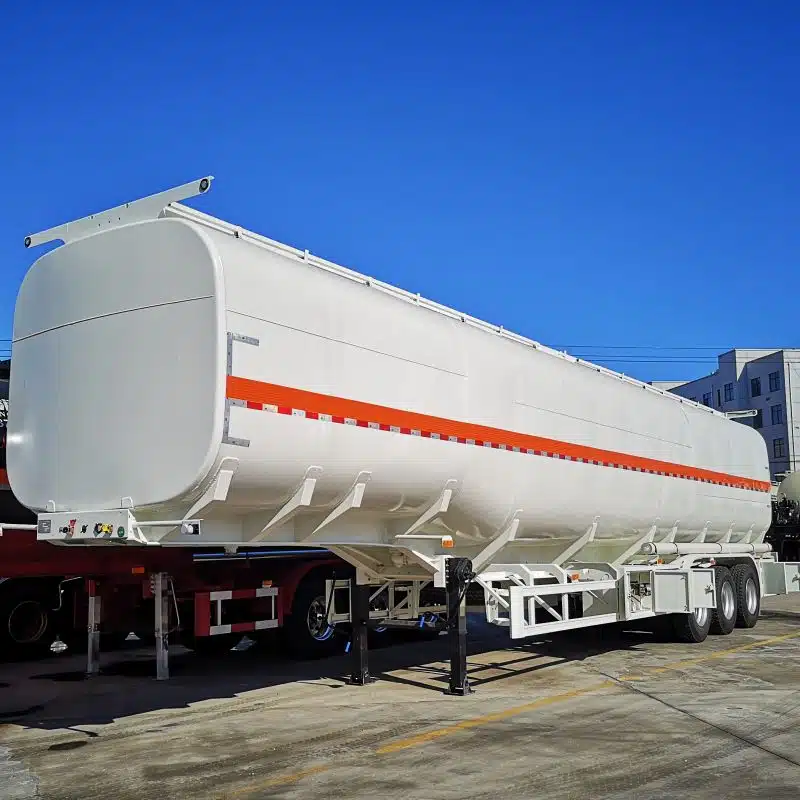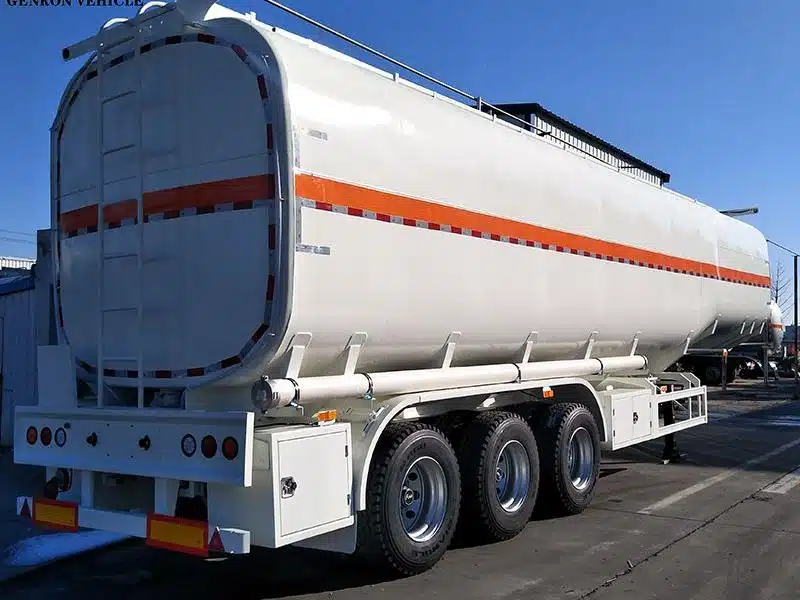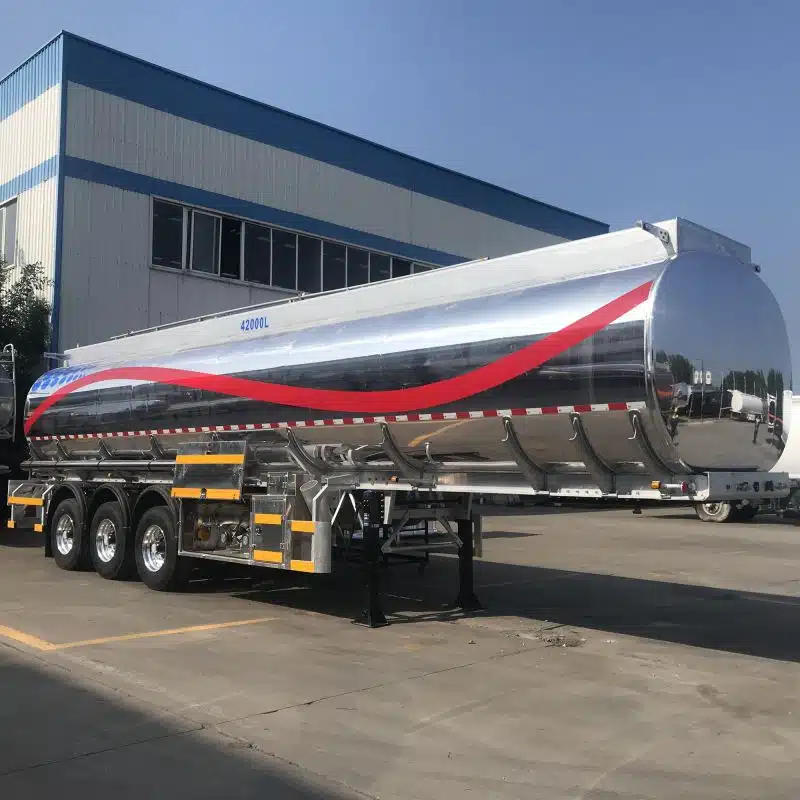
A fuel tanker trailer works by moving liquid fuel between a stationary tank and its own sealed compartments using a pressure difference: pump-driven at the loading rack, and driven by static head or an onboard pump at delivery. Which arrangement applies depends on three things — whether the transfer connection is open or vapour-tight, whether the receiving tank sits low enough to give useful head, and how the product in that compartment is classified. The compartments, internal valves and vapour path exist to keep those variables from becoming a spill or an ignition source.
| Reference point | What applies (United States, 49 CFR) |
|---|---|
| Current tank specification | DOT 406, the low-pressure cargo tank specification commonly used for petrol, diesel and other petroleum distillates. MC 306 is the pre-1995 legacy specification, still legal on qualified in-service units |
| MAWP | No lower than 2.65 psig and no higher than 4 psig (178.346-1(b)) |
| Primary pressure relief set point | 120–132% of MAWP, reclosing at not less than 108% of MAWP (178.345-10(d)) |
| Loading / unloading rate | No greater than the rate marked on the specification plate; where no rate is marked, held so tank pressure stays within 130% of MAWP (173.33(b)(4)) |
| External visual inspection and leakage test | Every 1 year (180.407(c)) |
| Internal visual and pressure test | Every 5 years for a standard DOT 406 in petroleum service. Insulated tanks and lading corrosive to the tank fall on shorter cycles, because the table is keyed to specification, configuration and service |
| Pressure test value | Plate test pressure, 34.5 kPa (5 psig), or 1.5 × MAWP, whichever is greater |
How a Fuel Tanker Trailer Works, End to End
A fuel tanker trailer works as three separate transfer events sharing one shell: a fill driven by rack pressure, a transit phase in which nothing should move, and a discharge driven by static head or an onboard pump depending on the delivery site.
Many petroleum distribution tankers divide that shell into several liquid-tight compartments. Each is closed on its own terms, with an internal self-closing stop valve at the bottom, a pressure-vacuum vent at the top, and a controlled outlet path that may run into a shared manifold. No product crosses between compartments, which is what lets one trailer carry three grades on one trip.
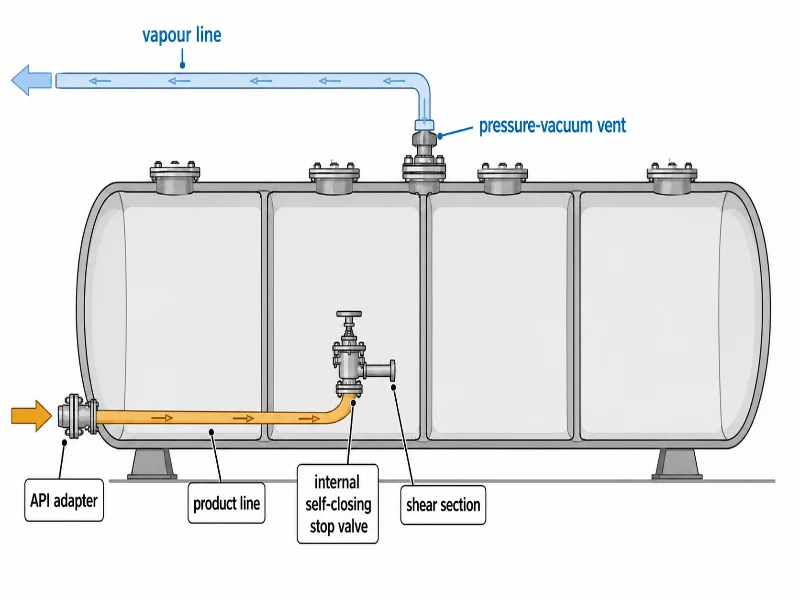
The valve at the bottom of each compartment is where the mechanism gets specific. On a DOT 406 tank an external self-closing stop valve is not accepted as a substitute for the internal one (49 CFR 178.346-4), because the internal valve keeps its closing energy inside the shell. Outboard of it sits a sacrificial device, typically a shear section. Under 49 CFR 178.345-8 that device has to break at no more than 70% of the load that would fail the valve it protects. Its failure has to leave the valve and its attachment intact and still holding product. In a collision the piping outside goes first. The tank stays shut.
In transit the equipment does nothing. Valves stay shut, the vent holds the compartment within its pressure band as the product warms and cools, and the only thing still moving is the liquid itself.
Why Partially Filled Compartments Need More Care
Liquid surge builds across the free surface of the product, so a compartment carrying a part load offers a wave path that a compartment filled close to its outage limit does not.
The vocabulary trips buyers up here, and the regulations are clearer than the trade press. The DOT 400-series definitions at 49 CFR 178.345-1 describe a baffle as a non-liquid-tight partition: it slows wave motion inside a compartment without creating one. A liquid-tight bulkhead does create a separate compartment, with its own valve and outlet. Asking for more baffling when the route needs a different compartment split changes the wrong thing.
The distinction has a consequence worth working through. Take a 45,000-litre trailer, a common fuel tanker trailer capacity, split into five 9,000-litre compartments running a 9,000-litre drop. Emptying one compartment completely leaves the other four full and none part loaded. Drawing the same volume proportionally from all five leaves each at 7,200 litres — five free surfaces where there could have been none.
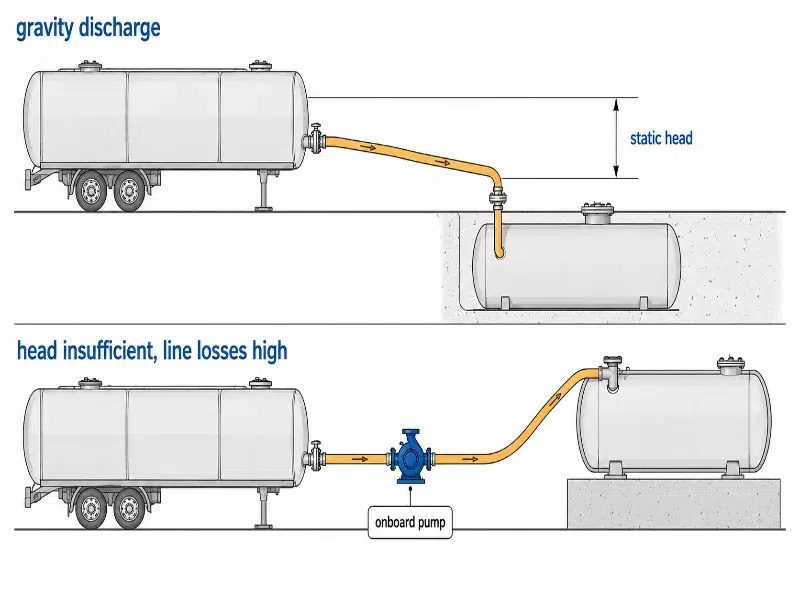
The arithmetic is one input, not an unloading instruction. Discharge sequence also has to keep axle and longitudinal load distribution within limits, and follow the carrier’s and the builder’s procedures. Driver training under 49 CFR 177.816 covers partial-load effects on stability because the interaction is not simple. The buyer’s takeaway is narrower. Compartment volumes close to typical drop sizes leave an operator the option of avoiding part loads; compartments much larger than the drop remove that option before the trailer is built.
| What it gets called | What it actually refers to | What to specify or check |
|---|---|---|
| “Baffle” used for “bulkhead” | 49 CFR 178.345-1 describes a baffle as a non-liquid-tight partition; only a liquid-tight bulkhead creates a compartment | Ask for compartment count and each compartment’s volume, then treat internal baffling as a separate line |
| “Emergency valve”, “foot valve”, “internal valve” | All three name the internal self-closing stop valve at the bottom of a compartment | Confirm each compartment has its own, and that remote closure and the outboard shear section appear on the drawing |
| “Breather valve” / “pressure-vacuum vent” | The vent that equalises the compartment as product volume changes with temperature. Separate device from the pressure relief valve, which is set far above it | Check both appear in the annual external visual scope, not only one |
| “Grounding” and “bonding” used interchangeably | Grounding routes charge to earth; bonding equalises potential between two containers. 177.837(c) sets out three branches, and which one applies turns on the connection type | Confirm what the receiving terminal’s own procedure demands, since site and insurer rules can go beyond the federal minimum |
| “Tanker trailer” / “cargo tank motor vehicle” | Cargo tank motor vehicle is the regulatory term for the tractor-and-tank unit | Search the regulations on “cargo tank”, or the clauses governing the equipment will not surface |
Loading: Top or Bottom Is One Question, Open or Vapour-Tight Is Another
Loading arrangements on a fuel tanker vary along two axes that get collapsed into one: where the connection sits on the tank, and whether the transfer path is open to atmosphere or vapour-tight.
The regulations treat them separately, in three branches. 177.837(c)(1) prescribes a bond wire when a cargo tank is loaded through an open filling hole, connected before the hole is opened and left in place until the last one is closed. 49 CFR 177.837(c)(2) then covers a vapour-tight, not-open-hole connection, top or bottom, and states that bonding or grounding is not required for it. The condition is that contact is made before flow starts and not broken until flow is complete. The third branch, (c)(3), covers unloading through a non-vapour-tight connection into a stationary tank; bonding or grounding is not required there either, as long as the metallic filling connection stays in contact with the filling hole. A vapour-tight top connection is a recognised arrangement, and it is the connection type that decides the static-control step.
Bottom loading through an API adapter does more than manage vapour. The operator stays at ground level, the connection interface standardises across racks, and overfill detection can tie into the rack’s own shutdown instead of depending on someone watching a gauge. Vapour leaving a compartment returns to the terminal only where the rack has vapour recovery fitted; the closed connection itself contains vapour without recovering it.
Before we quote a compartment and valve layout, we compare the connection types and vapour handling at the terminals a customer actually runs, because adapter position and vapour piping are welded-in decisions. On trailers that have spent time on open-hatch racks, the hatch gasket and the vent assembly are usually the first items worth re-checking. That duty cycle exercises them in a way a closed connection does not.
Discharge: Static Head, Line Losses, and the Rate on the Plate
Gravity discharge normally requires enough positive static head to overcome the line losses in hose and fittings. Sites with buried receiving tanks often manage without an onboard pump, while raised tanks, long hose runs or a demanding flow rate usually call for one.
Opening the internal valve gives the liquid a path. Everything after that in the loading and unloading process comes down to head. What moves the product is the difference between compartment and receiving tank, less whatever the hose diameter, hose length and fittings take back. A short run into a buried tank and a long run into a lower-but-distant one can share the same elevation on paper and behave nothing alike.
| Discharge method | Normally suits | What it depends on |
|---|---|---|
| Gravity | Buried or low receiving tanks with a short hose run | Available static head against line losses, and the flow rate the site needs within its window |
| Onboard pump | Raised receiving tanks, long runs, or ground giving no useful fall | Whether the engine may run — 177.837(a) permits it during Class 3 transfer only when it drives the pump |
| Facility pump | Sites supplying their own pump and hose, common at airports and larger depots | Whose equipment sits in the transfer path, since the trailer’s leakage-test record covers its own piping and valves |
Flow rate is not purely a pump number. 173.33(b)(4) caps the loading or unloading rate at whatever is marked on the cargo tank specification plate. Where no rate is marked, rate and pressure must be held so that tank pressure stays within 130% of the MAWP. On a DOT 406 tank that ceiling is low. A bigger pump does not automatically shorten the drop.
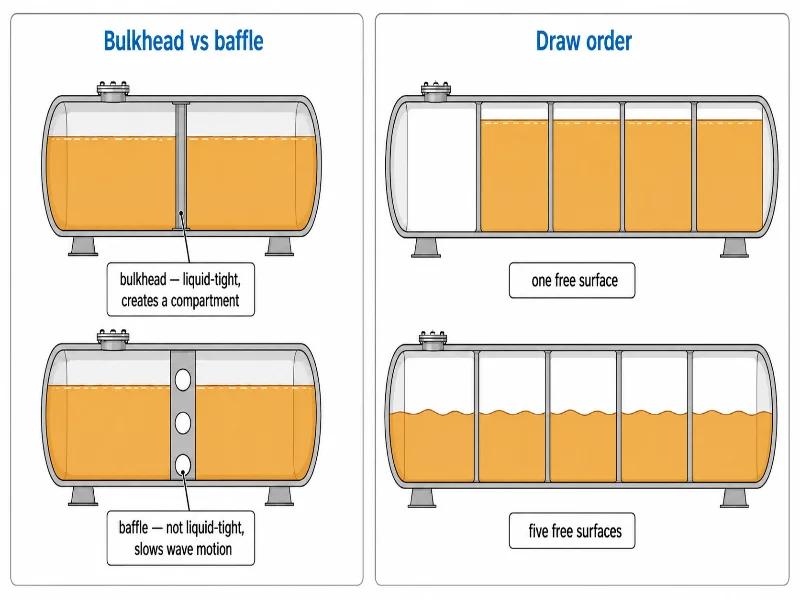
The three arrangements are not exclusive. A trailer can be plumbed for gravity drop and still carry a pump for the sites that need one, which is the usual arrangement on multi-drop work. If every stop on a route has buried tanks and the pattern is stable, the pump, its drive and its maintenance are cost that never comes back. Gravity discharge at those sites is the correct specification rather than a shortfall. When a pump is specified from a route plan never checked against receiving-tank elevations and hose runs, the result is usually equipment that adds tare weight and inspection scope without shortening a single drop.
What the Plate, the Configuration and the Product Classification Trigger
The inspection calendar for a cargo tank is keyed to its specification, configuration and service together, while the product in each compartment governs where the person attending a discharge has to stand.
The plate carries the numbers the rest of the system is built around, and the wider set of petroleum trailer specifications is fixed at the same point. A DOT 406 tank has an MAWP between 2.65 and 4 psig, and its primary relief valve must be set between 120% and 132% of that MAWP, reclosing at not less than 108%. Run it on a 3 psig plate value: the relief opens somewhere around 3.6 to 4.0 psig and reseats at about 3.2 psig or above. Take your own plate figure and the same three multipliers give the band your valve should have been bench-tested against.
The intervals follow from what wears. External visual and leakage tests run annually because they check gaskets, valves, manhole closures and remote closure devices, each of which has to be operated to show it still closes. The internal visual and pressure tests run on a longer cycle because they check the shell. A tank whose interval has lapsed may not be filled and offered for transport until the test is completed.
Classification is where transporting hazardous materials in a tanker trailer produces a result almost nobody writes down. 49 CFR 177.834(i)(3) sets out more than one way to attend an unloading. The standard in-person route puts the qualified person within 7.62 m (25 feet) of the cargo tank; the same paragraph also permits video monitoring and instrumentation-and-signalling arrangements that meet its stated conditions. Operations subject to 177.837(d) sit outside that paragraph altogether. Separately, 173.150(f) permits a flammable liquid flashing at or above 38 °C (100 °F) to be reclassed as a combustible liquid in domestic US transportation. Diesel commonly meets that threshold; petrol does not.
Put those together and the attendance arrangement can differ compartment to compartment at one stop. A petrol compartment discharged under standard in-person attendance holds the qualified person to the 25-foot rule. A diesel compartment reclassed and papered as a combustible liquid moves onto 177.837(d). That means within 150 feet of the cargo tank, within 25 feet of the delivery hose, and a check on both tank and receiving container every five minutes on longer drops. Reclassification is a step the carrier takes rather than a property of the fuel, so diesel offered as Class 3 stays on the general rule. Before we finalise a build, we verify which regime the trailer will be inspected under, because a plate written to one country’s specification does not carry into another’s inspection cycle.
Compartment Volumes and Site Head Lock First
Compartment volumes and the head available at the delivery sites have to converge together, and both lock early because both are physical: bulkhead positions are welded and the pump is plumbed into the discharge line. Connection type locks with the terminals for the same reason, since adapter position and vapour piping are fabricated in.
Where a route mixes buried-tank retail stops with raised tanks or long hose runs, resolve the discharge arrangement before anything else on the sheet. It is the decision that follows the trailer through every inspection cycle it will ever see.
If your typical drop is close to a whole compartment volume, say so at the specification stage. That is the point at which an operator can still be left the option of drawing one compartment at a time. If the drops are irregular, the compartment split is the thing to settle first, and it is where we align a fuel tanker trailer build with the route before anything else is drawn.
FAQ
The compartment has to be drained and, depending on the receiving customer’s specification, cleaned. For compatible petroleum products the concern is primarily product quality, though previous-cargo compatibility still has to be checked under 49 CFR 173.33. Dedicating a compartment to one grade for the length of a route avoids the question.
Longer than the pump rating suggests, and unevenly. The first compartment drops fastest and the last one slowest, because head falls as the tank empties.
Check first whether the destination’s environmental rules or the terminals’ procedures require one, since that settles the question before cost does. Where nothing requires it and the racks are not changing, the line adds weight and inspection scope, and retrofitting later means opening the tank and reworking piping.
A Registered Inspector, not the driver. Any test or inspection under 49 CFR 180.407 must be performed or witnessed by someone meeting the qualification rules in 180.409, and the result goes into a written inspection record under 180.417(b).
Only when it is driving the pump. There is one exception: a diesel tractor engine may be left running during Class 3 loading or unloading when the ambient temperature is at or below −12 °C (10 °F), under 177.837(a).
Related Posts
Fuel Tanker Trailer Sizes: Capacity Tiers by Use Case — capacity tiers by use case, for matching compartment volumes to typical drop sizes
How To Load a Fuel Tanker Trailer? — the step-by-step rack sequence behind the loading methods described above
How to Maintain a Fuel Tanker Trailer? — the day-to-day maintenance items that sit between the annual and five-year test intervals
What are the Common Issues With Fuel Tanker Trailers? — the wider fault list beyond the hatch gasket and vent assembly
How to Choose a Fuel Tanker Trailer? — the full selection sequence after compartment split and discharge arrangement are settled